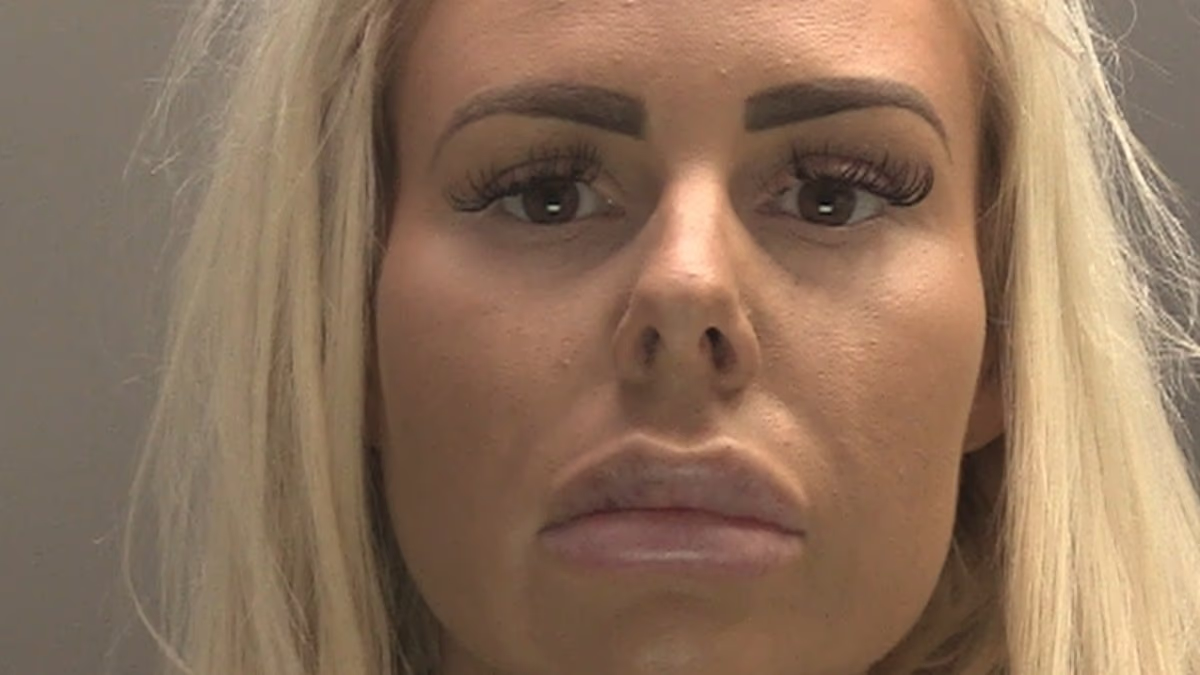

A benefits fraudster accused of selling counterfeit designer fashion on Instagram has insisted that the £158,000 discovered hidden among baby clothes was money saved for her children.
Megan Carney-Borrowman marketed fake items bearing the names of luxury brands including Chanel, Burberry and Versace to thousands of social media followers.
The online operation developed into a vast business, with accounts connected to the mother showing deposits totalling more than £4million over four years.
Carney-Borrowman, a mother of four from Southport, Merseyside, carried out the scheme with help from her husband, 35-year-old Jordan Borrowman. Her 65-year-old mother, Sandra Carney, and her long-standing business associate, 53-year-old Adam Yaffe, were also involved.
The four defendants were sentenced over two days at Liverpool Crown Court this week. Carney-Borrowman received four years and three months in prison for conspiracy to commit trademark offences.
The couple’s home was first raided in November 2022 after Chanel alerted anti-counterfeiting investigators to the suspected operation. Neither Carney-Borrowman nor Borrowman was at home, and both later claimed they did not have their phones.
Borrowman said his handset had been lost and was never found, although prosecutors told the court it was used again after his arrest.
Carney-Borrowman attempted to mislead officers by giving them her son’s phone and presenting it as her own. Her actual handset was later recovered, and messages on it helped detectives establish Yaffe’s role in the operation.
Following Carney-Borrowman’s first arrest, investigators examining her bank accounts identified substantial cash withdrawals. When officers searched the property again in April 2023, they found her phone hidden on top of a curtain rail in the main bedroom.

Megan Carney-Borrowman ran a counterfeit goods operation worth millions of pounds through online sales

Pictured: Cash seized from the Carney-Borrowman family home during the investigation into the counterfeit goods conspiracy
James Rae, prosecuting, told the court that Carney-Borrowman had tried to stop officers searching her baby’s bedroom. He said the true reason became clear when police found £158,000 in cash concealed inside. The money was seized despite her claim that it consisted of savings she had withdrawn for her children.
The phone provided crucial evidence, containing what prosecutors described as a “very large volume” of messages. They showed that Carney-Borrowman was selling counterfeit products through a drop-shipping arrangement, with overseas suppliers sending orders directly to customers.
Investigators identified eight business accounts and 18 personal accounts in Carney-Borrowman’s name, including some registered to her young children. Between 2019 and 2023, the business accounts received £4,319,952.73, with £753,419.50 transferred into her personal accounts.
She was later arrested for benefits fraud in May 2024. A Department for Work and Pensions investigation found that she had wrongly received around £68,300 after failing to disclose her self-employed income, the purchase of two homes, her relationship with Borrowman and their combined assets.
Carney-Borrowman also submitted a false insurance claim, telling Halifax that she had lost an expensive Rolex during a night out in Blackpool. However, officers from the North West Regional Organised Crime Unit who visited her home saw a Rolex on her wrist bearing the same serial number as the supposedly missing watch.
Footage released by the NWROCU captures an officer confronting Carney-Borrowman about the watch. When asked whether she was wearing a Rolex, she replied: “It’s not real… you’re not taking it off me. It was for my 30th birthday.”
After being instructed to hand over the watch, she said: “It’s actually my mum and dad who got it for me so I could probably get a receipt.” When questioned again about its authenticity, she changed her response and confirmed that it was genuine.
Mr Rae described Carney-Borrowman as the “prime mover” behind the criminal enterprise, saying she had been “clearly supported and encouraged by her mother”. Borrowman was considered a major beneficiary of the counterfeit profits and had helped sell, package and transport goods, although his role was described as supportive. Yaffe, meanwhile, was said to have “encouraged, cautioned and advised” Carney-Borrowman.
MORE STORY: VIDEO: Shocking Live Broadcast Accident: Reporter Hit by Vehicle in Monterrey
In mitigation, Nicholas Clarke, representing Carney-Borrowman, said her remorse was not self-pitying but reflected the “genuine fear she has for her children”. He told the court that all four children had developmental concerns and that the youngest continued to attend appointments at Alder Hey Children’s Hospital.

A Rolex seized from Carney-Borrowman’s property
Mr Clarke said: ‘Her children revolve around her and most of her waking life is dealing with them…the reports set out the concerns she has about all of the children being looked after by others.’
He told the court that Carney-Borrowman had PTSD following the tragic death of a child in April 2022. The prosecution said that Carney-Borrowman had lied to the author of her original pre-sentence report and claimed she only started selling counterfeit goods as a result of her daughter’s death when she felt unable to engage in conventional employment.
Michael Lavery, for Carney, said his client had worked her whole adult life, had carried out several selfless acts ‘over a number of years to assist people less fortunate than her’ and had supported her two daughters; both of whom had children of their own.
He told the court: ‘It seems to anyone approaching this case that this is a mother doing her best for a daughter who has a number of problems. There is no more a person than a mother who wants to help her child, misguided and naïve it has been.’
Richard Vardon, representing Borrowman, said: ‘It may be the position that the mother of the children cannot care for them in the immediate future so they would be more impacted if this defendant was to go to prison as well.’
Andy Evans, for Yaffe, told the court his client’s offending was characterised by his relationship with Carney-Borrowman. ‘He assisted her with things mundane, things tragic and difficult, and things happier, such as becoming her wedding photographer,’ he said.
Sentencing, Judge Louise Brandon said: ‘The business operated through Instagram accounts and WhatsApp ordering systems with multiple bank accounts, corporate structures, direct overseas suppliers, drop-ship methods, concealed payments and efforts to avoid detection.’
The judge added: ‘Involvement at any level of counterfeiting are grave offences. You all contributed. It is a consequence of your arrests that your families will also suffer from your criminality.’

Carney-Borrowman during a police raid at her home
Judge Brandon told Carney-Borrowman: ‘I can’t accept that your customers all believed they were buying counterfeit goods. If that was the case we would not be here today…You feel you are the victim. Your actions caused your children to see the police in your own home. You have no one else to blame for the impact on your children. You seem unable or unwilling to grasp that your situation is entirely of your own making.’
Carney-Borrowman, 35, and of Birdling Drive in Southport, was sentenced to four years and three months for conspiracy to commit trademark offences, conspiracy to launder money, benefit fraud, and conspiracy to defraud.
Borrowman, 35, and of the same address, received 12 months, suspended for 18 months and 120 hours of unpaid work after admitting conspiracy to commit trademark offences, conspiracy to launder money and benefit fraud.
Carney, 65, and of Court Road was handed two years, suspended for 18 months with 120 hours of unpaid work after pleading guilty to conspiracy to commit trademark offences, conspiracy to acquire criminal property, aiding and abetting fraud and conspiracy to defraud.
And Yaffe walked free from court with an 18-month community order and 120 hours of unpaid work after he admitted conspiracy to commit trademark offences and conspiracy to acquire criminal property.
Speaking after sentencing, Detective Inspector Adam Williams of the NWROCU, said: ‘This was a sophisticated and long-running trademarks and money laundering offence which generated significant profits through the sale of counterfeit designer goods while simultaneously exploiting public funds and defrauding an insurance company.
‘The defendants went to considerable lengths to disguise their offending, but detailed financial investigation and partnership working enabled us to uncover the full extent of their criminality.
‘Counterfeit goods are far from a victimless crime. The proceeds often support wider organised criminality, while consumers are deceived into purchasing products they believe to be genuine. This case demonstrates our commitment to pursuing offenders who seek to profit through fraud and protecting both businesses and the public from financial harm.’


