
Share this @internewscast.com

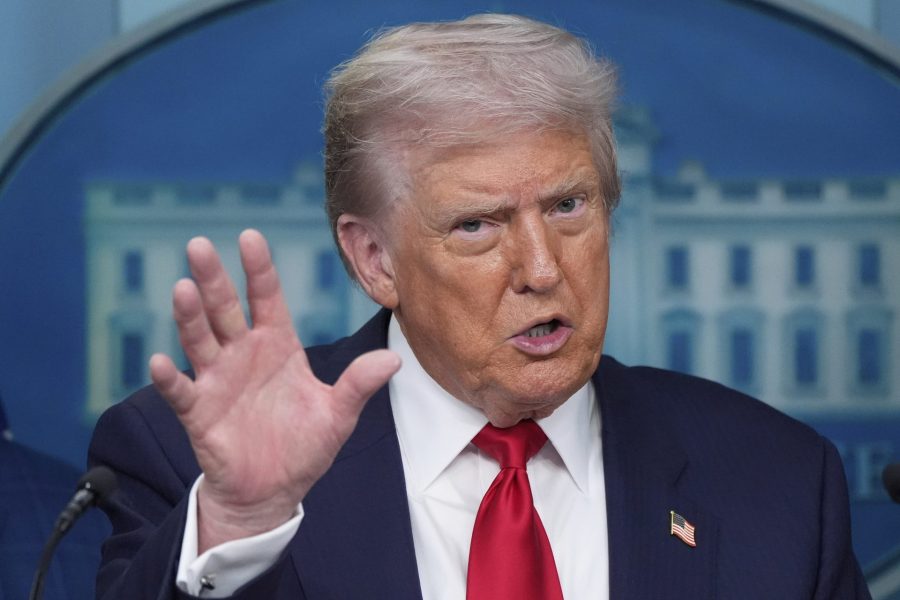
WASHINGTON (AP) — President Donald Trump prolonged a trade truce with China by another 90 days on Monday, at least momentarily averting a potential clash between the two largest economies in the world.
Trump shared on his Truth Social platform that he had signed the executive order for the extension, stating that “all other elements of the Agreement will remain the same.”
The previous deadline was due to lapse at 12:01 a.m. on Tuesday. Without the extension, the U.S. could have increased tariffs on Chinese imports from an already steep 30%, while Beijing might have retaliated with heightened levies on U.S. exports to China.
This respite provides both nations some time to resolve their disputes, potentially paving the way for a summit later in the year between Trump and Chinese President Xi Jinping, and it has received approval from U.S. companies trading with China.
Sean Stein, president of the U.S.-China Business Council, called the extension “critical” to allowing both governments the necessary time to negotiate a trade accord that U.S. businesses hope would enhance their market access in China and offer the stability needed for companies to plan medium- and long-term strategies.
“Reaching an agreement on fentanyl that results in reduced U.S. tariffs and a rollback of China’s retaliatory measures is crucial to resuming U.S. agriculture and energy exports,” Stein stated.
Reaching a pact with China remains unfinished business for Trump, who has already upended the global trading system by slapping double-digit taxes – tariffs – on almost every country on earth.
The European Union, Japan and other trading partners agreed to lopsided trade deals with Trump, accepting once unthinkably U.S. high tariffs (15% on Japanese and EU imports, for instance) to ward off something worse.
Trump’s trade policies have turned the United States from one of the most open economies in the world into a protectionist fortress. The average U.S. tariff has gone from around 2.5% at the start of the year to 18.6%, highest since 1933, according to the Budget Lab at Yale University.
But China tested the limits of a U.S. trade policy built around using tariffs as a cudgel to beat concessions out of trading partners. Beijing had a cudgel of its own: cutting off or slowing access to its rare earths minerals and magnets – used in everything from electric vehicles to jet engines.
In June, the two countries reached an agreement to ease tensions. The United States said it would pull back export restrictions on computer chip technology and ethane, a feedstock in petrochemical production. And China agreed to make it easier for U.S. firms to get access to rare earths.
“The U.S. has realized it does not have the upper hand,’’ said Claire Reade, senior counsel at Arnold & Porter and former assistant U.S. trade representative for China affairs.
In May, the U.S. and China had averted an economic catastrophe by reducing massive tariffs they’d slapped on each other’s products, which had reached as high as 145% against China and 125% against the U.S.
Those triple-digit tariffs threatened to effectively end trade between the United States and China and caused a frightening sell-off in financial markets. In a May meeting in Geneva they agreed to back off and keep talking: America’s tariffs went back down to a still-high 30% and China’s to 10%.
Having demonstrated their ability to hurt each other, they’ve been talking ever since.
“By overestimating the ability of steep tariffs to induce economic concessions from China, the Trump administration has not only underscored the limits of unilateral U.S. leverage, but also given Beijing grounds for believing that it can indefinitely enjoy the upper hand in subsequent talks with Washington by threatening to curtail rare earth exports,” said Ali Wyne, a specialist in U.S.-China relations at the International Crisis Group. “The administration’s desire for a trade détente stems from the self-inflicted consequences of its earlier hubris.”
It’s unclear whether Washington and Beijing can reach a grand bargain over America’s biggest grievances. Among these are lax Chinese protection of intellectual property rights and Beijing’s subsidies and other industrial policies that, the Americans say, give Chinese firms an unfair advantage in world markets and have contributed to a massive U.S. trade deficit with China of $262 billion last year.
Reade doesn’t expect much beyond limited agreements such as the Chinese saying they will buy more American soybeans and promising to do more to stop the flow of chemicals used to make fentanyl and to allow the continued flow of rare-earth magnets.
But the tougher issues will likely linger, and “the trade war will continue grinding ahead for years into the future,’’ said Jeff Moon, a former U.S. diplomat and trade official who now runs the China Moon Strategies consultancy.