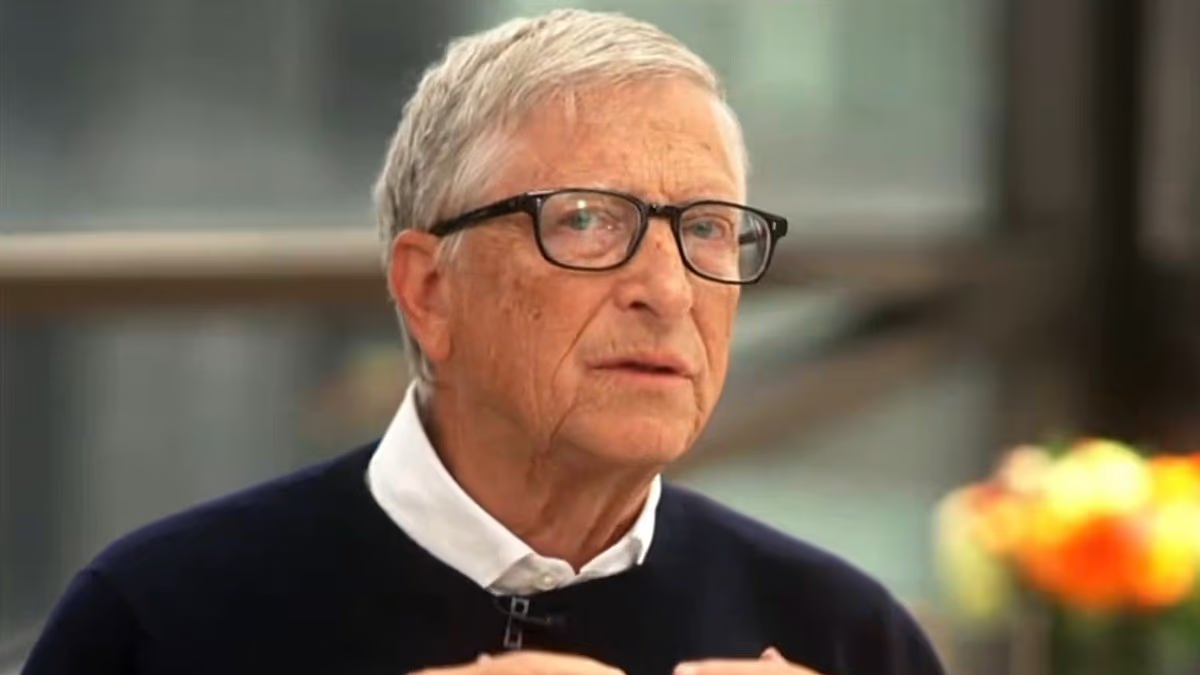

Bill Gates, the tech billionaire and Microsoft co-founder, has issued a stark warning about the dangers posed by artificial intelligence as the technology continues to advance at extraordinary speed.
During an appearance on NBC’s Meet the Press on Sunday, Gates urged governments to strengthen oversight of AI. He also warned that, in the wrong hands, the technology could contribute to events resulting in “a billion deaths.”
“AI is certainly powerful enough to drive events that cause a billion deaths,” Gates told moderator Kristen Welker. He added that while wiping out all of humanity would be extremely difficult, no previous weapon had combined such enormous power with the potential for malicious individuals to use advanced AI tools.
Welker then asked Gates what could be done to prevent an AI-related catastrophe.
Gates said artificial intelligence could make it increasingly challenging to tell the difference between researchers working on lifesaving medicines and individuals attempting to develop biological weapons.
“I wish it was easier to distinguish good intent, like ‘I want to design a new drug for a disease,’ versus negative intent, which is ‘I want to design a tool of bioterrorism,’” Gates said.
He argued that the potential consequences of advanced AI make firm supervision essential, and said the United States should take the lead in creating effective safeguards for the rapidly growing industry.
“Because those are so close, we do need to monitor any sophisticated model and record exactly what’s being done,” Gates told Welker.

Gates urged stronger government oversight of artificial intelligence, warning that the technology could contribute to events causing “a billion deaths”

OpenAI CEO Sam Altman, left, speaks with Meta CEO Mark Zuckerberg at President Donald Trump’s state dinner for Chinese President Xi Jinping on September 24. Altman and Zuckerberg are among the leading figures shaping the AI industry
Gates said China would likely adopt comparable controls, but maintained that the US should move first by setting clear standards and expectations for AI companies.
“You’ll hear from the industry, it’s a very doable thing. It would not slow them down dramatically,” he said.
Gates also separated the question of AI safety from the wider argument over whether the pace of artificial intelligence development should be reduced.
“These safeguards, their monitoring, are separate from whether we would be better off slowing down,” Gates explained.
President Donald Trump rejected the suggestion earlier this month that continued AI progress could bring about the end of humanity. Speaking to reporters, he dismissed such scenarios as “things that won’t happen.”
“We’re leading China in AI. We’re the most sophisticated country in the world, and frankly, I want to keep it that way because whoever wins AI wins,” Trump told reporters at his golf course in Doonbeg while attending the Irish Open earlier this month.
House Republican Speaker Mike Johnson has expressed a similar concern about falling behind China. In a CNN interview earlier in September, he said, “We cannot put a moratorium on this because China will overlap us.”
Democratic lawmakers, by contrast, have generally shown greater support for regulating emerging artificial intelligence technologies.
Former Democratic President Barack Obama recently addressed the issue at a private gathering, in comments first reported by The New York Times.
“This is something that is moving very fast in private hands, and if we don’t get on top of it, I think it can be dangerous,” Obama reportedly said at an event this month.
Obama, who believes that House Minority Leader Hakeem Jeffries will be the next Speaker after the November elections, also urged the top Democrat to act.

US President Donald Trump gestures as he speaks to members of the media after exiting Air Force One at Chicago O’Hare International Airport on September 27, 2026
‘Once you are speaker, I would strongly urge that the Democrats put together a framework for a very public conversation,’ Obama told Jeffries per the Times.
This comes after Anthropic researcher Jacob Coxon sensationally resigned from his position and accused the company and its rival OpenAI of not doing enough to address the potential dangers of the technology earlier this month.
Coxon warned that researchers working in the field believe AI could potentially ‘kill all humans’ by the end of the decade.
Days later, an Anthropic report said that it has stopped several potential plots to build biological weapons using its artificial intelligence this year.
The company determined that scientists were using its platforms to conduct research that could be used to develop biological weapons, according to the company’s new AI misuse report that was obtained by The New York Times.
Anthropic was unable to determine if the research ‘served a legitimate or nefarious purpose,’ the report said.
The firm noted that valid biological inquiry can result in scientific breakthroughs like vaccines, but the company erred on the side of caution because that same research could also be used to create dangerous pathogens.