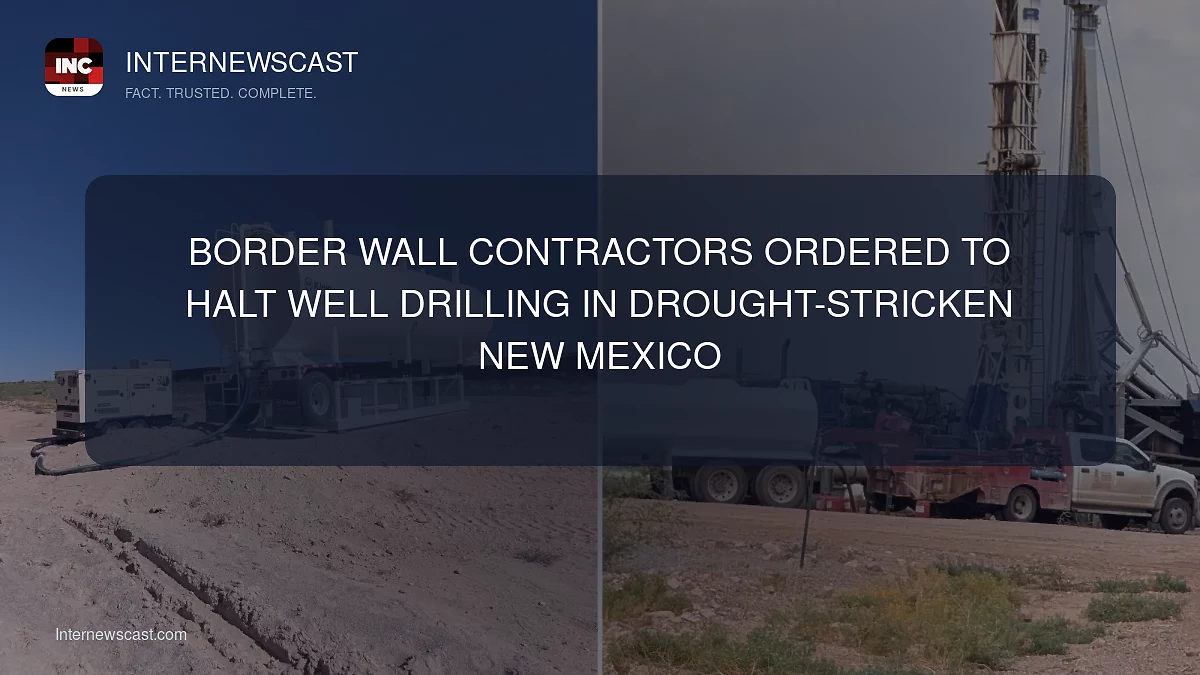

PHOENIX — The Trump administration has told border wall construction crews in drought-hit New Mexico to halt drilling new wells after local ranchers warned that tapping groundwater for concrete production could endanger the water supply their cattle depend on.
The directive lands as crews along the U.S.-Mexico border push to finish one of President Donald Trump’s signature domestic projects: a barrier system stretching across four states and backed by more than $46 billion in federal funding. The effort has already drawn criticism in Texas and California, where border communities and environmental advocates have reported a range of problems tied to construction.
U.S. Customs and Border Protection, the agency overseeing border wall work, has said water is necessary for mixing concrete, building roads and wall sections, and controlling dust. But cattle ranchers in southern New Mexico say an ongoing drought has already forced them to shrink their herds.
“It would put us in an immediate catastrophe and having to do something with our livestock. I mean, it could potentially put some people out of business, us included,” said Russell Johnson, a cattle rancher whose land runs along the border.
Johnson brought the concern to public attention at a July meeting after spotting an industrial well on land he leases for grazing. Drilling crews told him the well could pump 300 gallons a minute, he said. By comparison, Johnson’s ranch has about a dozen wells, each producing only three to seven gallons per minute.
A CBP spokesperson said Monday that contractors working on the New Mexico border wall have been directed to stop drilling additional wells. The agency did not say whether wells that have already been drilled may still be used. CBP said it plans to work with New Mexico officials and the U.S. Department of Agriculture on a groundwater management strategy.
“CBP is committed to working collaboratively with local landowners to ensure that construction activities do not adversely impact their water needs,” the agency said in a statement.
The federal contractors building the wall in New Mexico, Caddell Construction Co. and Fisher Industries, did not respond to requests for comment by email or phone. Messages left with receptionists for Barnard Construction and Spencer Construction Co., the companies working near Johnson’s ranch, were not immediately returned.
State agency that monitors wells said contractors drilled illegally
The New Mexico Office of the State Engineer, which monitors and approves wells across the state, said staff have counted eight wells drilled without the office’s permission along the southern border, but cautioned there could be more. Staff visited two wells in July and reported they were pumping 200 gallons per minute.
“All non-tribal wells in New Mexico, whether they are drilled on state or federal land, must have permits from the state engineer before they can be drilled or water can be pumped from them,” the Office of the State Engineer said in a statement.
The wells for border construction were all drilled on a federally owned strip of land 60 miles (96 kilometers) north of the border called the Roosevelt Reservation. CBP did not respond to follow up questions about whether the federal government has a right to pump groundwater on federal land without state oversight.
Cattle ranchers report culling herds due to water scarcity
Tom Patterson, president of the New Mexico Cattle Growers’ Association, says water is the No. 1 concern for ranchers and that if wells start to go dry, it’s already too late. During wall construction in Trump’s first term, Patterson said, contractors bought water from farms, ranches, or municipalities in the area, which meant the amount of water being pumped from nearby basins didn’t increase during construction.
“Why do they need all this water?” said Patterson. “And why can’t they buy it as they have in the past from farmers, ranchers, or even from Luna County?”
Johnson said the moratorium on future well drilling is a step in the right direction, but he’s still worried after a contractor told him the well near his ranch could eventually be pumped if crews ended up needing the water. Though beef prices are up, Johnson has been forced to reduce his herd to one third its original capacity. He cites the drought, which has left less grass for cattle to graze on, as the main reason for the drop.
Before the first border wall went up, Johnson remembers seeing at least one truck of people crossing his ranch every week. Now, he says illegal crossing hardly ever happens on his ranch. As a former Border Patrol agent, he supports the border wall but doesn’t believe it should cost him his livelihood.
So far, half a mile of secondary wall has gone up near Johnson’s property.
“They need to stop pumping all of these wells because they were all drilled illegally,” Johnson said.

New Mexico politicians scramble to claim credit for deal
Both candidates in the race for a congressional seat that represents this area in New Mexico claimed credit for the moratorium.
Congressional candidate Greg Cunningham, a Republican, said he advocated for the agreement between CBP and border wall contractors and was the first to announce the news over social media on Friday.
“Ranchers, families and local officials brought us their concerns. I raised it with the Trump Administration. They listened. They acted fast,” Cunningham said in a post on X.
Congressman Gabe Vasquez, who faces Cunningham in November’s midterm elections, spoke about the issue on the House floor earlier this month.
“This illegal drilling by this administration should never have happened, but when it did, I heard our ranchers’ concerns loud and clear and immediately raised hell in Washington to get the job done and protect New Mexicans’ water rights.”
Schuettler is a corps member for The Associated Press/Report for America Statehouse News Initiative. Report for America is a nonprofit national service program that places journalists in local newsrooms to report on undercovered issues.