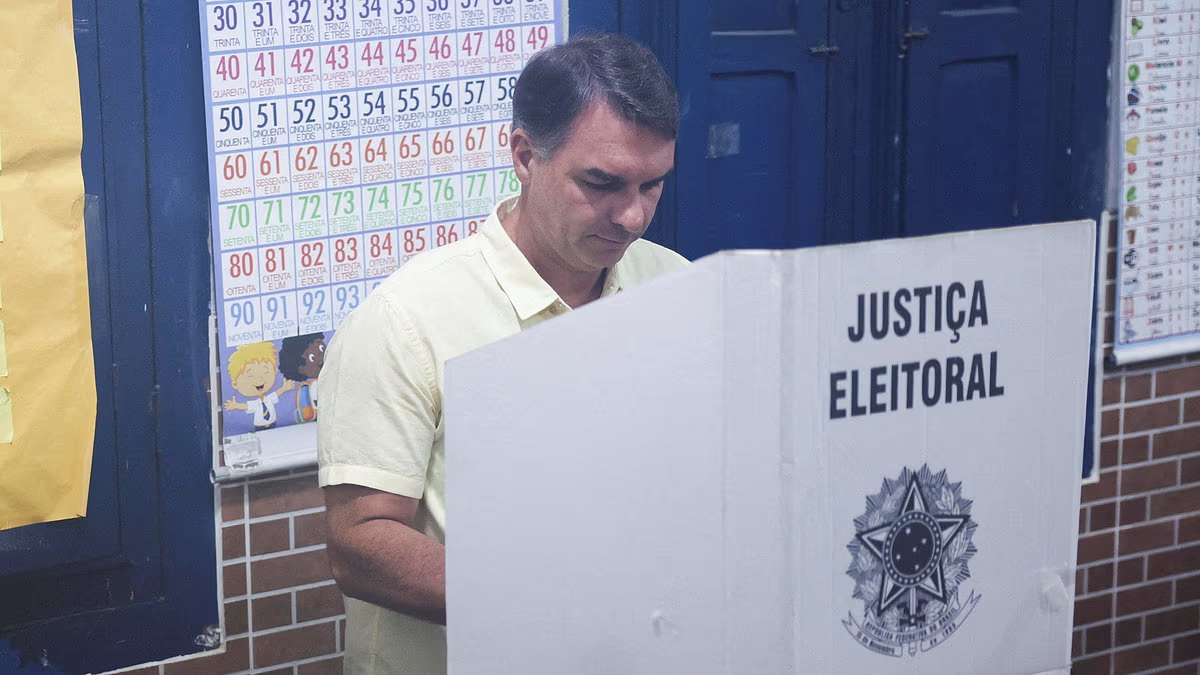

Right-wing Senator Flavio Bolsonaro voted early Sunday, urging Brazilians to choose “real change” as the country went to the polls.
The fiercely contested election will decide whether Brazil remains one of Latin America’s few left-leaning countries or follows the region’s shift to the right, a movement championed by US President Donald Trump.
“Brazil can’t stand another four years like this; everyone’s life has gotten worse,” Bolsonaro said outside a polling station in Rio de Janeiro. He has campaigned on promises to tackle crime and reduce government spending.
The 45-year-old candidate is challenging veteran leftist President Luiz Inacio Lula da Silva, who has portrayed himself as a safeguard against US interference and democratic backsliding while promising to expand social protections.
At 80, Lula is seeking a dramatic recovery after finishing a surprise second in the first round to the son of imprisoned former president Jair Bolsonaro.
The final polls put the two candidates virtually level.
The vote marks Lula’s last electoral contest as he seeks a fourth non-consecutive term. Earlier Sunday, he told voters they were deciding between a candidate who stood for Brazil’s national flag and one who “wants to govern with the American flag.”
Lula, who remains widely admired for welfare programs credited with lifting millions out of poverty, made a remarkable political comeback in the 2022 election after a major corruption scandal led to his imprisonment for more than 18 months.

Right-wing Senator Flavio Bolsonaro voted early Sunday and called for “real change” as Brazil headed to the polls

“Brazil can’t stand another four years like this; everyone’s life has gotten worse,” Bolsonaro said outside a polling station in Rio de Janeiro

President Luiz Inacio Lula da Silva has presented himself as a bulwark against US interference and democratic backsliding while promising to expand social protections
Although the charges were annulled on procedural grounds, they have continued to weigh on his political reputation.
During his third term, inflation and unemployment have fallen, while millions have been lifted out of hunger. Yet voters continue to voice concerns over living costs and public safety.
Bolsonaro, the son of a Trump ally, has pledged to hand Brazil to “the Lord Jesus Christ.” His message of political change has resonated with Brazilians eager for a new direction.
“This is about renewal—enough of the same old thing,” said 67-year-old retiree Eduardo Viana. He added that Lula “says he governs for the poor… just look, people can’t even go to the supermarket.”
Bolsonaro has sought to present himself as more moderate than his firebrand father, who is serving a 27-year sentence under house arrest for an alleged attempted coup following his defeat in the 2022 election.
If elected, he has promised that his first action would be to free Jair Bolsonaro, a deeply polarizing figure whose political legacy dominated the campaign of his eldest son.
FIND OUT MORE: Man Admits Beating Father to Death Decades After ‘First Body’ Boast
Following the first-round defeat, the left mobilized through huge “Never Again Bolsonaro” rallies. Demonstrators highlighted the former president’s chaotic handling of the Covid pandemic, the destruction of the Amazon rainforest and reductions in public programs.
Under Lula, deforestation in the world’s largest rainforest has fallen to its lowest level in four decades.

President Donald Trump met then-Brazilian President Jair Bolsonaro at the Mar-a-Lago resort in Palm Beach, Florida, in 2020

People queue to vote at a polling station during the presidential runoff election, at Cidade de Deus favela in Rio de Janeiro, Brazil

A man wrapped in a Brazilian flag arrives to vote in the presidential runoff in Brasilia, Brazil
Yet, as the El Nino weather phenomenon fueled fires that choked Amazonian cities with smoke in recent weeks, climate change barely featured in the campaign.
Lula’s famed social policies became a point of tension as he expanded welfare programs during the campaign. Critics want the government to rein in spending.
‘Even if people call it handouts, for us, they were an enormous help. Because anyone who has ever gone hungry knows not to take these programs for granted,’ said Walter dos Santos, 56, who lives in northeastern Brazil, a bastion of support for the president, who hails from the same region.
After his first-round blow, Lula revamped his social media strategy, turning to video selfies and even buying his first cellphone.
A fierce social media battle drew in Meta, parent company of WhatsApp, Facebook and Instagram, which Lula’s campaign accused of favouring his opponent with ‘algorithmic manipulation.’
Meta has denied this, but acknowledged that some of Lula’s campaign ads had been mistakenly deactivated due to technical errors.
Whoever wins, Brazil is facing a bruising election aftermath.
‘If the left wins, it faces four years with a hostile Congress and threats of impeachment,’ said political analyst Thomas Traumann, referring to sweeping legislative gains by the right.
‘If the far right wins, it will be a government of retribution, directed at the Supreme Court,’ hated by the right after its conviction of Jair Bolsonaro over the attempted coup.
Flavio Bolsonaro has said he would seek the impeachment of Supreme Court Judge Alexandre de Moraes, who led the case against his father.
Polling stations will close at 5:00 pm local time (2000 GMT), and results are expected within hours.


