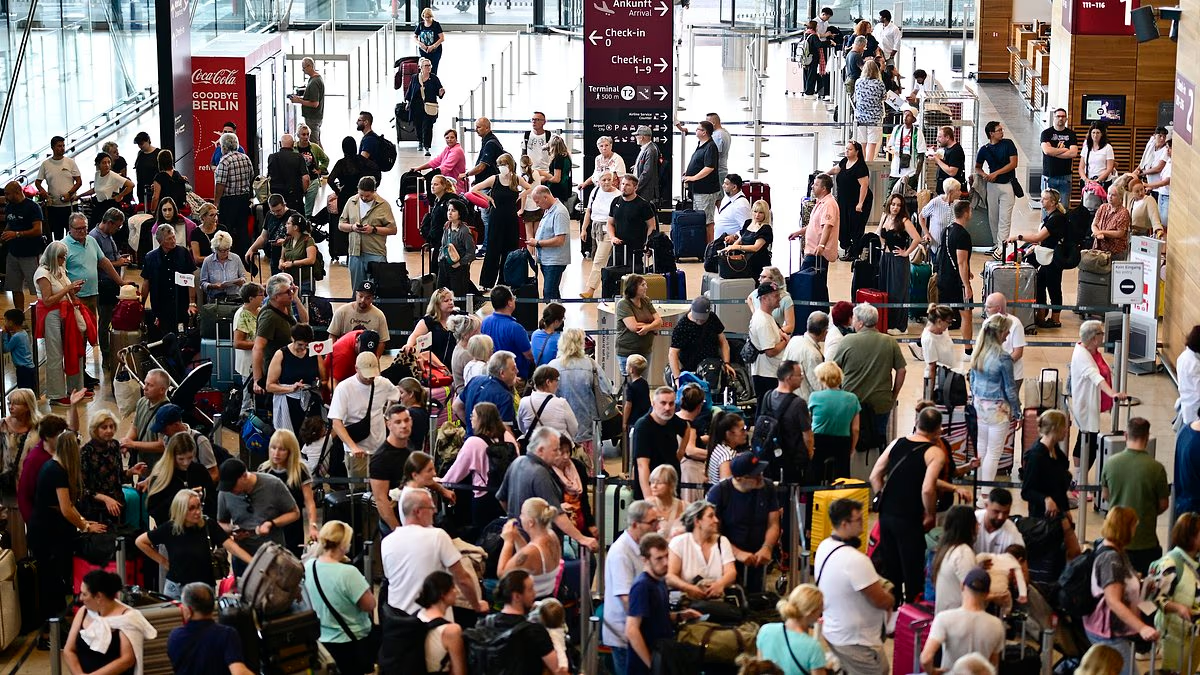

British travellers heading to Europe this summer are being cautioned that border queues could stretch to as long as five hours.
Aviation leaders have warned that airports risk grinding to a “complete standstill” because of new procedures affecting visitors from outside the EU.
Industry figures are now pressing for the recently launched Entry-Exit System (EES) to be suspended until September, arguing it is “unsustainable” as Europe’s airports prepare for an additional 40 million passengers over the busy summer season.
Under the EES, non-EU nationals must have their fingerprints and photographs recorded when they first cross the bloc’s borders, with the information checked again when they leave — a process that has contributed to longer delays.
The European airport trade body ACI has written an open letter to European Commission President Ursula von der Leyen, urging her to step in before the peak holiday rush. The group pointed to recent disruption at airports, where travellers have reportedly missed flights because of delays inside terminals.
According to the organisation, the EES has been “creating severe operational consequences”, disrupting passengers while placing border agencies, airports and airlines under pressure it described as unsustainable.
Since the system was introduced in April after multiple postponements, border control delays have “increased significantly”, with waits now reaching up to five hours at the busiest times, the group said.
One option being proposed is a temporary return to conventional Schengen border procedures, including the stamping of passports.

British holidaymakers have been warned that they could face up to five-hour long queues at border controls in Europe this summer (file image of queues at Brandenburg Airport in Berlin)

The EU completed the rollout of its Entry-Exit System (EES), which requires travellers from outside the bloc to register biometric information like a person’s fingerprints, in April this year
Regarding the EES, the ACI wrote: ‘These delays are impacting millions of passengers entering the Schengen Area, including families travelling with young children, elderly passengers and persons with reduced mobility.
‘At the same time, airports and airlines are experiencing growing operational disruption, including flight delays and missed connections and increasing pressure on frontline staff.’
This was not a problem affecting only the largest airports in Europe but also smaller airports that specifically serve tourism hotspots, which have seen passengers queueing ‘for extended periods outside terminal buildings and on exposed aprons because border control facilities cannot process arrivals quickly enough’.
‘Airlines face half-empty planes at gate closing time, while passengers are stuck in border control queues,’ they continued.
ALSO READ: Belgium Issue Angry Statement Over Controversial Balogun Red Card Decision
UK airlines have identified that Lanzarote, Tenerife South, Malaga, Porto, Lisbon, Amsterdam, Krakow, Paris CDG, Rome, Palma, Malta, Menorca, Milan Linate and Malpensa, Naples and Budapest will be the worst for queues this summer.
The ACI added that despite the suspension of the collection of biometric data until September has alleviated the problem somewhat, the move has not ‘prevented excessive queues for passengers nor preserved airport and airline operations’.
Continuing in its current form ‘would result in a significant worsening of an already very difficult situation for passengers’.
The group went on to rebuke claims by the European Commission that the EES was ‘working well’ and instead lay the blame for border queues on ‘demand-driven airline scheduling’.
It said: ‘The roll-out of EES was meant to be adapted to the realities of passenger numbers, peak season and peak hours of travel – all of which are known well in advance and are in no way a surprise.
‘The success of EES cannot be measured solely by its technical deployment. It must also be judged by its ability to function effectively within the operational environment for which it was designed.
‘At present, the system is failing to deliver one of its core objectives: facilitating efficient border crossings while maintaining the smooth functioning of Europe’s transport network.’
Ms Von Der Leyen was reported to have said last Friday that there was ‘still a lot to do’ in regards to solving the ‘problems’ facing the EES, adding that ‘we are working closely with the Member States to resolve the technical issues’, per the Brussels Times.
Most airlines agree the EES is necessary in the long term, as countries such as the UK, US, and Australia all have their own digital border systems.
The system has also already caught 7,000 people who stayed longer than planned in the months since it was launched.
However, some EU member states have since attempted to connect their own national system to the EES platform.
As each nation is responsible for its own installation of the technology, it has subsequently been designed and rolled out by different providers.
On the weekend, Marco Troncone, chief executive of Aeroporti di Roma, which operates Fiumicino airport, said processing times had doubled at the border since its launch.
He said the airport, which is one of the biggest in Europe, has spent €12 million (£10 million) on the new system, but it is still causing delays.
He told The Times: ‘We managed to optimise the process on our end bringing this to 90 seconds [down from two minutes] but it is still too high. This is of course not compatible with 50,000-60,000 passengers every day.
‘The problem is related to the way this process has been designed. It’s not a matter of implementation.’
He similarly said that the only way to avoid the impending ‘disaster’ in the coming peak travel weeks is to allow passengers to skip the new system.