China is facing allegations that it helped Iran plan a deadly drone and missile strike against American troops, according to a newly published report.
Sources told the Wall Street Journal that Beijing provided Tehran with high-resolution satellite images before Iran attacked Muwaffaq Salti Air Base in Jordan on July 17.
The strike came as service members slept, killing three American troops and leaving four others injured.
It was one of three attacks on the base within a 24-hour period, marking a significant escalation in the conflict.
US officials said the alleged cooperation offers the clearest evidence so far of the extent of China’s backing for Iran during its confrontation with the United States. They warned that the suspected assistance is having deadly consequences.
Officials familiar with the matter said the satellite imagery was likely among several resources Iran used to select and assess potential targets.
Such images can help military planners evaluate the impact of a strike and determine where to attack next. According to sources cited by the Journal, Iran also relies on its own satellite capabilities as well as imagery supplied by Russia.
The United States reportedly raised the issue with Chinese officials, who denied that companies in China were involved.

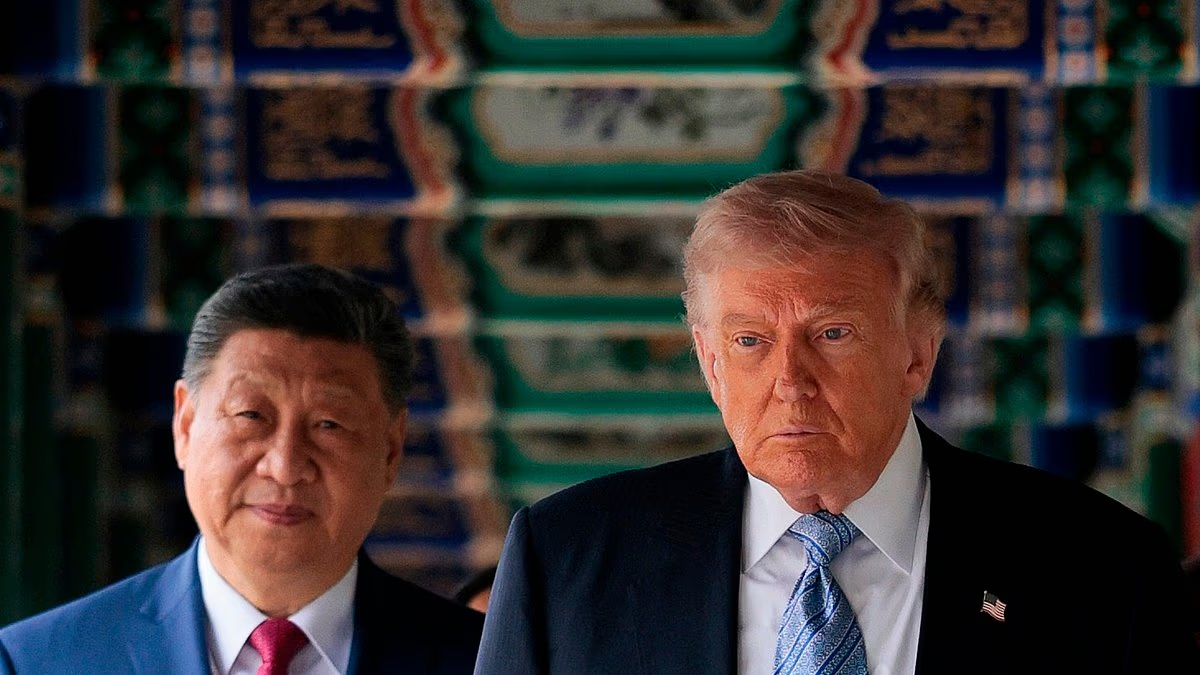
Chinese President Xi Jinping is expected to meet Donald Trump in Washington later this month, following talks in Beijing during the spring. The planned visit comes amid allegations that Chinese companies provided Iran with satellite imagery used in a fatal attack on US troops.

Iran’s July 17 strike on Muwaffaq Salti Air Base in Jordan killed three American service members. The fallen troops were honored at a military ceremony on July 22.

Donald Trump and Defense Secretary Pete Hegseth saluted as soldiers carried the remains of fallen service members.
A spokesperson for the Chinese Embassy said any cooperation with Iran did not breach international law, accusing critics of “maliciously linking and smearing other countries.”
The discovery could complicate Chinese President Xi Jinping’s first visit to Washington DC in a decade, which is set to take place on September 24.
Trump visited Beijing last May to smooth over tensions over sanctions and export restrictions.
The two met last year to extend a truce that paused additional US tariffs and postponed China’s plan to enforce a tax on its rare-earth exports. The truce expires on November 10.
China also has its eye on dominance in the Middle East, supplying Iran with resources to destabilize the region.
The State Department announced sanctions on China-based entities in May for providing satellite imagery that enabled Iranian military strikes.
‘The United States will continue to take action to hold China-based entities accountable for their support to Iran and ensure Iran cannot reconstitute its proliferation-sensitive programs following Operation Epic Fury,’ the department said in a fact sheet.
‘The targeting of US service members and partners will not go unanswered.’
The department claimed that Meentropy Technology, a China-based geospatial intelligence firm, published open-source images of US military activity, and a company called Earth Eye shared satellite imagery with Iran.

Footage showed Iranian ballistic missiles striking the base. It is now believed that Iran used Chinese satellite technology to aid the strike


Three soldiers were killed at the Jordan air base in July (left to right): Pvt Isabella Gonzales, 1st Lt. Tyler James Feehan and Sgt. Angel S. Rampersad
MizarVision, Earth Eye and Chang Guang faced sanctions in the spring after the Trump administration accused them of providing images that could help Iran target US forces.
Chang Guang was also accused of providing satellite imagery to the Iran-backed Houthis in Yemen last year.
Sources did not share which companies were involved with the July 17 attack. Private companies still operate under government oversight in China and often have ties to the Communist Party.
Three soldiers at the base were later identified as the fatalities in the strike.
Tyler James Feehan, 25, of Hawaii, and Isabella Gonzales, 19, of Texas, were the first victims publicly identified.
New Yorker Angel Rampersad, 28, was briefly reported as missing before her remains were also discovered.
US Central Command (CENTCOM) announced after the attacks that it was retaliating against Iranian attacks on ships in the Strait of Hormuz, but did not initially disclose the strikes on American troops in Jordan.
In the days after the July 17 attack, Secretary of State Marco Rubio met with Chinese Foreign Minister Wang Yi and told reporters afterward: ‘Nothing that China has done has in any way changed the trajectory of the conflict.’
Our News Outlet has reached out to the Pentagon, the White House and the Chinese Embassy for comment.


