
China is gaining ground on the United States in the artificial intelligence race, after strengthening its cyber capabilities to a level that analysts say is approaching those of American AI company Anthropic.
Tech companies based in Beijing, including 360 Security Technology and Z.ai — also known as Zhipu AI — have reportedly reduced the distance between themselves and US rivals in the high-stakes field of software vulnerability detection.
Speaking at a cybersecurity conference in China’s capital, 360 Security Chief Executive Zhou Hongyi said the firm’s bug-hunting system, Tulongfeng, can now be compared with Anthropic’s Mythos, a tool designed for similar purposes.
‘This kind of powerful weapon that can alter the landscape of cyberwarfare can’t remain solely in American hands,’ Zhou said, according to the Wall Street Journal.
Using AI to uncover flaws in software can give hackers the ability to move quickly, exploiting weaknesses before developers have time to patch them. Experts warn that such tools could contribute to a global “bugmageddon” scenario, in which cybercriminals unleash large-scale, highly damaging attacks.
Despite China’s rapid progress in cybersecurity-focused AI, its technology sector continues to trail the US in other areas, including leading OpenAI products such as ChatGPT.
Although Donald Trump has described his relationship with Chinese President Xi Jinping as “good,” strategic competition between Washington and Beijing remains fraught.
Against a backdrop of mounting national security concerns, the Trump administration has moved to restrict public access to newer Anthropic systems — a policy that critics argue may inadvertently benefit Beijing by slowing the development and improvement of US AI models.

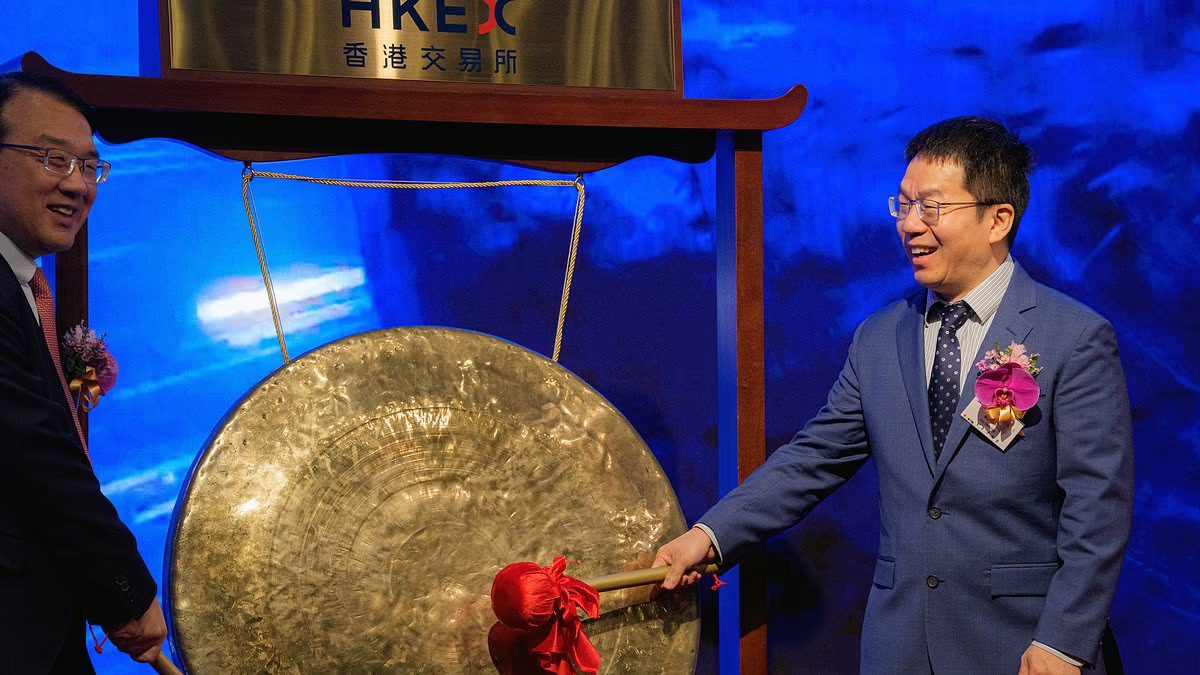
China is closing in on the US in the AI race after the superpower developed its cybersecurity capabilities to match those of American tech firm Anthropic. Pictured left: Liu Debing, chairman of Knowledge Atlas Technology JSC Ltd, better known as Zhipu, which runs Z.ai

It comes as President Donald Trump’s administration has been increasing regulation on AI

Chinese President Xi Jinping enjoys a ‘good relationship’ with the US, according to Trump
The decision to allow AI chips to be exported to China while Anthropic’s Fable 5 model is taken offline has also been criticized, with think tank fellow Saif Khan calling it a ‘gift’ to Xi.
Niels Provos, a researcher who led security teams at Google and Stripe, said: ‘It is incentivizing companies across the globe to use cheaper but very capable Chinese open-weight models, while at the same time undermining the US AI industry.
‘I don’t understand it.’
Lior Div, chief executive of cybersecurity company 7AI, said China was ‘making sure that the gap becomes smaller and smaller over time.’
Microsoft and other American companies are reportedly mulling over how they can over Chinese AI models on their platforms.
‘Our administration is very much focused on Chinese open-source models,’ Jacob Helberg, who is undersecretary of state for economic affairs and a former tech adviser and investor, told the WSJ. ‘It’s something that we’re tracking very closely.’
The Daily Mail has contacted the White House for comment.
ChatGPT maker OpenAI said Friday it is restricting the release of its new artificial intelligence model at the request of the Trump administration, the latest in an unprecedented government vetting of AI products for cybersecurity risks.
EXCLUSIVE: Intriguing Parallels Emerge Between Missing Boys Gus Lamont and William Tyrrell
Its chief rival, Anthropic, announced hours later that the Trump administration has approved a limited release of its strongest cybersecurity model, two weeks after the Commerce Department effectively banned it.
Both companies said their newest models would be available to small groups of trusted partners. OpenAI said its new AI product, called GPT-5.6 Sol, would be accessible only to customers approved by the Trump administration.
‘We don´t believe this kind of government access process should become the long-term default,’ OpenAI said in a statement. The company said it viewed the testing period as a temporary step on the ‘path to broader availability in the coming weeks.’
OpenAI’s staggered release of a powerful new AI system follows actions the government took earlier this month against Anthropic, maker of the Claude chatbot.
Anthropic took offline two new AI models, known as Fable 5 and Mythos 5, just days after unveiling them to comply with a Trump directive blocking their use by foreign nationals.
The government on Friday lifted restrictions on one of those models, Mythos 5, enabling it to be ‘redeployed to a small group of cyber defenders and infrastructure providers,’ Anthropic said.
The White House said Friday it continues to collaborate with frontier AI labs on addressing the challenges of scaling the fast-growing technology.
Officials have grown increasingly concerned since Anthropic warned earlier this year that its Mythos model was adept at finding software flaws in a way that could be weaponized by malicious hackers and threaten critical computer networks around the world.

CEO of OpenAI Sam Altman talks to reporters following a meeting with Senator Bernie Sanders earlier this month

Anthropic CEO Dario Amodei addresses a gathering at the AI Impact Summit in India
Trump earlier in June signed an executive order on AI oversight that established a framework for the federal government to vet the national security risks of the most advanced AI systems for up to 30 days before their public release.
The order described participation by AI developers as voluntary but the framework has not yet been fully developed.
Some of Trump´s allies have laid blame on San Francisco-based Anthropic and CEO Dario Amodei for the need for heightened government scrutiny.
‘Dario came to Washington a few months ago, back in April, and basically said that he had created a cyber weapon called Mythos,’ said investor David Sacks, who co-leads Trump´s council of technology and science advisers, on a recent podcast.
‘And he spiked the cortisol level, got everyone really worried. And there was some truth to it in terms of the sense that this model had advanced cyber capabilities.’
OpenAI, also based in San Francisco, said its new Sol model ‘is better at helping people find and fix vulnerabilities’ than it is at carrying out cyberattacks and does not cross the company´s own risk threshold.
But it acknowledged there could be unforeseen risks especially if its model is combined with other tools.
‘That uncertainty, along with the model´s broader step change in capabilities, is why we are pairing the model´s increased capabilities with stronger safeguards and a phased release,’ the company said Friday.
OpenAI hasn’t named any of the roughly 20 customers that have been approved to use the new model so far.
US Representative Lori Trahan, a Massachusetts Democrat and co-author of a bipartisan bill that would regulate AI, said in a statement that she is concerned ‘the Trump administration is deciding company by company who gets access to the newest AI model. No law. No process. No oversight. Just appointees in Washington deciding who´s in and who´s out.’