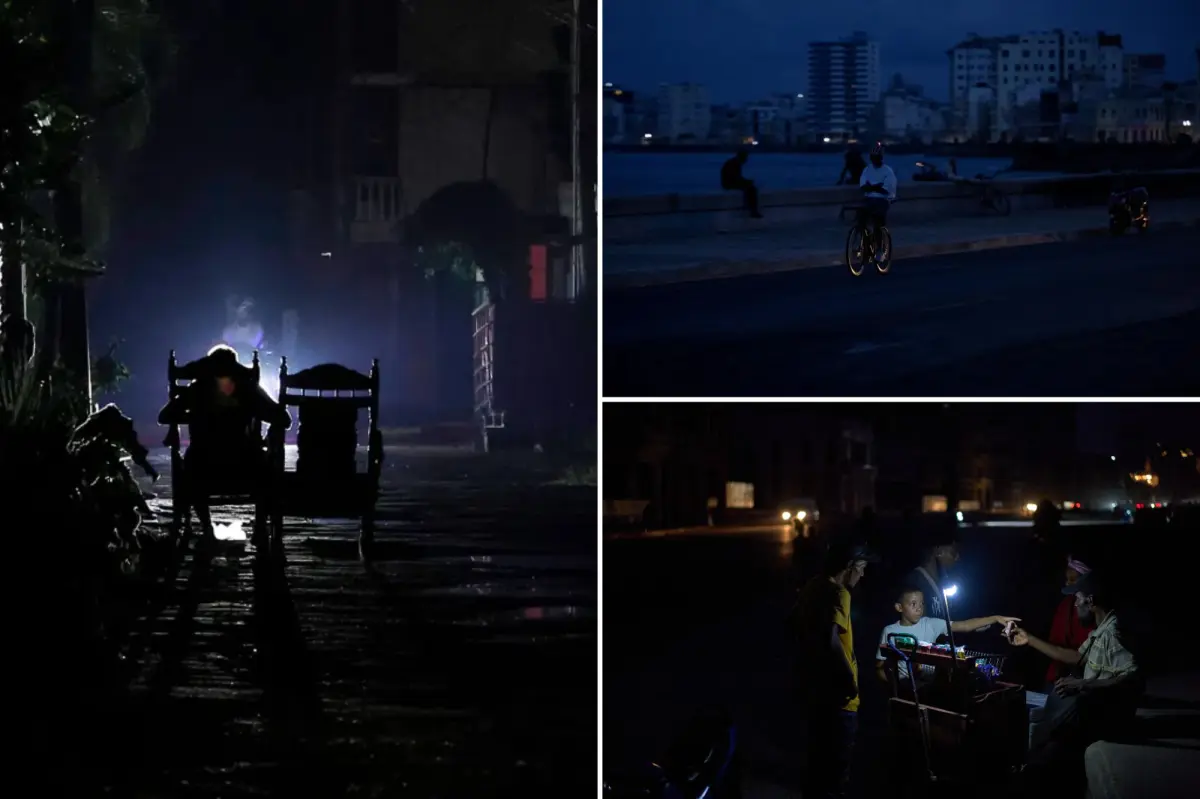
Cuba’s power grid collapsed again Friday, plunging millions of people across the island into darkness. It was at least the sixth nationwide blackout since President Donald Trump cut off fuel supplies to Cuba in January.
The Ministry of Energy and Mines confirmed the islandwide outage in a post on its official X account, saying authorities had begun “activating service-restoration protocols.”
“No one can stand these constant blackouts. There isn’t enough food, there’s no water, there’s no electricity — you have no idea,” Mercedes Rodriguez, a 60-year-old worker in Havana, told The Associated Press while waiting for public transportation to take her home. “The country is in such a sad state, and there are no words for what we’re going through.”
Cuban authorities said a failure in transmission lines in the western part of the country caused the grid to collapse as far east as Matanzas province. The eastern part of the island was then disconnected from the system.
The state-run newspaper Granma said “unstable” weather conditions had further worsened the already fragile power grid.
By dusk, electricity had returned to 5% of Havana’s users. The capital has approximately 862,000 customers, according to official figures.
Authorities were creating small power-distribution “micro-islands” in the provinces of Camagüey, Pinar del Río and Granma. Systems supplying hospitals and other emergency facilities were also being brought back online.
Nationwide power grid failures have become increasingly frequent over the past two years as Cuba confronts a deepening economic crisis.
The situation has deteriorated further since January, when the United States imposed an energy blockade intended to force a change in Cuba’s political system.
The restrictions bar Cuba from importing the fuel needed to run its thermoelectric power plants. They also limit access to replacement parts for infrastructure that is, in many cases, outdated.
Since then, only one fuel shipment has reached the island: a delivery by a Russian tanker in March.
The two latest nationwide blackouts struck in early August, following outages in July and March, along with several regional power failures.
Even when the national grid remains operational, people in Cuba routinely face blackouts lasting more than 30 hours at a time.
The prolonged outages have disrupted daily life across the island. Together with the energy embargo, they have contributed to transportation restrictions, shorter working hours and canceled flights, while creating serious public health risks.
The loss of electricity also interferes with essential tasks, including cooking and securing water, as well as internet and telephone services.
In central Havana on Friday, homemaker Abilén Marrero sat quietly at the entrance of her building, resigned to another uncertain wait.
“Maybe it’ll come back this afternoon or tomorrow—there’s no way to know. We just have to wait,” she said.


