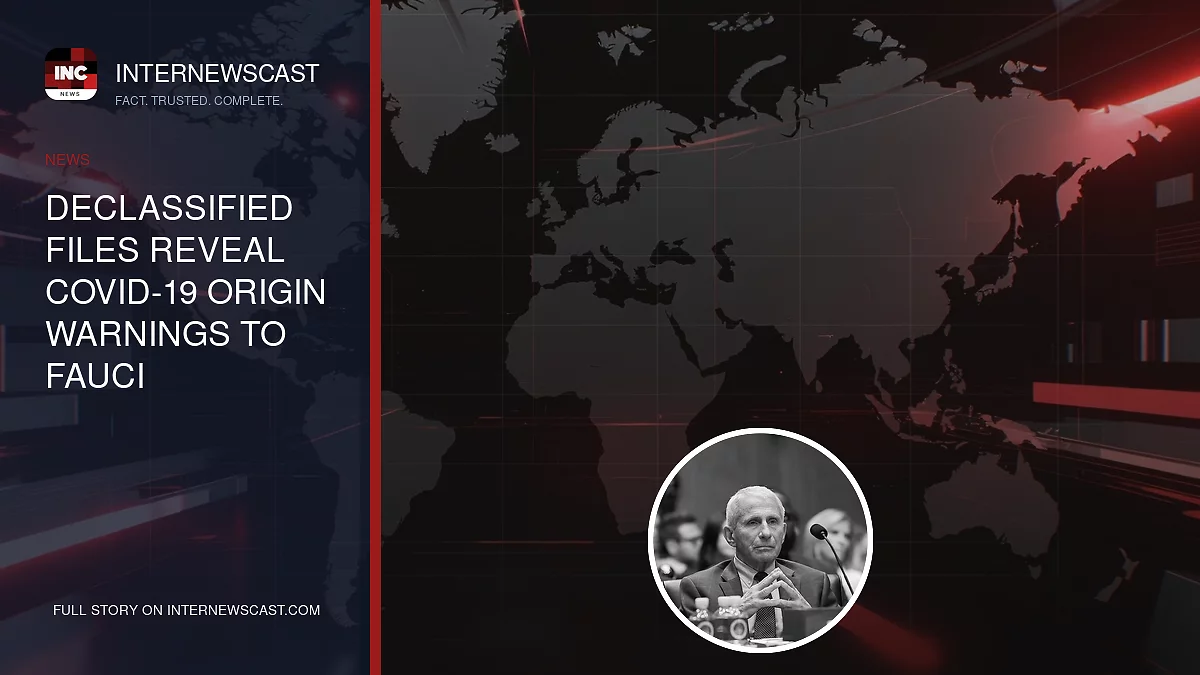

Dr Anthony Fauci was one of the most prominent public voices arguing that COVID-19 most likely arose in nature, but newly declassified documents suggest officials and scientists were weighing a far less settled picture in private.
By early February 2020, senior researchers had already reached out to the former chief medical advisor after identifying what they described as “improbable mutations” in the virus — features they said were difficult to explain and raised questions about whether SARS-CoV-2 had evolved naturally, been engineered, or been adapted during laboratory experiments.
On February 3, Fauci took part in a closed-door discussion during which experts were told that the Wuhan Institute of Virology (WIV) had carried out gain-of-function research involving the receptor used by the virus to enter human cells.
According to the newly declassified account, only two scientists on an earlier call reportedly viewed the genetic sequence as natural, while the rest had not reached a firm conclusion.
Those involved in the meeting recorded a broader consensus that COVID-19 could have emerged through natural spillover or as the result of a laboratory accident, while cautioning that the available evidence might never be enough to clearly separate one possibility from the other.
Yet six days later, when Fauci was publicly asked about allegations that the virus had escaped from a biological-warfare facility in Wuhan, he said such claims remained in the “realm of conspiracy theories without any scientific basis.”
The documents further show that Fauci later suggested scientists for the intelligence community to consult during President Joe Biden’s review of COVID origins, after he had publicly described natural emergence as the most likely explanation.
One official raised concerns about whether investigators should rely on recommendations from a policymaker who had already taken a clear public position on the issue, while another defended Fauci’s involvement, citing his standing as a leading expert on coronaviruses.

Dr Anthony Fauci appeared before a Senate committee on Wednesday but invoked the Fifth Amendment in response to more than 100 questions from lawmakers
The documents do not prove Fauci concealed the pandemic’s origin, manipulated intelligence officers or secretly believed COVID escaped from WIV.
However, they reveal that the private scientific debate surrounding him was far less settled than his early public emphasis on natural emergence suggested.
The 94 pages of government records were released in June by then-director of national intelligence Tulsi Gabbard as part of a wider disclosure concerning the government’s handling of the lab-leak theory.
While the documents were released a month ago, they came as Fauci appeared before a Senate committee on Wednesday under subpoena to face questions about COVID’s origins, pandemic-era policies and what Republican lawmakers described as discrepancies in his personal diaries
However, the former chief medical advisor invoked the Fifth Amendment in response to more than 100 questions from lawmakers.
‘On the advice of counsel, I respectfully decline to answer based upon my rights under the Fifth Amendment of the Constitution,’ Fauci repeatedly said.
Invoking the Fifth Amendment does not establish wrongdoing, and Fauci said he was following his lawyers’ advice amid concerns that his answers could expose him to prosecution.
The new records trace the private debate over COVID’s origins back to the opening weeks of the outbreak.

While Fauci publicly championed the theory that COVID emerged naturally, declassified documents reveal a more complicated story was unfolding behind closed doors

A 2020 assessment from Lawrence Livermore National Laboratory found that the conditions necessary for the accidental release of a laboratory-modified, human-adapted coronavirus were present at WIV in late 2019 (pictured)
On January 31, 2020, scientists with backgrounds in bat coronaviruses contacted Fauci after identifying what an intelligence-community readout described as ‘improbable mutations’ that they could not immediately explain.
They compared the virus’s apparent evolution to a ten-step process in which the first six stages and the final result were visible, but the connecting stages appeared to be missing.
That left them questioning whether the virus had been modified, adapted through serial passage, repeatedly grown in cells or animals, or evolved through natural intermediate forms that had not yet been discovered.
A further call was held the next day, during which participants were told WIV had conducted gain-of-function research involving hACE2, the receptor the coronavirus uses to infect human cells.
Only two experts on a subsequent call reportedly believed the genetic sequence was natural, while the others remained unsure.
Fauci then joined a February 3 meeting at the National Academy of Sciences where the recorded consensus was: ‘Natural or laboratory accident.’
Participants agreed that an accidental release could not be ruled out and warned that the evidence available at the time might never distinguish it from natural emergence.
The meeting did not conclude that COVID had been engineered or escaped from WIV.
An intelligence readout noted that Ralph Baric, one of the scientists involved, said the virus did not display the signs of ‘perfect engineering’ he would expect from deliberate design and viewed that as evidence favoring natural evolution.

One official questioned whether investigators should accept recommendations from a policymaker who had already expressed strong views about the answer, but another defended Fauci as a leading coronavirus expert
The same account said Baric could not rule out a laboratory accident using the evidence then available.
On February 9, former House speaker Newt Gingrich asked Fauci about an ‘urban legend’ that the coronavirus had escaped from a biological-warfare center in Wuhan.
‘I’ve heard these conspiracy theories,’ Fauci responded. ‘And like all conspiracy theories, Newt, they’re just conspiracy theories.’
He added that he could not say the scenario was impossible, but said it remained ‘in the realm of conspiracy theories without any scientific basis.’
The question concerned the more specific allegation of an escape from a biological-warfare facility, rather than every possible scenario involving an accidental laboratory release.
In private emails on April 16, 2020, then-NIH director Francis Collins asked Fauci whether the agency could help ‘put down’ what he called the ‘very destructive conspiracy’ surrounding reports of a possible Wuhan laboratory origin.
Fauci advised against responding, writing: ‘I would not do anything about this right now. It is a shiny object that will go away in time.’

Fauci was asked in 2020 if COVID escaped from the lab, to which he said: ‘I’ve heard these conspiracy theories’
A May 27, 2020 assessment from Lawrence Livermore National Laboratory found that the conditions necessary for the accidental release of a laboratory-modified, human-adapted coronavirus were present at WIV in late 2019.
The assessment said the institute possessed relevant viruses, expertise and experimental systems, making a laboratory incident plausible.
But investigators did not determine that a leak had occurred and placed equal weight on three possibilities: laboratory modification, the escape of a naturally occurring virus from a laboratory or entirely natural transmission.
A June 7, 2021, memo titled ‘Quick Recap of 4 June Dr Fauci Briefing’ details how intelligence officials briefed Fauci about unresolved evidence surrounding COVID’s origins.
According to the memo, Fauci recommended that intelligence officers examine a study he believed offered a ‘clear indication’ that COVID had emerged naturally.
He argued that the failure to identify an infected animal did not disprove that theory, noting that tracing the origins of previous viruses had taken years or remained impossible.
Fauci also recommended several US scientists for the intelligence community to consult as it continued examining COVID’s origins.
The scientists’ names were redacted, and the documents do not reveal whether they were contacted or influenced the final assessment.
Another official questioned whether the National Intelligence Council should accept recommendations from a policymaker, ‘particularly given the various strong views on the subject and statements regarding their own conclusions.’
In a July 14 response, a colleague defended the decision to pursue Fauci’s recommendations, arguing that he was not acting as a policymaker but as a subject-matter expert.
‘Given Dr Fauci’s background, we absolutely would like to follow up on his outreach suggestions,’ the official wrote.
‘He’s a SME with a wealth of knowledge about current and historical research who probably knows better than most who the real Coronavirus experts are.’
The final intelligence assessment did not conclude that COVID emerged naturally or show that Fauci’s recommendations determined its findings.
It said both natural exposure and a laboratory incident remained plausible, with intelligence agencies divided over which was more likely.
Most agencies also assessed with low confidence that the virus probably was not genetically engineered, noting that its unusual furin cleavage site could have developed naturally.
Fauci has since maintained that an accidental laboratory origin is not inherently a conspiracy theory, distinguishing it from allegations that COVID was deliberately created as a biological weapon or caused by research funded by his agency.


