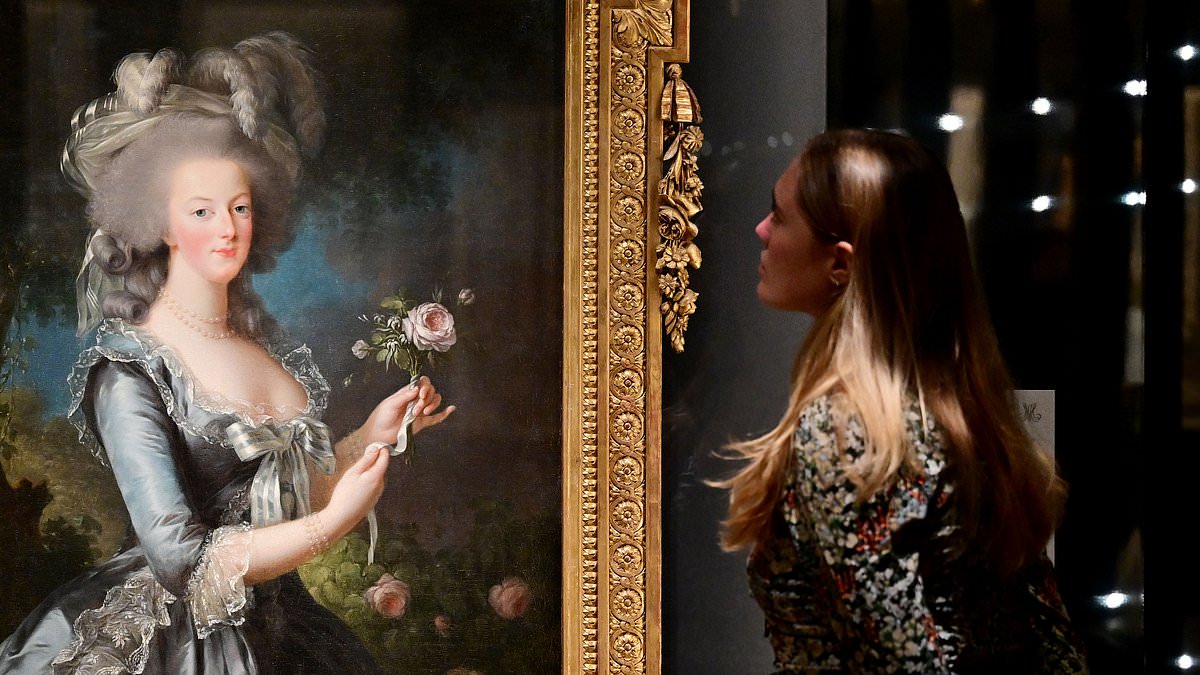

The first-ever UK exhibition dedicated to France’s last and notably contentious Queen opens this weekend, showcasing items that range from the luxurious to the eerie, with everything else in between.
Launching at the V&A in South Kensington on September 20th, “Marie Antoinette Style” is expected to attract numerous history enthusiasts over the coming six months. The exhibition will depict a royal life marked by opulence which was abruptly ended by a violent revolution.
The exhibition features various items including a guillotine—which boasts a shining blade—used during the French Revolution, 18th-century pornography, and Marie Antoinette’s extravagant headpiece, the pouf à l’inoculation, which marked King Louis XVI’s smallpox vaccination.
Major pieces from Marie Antoinette’s jewellery collection, the biggest of any French queen, are also on display.
The exhibition’s most poignant artifact is a timeworn note written by the deposed queen shortly before her execution at Place de la Concorde in Paris on October 16th, 1793, at the age of 37.
Often considered the world’s first celebrity, Marie Antoinette was convicted on overblown charges, including high treason, promiscuity, and incest with her son.
Her final note reads: ‘My God, have mercy on me! My eyes have no more tears to cry for you, my poor children. Farewell, farewell!’
The new highlight at London’s museum—prior to its Cartier exhibition closing in November—drew a star-studded crowd, featuring shoe designer Manolo Blahnik, filmmaker Sofia Coppola, known for her 2006 film on the French Queen, and fashion icon Lady Amanda Harlech.
Curated by historian Dr Sarah Grant, the exhibition paints a portrait of the Queen as a more complicated character than the rampant, greedy royal that is often depicted.

From September 20th, history fans will have the chance to delve into the extraordinary life of Marie Antoinette, when an exhibition (pictured) on her controversial life – which ended at the guillotine when she was 37, opens for six months at London’s V&A museum
The Austrian-born princess was famously nicknamed ‘Madame Deficit‘ for her love of spending; she has also been portrayed as a heavy drinker and sexually voracious.
Historians have long since ruled that Marie Antoinette never said the line most famously attributed to her: ‘Let them eat cake’… but many of the other rumours about her excesses – including cuckolding the king – are likely to have had more truth in them.
Born Archduchess Maria Antonia of Austria in 1755, Marie Antoinette was the youngest daughter of Empress Maria Theresa and Emperor Francis I, the daughter of Francis I, the Holy Roman Emperor.
Her father betrothed her to King Louis XVI to strengthen ties between France and Austria and Marie Antoinette was only 14 and Louis just 15 when they were wed.
The teenage bride receiving two million francs worth of jewellery from her French father-in-law.
Marie Attoinette would receive many more jewels from her husband over the years of their marriage.
The young bride’s jewellery collection was by far the biggest of any French queen and rivalled only by Empress Josephine, the wife of Napoleon Bonaparte.
The glittering pieces were fitting for a woman who enjoyed the kind of fame not previously seen, someone who easily outshone her rather drab husband.
It was said that her smile had an ‘enchantment’ that could win over ‘the most brutal of her enemies’.
Tobias Kormind, Managing Director of Europe’s largest online diamond jeweller 77 Diamonds, attended a preview of the exhibition, saying the V&A’s exhibition will delight jewellery fans.
He told the Daily Mail: ‘Marie Antoinette’s untimely death only cemented her place as one of history’s greatest style icons, and her love of luxury continues to fascinate centuries later.
‘What struck me most at the V&A was seeing her extraordinary jewellery casket – usually kept at Versailles – displayed for the first time alongside jewels from her collection. It was remarkable to witness these treasures, once part of the royal court, reunited from across the globe.’

Among the exhibits is a 2012 photograph of Kate Moss, styled by Sarah Burton for Alexander McQueen, posing as France’s last Queen, with a trio of chihuahuas around her, at The Ritz in Paris
By the end of 1776, Marie Antoinette also had a dress allowance of 150,000 livres, at a time when the price of an average house in a French town was 200 livres.
As she gambled, partied and lavished money on whatever took her fancy, she racked up bills of nearly 500,000 livres.
Versailles was the centre of fashion at its peak of eccentricity. Wigs were packed with powder and adorned with ribbons, feathers, flowers, fruit and even stuffed birds.
The queen had a personal coiffeur who designed her own 4ft tall hair-do that boasted a replica of the French warship La Belle Poule, complete with four masts, sails and jewelled portholes.
Louis raided the French crown jewels to allow his queen to indulge her passion for rubies, and she was also a particular fan of pearls.
As she was being painted while decked out in strands of pearls and other glittering pieces, the French economy was in the doldrums.
Harvests failed, peasants starved and rumours about the queen swirled. They focused not only on her remarkable excesses, but also her serial infidelity.
But it was the Affair of the Diamond Necklace in 1785 that many scholars believe paved the way for her execution.
It would be the scandal that rocked France and permanently damaged the Queen’s reputation.

The Austrian-born Queen’s extravagance saw her with a dress allowance of 150,000 livres – in the 18th century, the price of an average house in a French town was 200 livres (A collection of dresses in the Marie Antoinette Style exhibition at the V&A Museum)

Written in the early hours of the morning on October 16th, 1793, Marie Attoinette’s final death note spoke of her grief for her children at the loss of their mother
It revolved around the sale of a necklace – then the most expensive in the world – that the ailing King Louis XV had commissioned for his mistress. Marie Antoinette was inextricably caught up in the public outcry that followed.
The jewellery, which was made of 647 stones weighing nearly 2,800 carats is valued at around $20million today.
It had been designed by Louis XV’s jewellers, the esteemed Boehmer and Bassange, for his mistress, Madame du Barry.
However, Louis passed away before the piece could be finished and so Boehmer and Bassange tried to sell the necklace to Marie Antoinette and the new King Louis VI.
But the royal couple refused to buy it and the queen instead urged Boehmer to break it up and sell it in several pieces.
In stepped impoverished aristocrat Jeanne de Valois-Saint-Rémy, who had become the mistress of the powerful Cardinal de Rohan, a former French ambassador to Vienna.
He was keen to get back in the queen’s good books after she recalled him from his post in the belief that he was stirring up trouble with her mother.
The cardinal was encouraged by de Valois-Saint-Rémy to write to the queen.

From Versailles, the Sutherland Diamonds, which were at the heart of the ‘Affair of the Diamond Necklace’, a scandal that would see Marie Antoinette’s reputation further plummet amongst the French people, will also feature in the exhibition
What he did not know was that the queen’s affectionate replies were being written by de Valois-Saint-Rémy.
Believing that Marie Antoinette was in love with him, the cardinal was persuaded to meet with a woman he was told was the queen.
In fact, this woman was a prostitute who had been hired by de Valois-Saint-Rémy to pretend to be the queen.
When the cardinal received a purported letter from the queen asking him to organise the purchase of the diamond necklace for her, he went about doing so.
After showing Boehmer and Bassange the correspondence as proof and giving them a deposit, the Cardinal was given the necklace in the belief he would deliver it to the queen.
But instead he gave it to de Valois-Saint-Rémy, who promised that she would give it to Marie-Antoinette.
The mistress then sold its constituent jewels on the black market. When Boehmer sought payment from the queen, she truthfully insisted that she knew nothing.
Despite her innocence in this particular scandal, in the eyes of the public Marie Antoinette was guilty. Here, many believed, was evidence of wrongdoing and yet more unjustifiable extravagance.
Even Napoleon would later say: ‘The queen’s death must be dated from the Diamond Necklace trial.’
When she visited Paris soon after giving birth to her fourth child, Marie Antoinette was greeted in ‘perfect cold silence’ by the crowd.
In 1791, two years after the French Revolution had begun, Marie Antoinette and her husband were captured as they tried to flee Paris.
Nine months after her husband’s execution, Marie Antoinette was tried and found guilty on exaggerated charges that included high treason, promiscuity and incest with her son.
On October 16, 1793, her head was cut off and presented to the cheering crowd.


