
Esther Rantzen made it possible for a Holocaust survivor to come face to face with Sir Nicholas Winton and personally thank him for saving her life.
The celebrated broadcaster, who died this week aged 86 after living with stage four lung cancer, was responsible for one of television’s most emotional reunions. Through her work, she brought the Second World War hero together with some of the children he had rescued decades earlier.
Sir Nicholas, a modest stockbroker from Hampstead, had kept his wartime actions private for nearly half a century. His secret began to emerge in 1987, when his wife, Grete, discovered an old scrapbook in the attic of their Maidenhead home.
The book contained photographs and names belonging to hundreds of children. They revealed that, at just 29, Sir Nicholas had helped organise their escape from Nazi-occupied Prague shortly before the outbreak of war.
Through the Kindertransport, he ultimately helped 669 children—most of them Jewish—leave Czechoslovakia for Britain by train. He also helped arrange sponsors and places to live under legislation introduced after Kristallnacht.
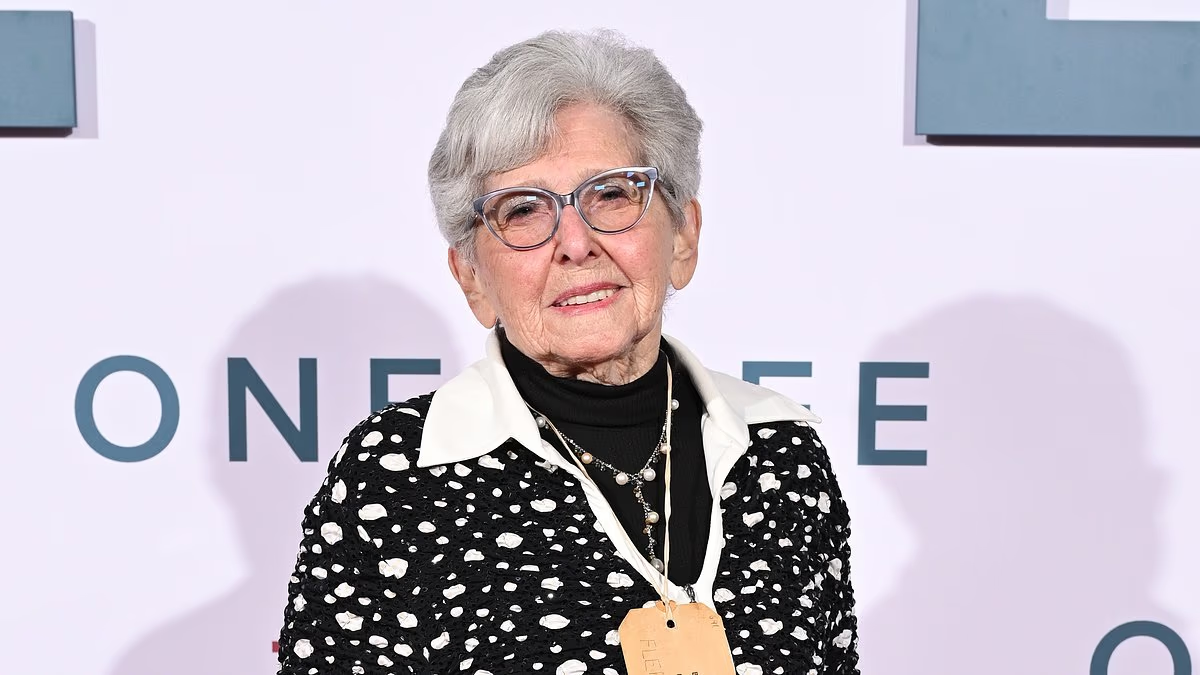
Among the first children found by the BBC for Rantzen’s That’s Life! was Lady Milena Grenfell-Baines. She had been rescued at the age of nine as Milena Fleischmann, travelling with her three-year-old sister.
Now 96, Lady Milena was among the small number of children rescued by Sir Nicholas who were not Jewish. Her father had been targeted by the Nazis after helping the writer Thomas Mann flee the regime.
For years, Lady Milena knew very little about the circumstances that brought her to Britain. She was also fortunate that both of her parents managed to escape Czechoslovakia before it was too late.

At 96, Lady Milena Grenfell-Baines is one of the 669 children Sir Nicholas Winton helped flee the Nazis through the Kindertransport

She met Sir Nicholas for the first time after Dame Esther arranged the reunion for an episode of That’s Life!

Dame Esther Rantzen introduced Sir Nicholas to a wider audience as the man who rescued children from Nazi-occupied Prague in 1939
The connection finally began to make sense after a telephone call in 1988—one made possible by Dame Esther, the broadcaster and founder of Childline.
Lady Milena recalled being stunned when Rantzen contacted her unexpectedly. At first, she was so doubtful that she assumed the call could not be genuine.
“And I’m the Queen of England,” she joked in response when Dame Esther identified herself, according to her recollection.
Rantzen eventually persuaded her that the call was real. She explained that Lady Milena’s details had been found in Sir Nicholas’s scrapbook and invited her to the studio, where she would meet the man who had arranged the Kindertransport.
Speaking to The Telegraph, Lady Milena said: “When I arrived at the studio, all Esther told us was that we were going to meet the man who had organised the Kindertransport.
“She also said, ‘Now, you’re not to tell him who you are.’ I was seated in the front row to his right. On his other side was Vera Gissing, another child he rescued, who had attended school with me in Wales during the war.”
During the programme, Rantzen’s co-presenter read aloud the message Lady Milena had given to the production team: “If it was Nicholas Winton who helped me escape, along with my sister and cousin, then I would be honoured to meet him—to thank him.
“If it were not for him, I would have suffered the same fate as my other cousins, who both ended up in concentration camps.”

Lady Milena, pictured with her younger sister Eva, adoptive parents Roland Ratcliffe and Florie, and daughter Mary after arriving in England

Sir Nicholas is seen surrounded by dozens of the children he saved in a special episode of That’s Life! presented by Dame Esther

A visibly moved Sir Nicholas could be seen wiping away tears after being reunited with his ‘children’
Lady Milena was able to meet with her saviour after the show, although he is said to have left quickly: ‘He was a gentle man who never looked for thanks. He was quite cross with Esther for springing it all on him.’
But he returned for a second show on July 3 1988, in which dozens of the children he had saved – but not Lady Milena herself on that occasion – were all seated around him.
Asking the audience if any of them ‘owes their life to Nicholas Winton’, around two dozen people sat immediately around him in the studio stood up – all children evacuated from Prague thanks to his efforts.
Sir Nicholas flashed a brief grin – then, as he sat down, wiped tears from both eyes.
That it took decades for his understated heroism to come to light is no surprise: not even his wife Grete knew he had travelled to Prague in 1938 at the behest of his friend, Martin Blake, who was working with Czech refugee groups.
Sir Nicholas – known as ‘Nicky’ among his family – spent just three weeks in the city but set in motion part of what became known as the Kindertransport operation that would ultimately rescue 10,000 children from across Nazi-occupied Europe.
He chipped in to cover costs, dealt with the heavy bureaucracy and organisation and, reportedly, forged travel documents and bribed officials when frustrated by delays.
With assurances given that each child would come with a £50 guarantee (£2,900 now) to cover the costs of repatriation post-conflict, the first train left on March 14 1939, a day before the Nazis fully occupied the country.

Dame Esther kept in touch with Lady Milena throughout her life and wrote a new forward about Sir Nicholas just months before her death this week
Eight would leave in all, with collaborators in Prague including Trevor Chadwick seeing them off before being met by Sir Nicholas and others in London. The children were then settled with willing British families, most never to see their own parents again.
What was to be the last train was cancelled by the Nazis on September 1 – the day they invaded Poland and closed all borders.
Of the 250 children on board, just two are thought to have survived the war, according to an interview Vera Gissing gave in 2006. The failure to get the final train through haunted Sir Nicholas for the rest of his life.
In the years following the recording, Lady Milena started getting to know Sir Nicholas, and the pair eventually wound up seeing each other regularly.
She would visit him at his home in Maidenhead, often picking up his favourite lunch on the way – a typically understated cauliflower cheese and rice pudding.
But it wasn’t the only friendship forged from the experience: Lady Milena kept in touch with Dame Esther too, right up until the end of her life.
Years later she is said to have told Lady Milena that the second episode featuring Sir Nicholas was the most important evening of her entire life.
‘She was very much the way you saw her on the screen – friendly, easy and warm,’ she said.
‘Even right to the last few months of her life, when I wrote to her, she immediately wrote back, or I got a message back from her daughter. She was glad to know what we were all doing.’
Given all of Dame Esther’s charitable works, it is perhaps fitting that one of her last major contributions before her death was to write about Sir Nicholas for a new book about the Kindertransport.
In telling his story to the nation, she created a new national hero – and ensured her own legacy will live on too.


