Share this @internewscast.com
Once a staple of American dining, the all-you-can-eat buffet, complete with soft-serve machines and endless crab legs, is making a notable comeback.
The Covid-19 pandemic had left these buffets deserted, with sneeze guards and self-service stations largely unused. However, the revival of this dining style is now in full swing.
Yelp, a popular restaurant review site, reports a significant 252% increase in searches for ‘all you can eat buffet near me’ over the past year, indicating a resurgence that experts believe will continue growing through 2026.
According to analysts, much of this resurgence is driven by a renewed interest in Asian cuisine. Searches for all-you-can-eat dim sum rose by 244%, while searches for ‘sushi bars all you can eat’ saw a 93% increase.
Notably, the popularity of unlimited Korean BBQ and hot pot has skyrocketed by 591%, highlighting a trend towards interactive and communal dining experiences.
Yelp’s analysis of consumer search behavior, comparing data from September 2024 to August 2025 against the prior year, reveals these emerging trends. The results suggest that the American buffet is not just surviving but potentially entering an exciting new chapter.
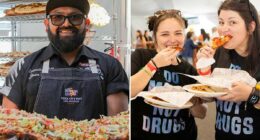
Yelp experts say restaurants such as NIKU X – which has locations in New York and Los Angeles – are helping to redefine the concept, transforming the traditional buffet into a more curated, destination-worthy experience.
The eatery offers an unlimited buffet featuring prime Wagyu steak, seafood, sushi and desserts from $158 per person.

From soft-serve machines to bottomless crab legs, the all-you-can-eat buffet was once a cornerstone of American dining

Much of the buffet’s revival is being fueled by a renaissance in Asian cuisine
Meanwhile, the upscale The Peninsula New York hotel launched an ‘elevated’ Sunday brunch buffet last year starting at $115, tapping into the growing trend.
A description of the dining experience reads: ‘Guests are invited to indulge in more than 40 culinary offerings served in a grand display, including a charming artisanal bagel and bread cart – all of which are made in-house or sourced locally – alongside elevated American staples ranging from eggs and frittatas with savory accompaniments to fresh waffles, yogurt parfaits and more.’
Elsewhere across the country, hotel and restaurant owners alike are celebrating the buffet’s return.
Mike Darby, owner of Buffalo Bill’s Irma Hotel & Restaurant, said the establishment’s Prime Rib Buffet – priced at $35.99 – has gradually galloped back to the forefront as a firm family favorite.
In 2025, Darby estimates that a record 12,000 to 13,000 diners loaded up their plates at The Irma’s dinner buffet.
Aside from the prime rib, the coconut shrimp and baked salmon have proven especially popular.
In a bid to make guests feel comfortable after the pandemic, Darby invested in new sneeze guards.
Buffets across America began large-scale shutdowns in early to mid-March 2020 due to Covid-19 restrictions and hygiene concerns, with major Las Vegas casinos such as MGM Grand halting operations.

The upscale The Peninsula New York hotel launched an ‘elevated’ Sunday brunch buffet last year starting at $115, tapping into the growing trend

Mike Darby, owner of Buffalo Bill’s Irma Hotel & Restaurant, said the establishment’s Prime Rib Buffet – priced at $35.99 – has gradually galloped back to the forefront as a firm family favorite
By May 2020, some chains – including Garden Fresh Restaurants – announced the permanent closure of all locations.
Detailing the history of buffets, the Hospitality Institute notes that the word ‘buffet’ originates from the French term for a sideboard where food was displayed.
‘This method of serving food has deep roots in history, evolving significantly over centuries. Buffets were initially designed to allow guests the freedom to choose their meals while mingling in a social setting,’ the organization explains.
In the United States, all-you-can-eat buffets surged in popularity during the 1970s and 1980s. Not only were they seen as a lavish way to dine, they also proved to be a practical and appealing option for serving large groups.
While the concept is widely associated with Las Vegas, one of the earliest examples was the Buckaroo Buffet, launched in 1946 by Herb McDonald.
From there, the model expanded into suburban, family-oriented chain restaurants throughout the 1970s and 1980s – laying the foundation for the buffet boom now enjoying a second helping.