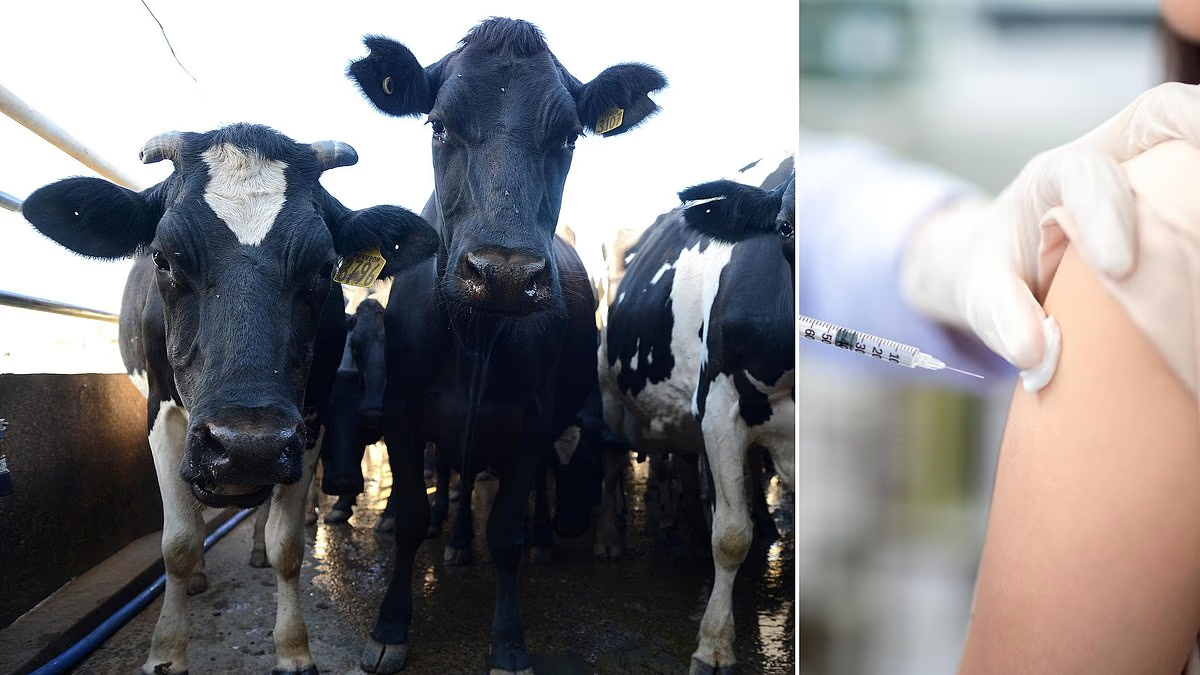

Thousands of Scots who work with cattle and pigs are being encouraged to receive a flu vaccine in an effort to protect the wider public from a potentially dangerous new strain of the virus.
Health specialists fear that animal and human flu viruses could combine, producing a hybrid capable of causing severe illness and potentially triggering another pandemic.
The risk could arise if someone who regularly handles livestock contracts both human and animal flu at the same time, unknowingly providing the conditions for a new and potentially hazardous virus to develop.
In an unprecedented move to reduce that risk, Scotland’s farmers, agricultural workers, vets, inspectors, livestock transport drivers and abattoir employees are being urged to get a flu jab for the first time.
Information leaflets issued by Public Health Scotland (PHS) state that vaccinating animal workers could ‘reduce the risk of a new type of flu virus being made.’
The guidance warns: ‘If someone has bird flu and human flu at the same time, the viruses could mix in their body and create a new type of flu virus. A new flu virus produced in this way could spread very easily and cause serious illness, because people would not have immunity to it.’
Health officials are contacting farming and veterinary organisations to promote the free vaccination among livestock workers, as well as people employed in the poultry sector.
Unlike groups such as older people and those with weakened immune systems, animal workers are being offered the jab not only to protect their own health, but also as a precaution designed to safeguard the population more broadly.

Farm workers are being urged to get a flu vaccine to help prevent the emergence of a new strain

Flu is a highly contagious respiratory illness that can be fatal for people with weakened immune systems
A similar public-health approach was adopted during the Covid pandemic, when vaccination was promoted not just to reduce individual illness but also to slow the spread of coronavirus throughout the population.
Dr Claire Cameron, a consultant in health protection at PHS, said: ‘We know that flu viruses change and mutate all the time, and that these changes can lead to increased flu activity and pandemics.
‘What we don’t want is for people working in close contact with live animals to be infected with animal and human flu at the same time. That could create a new and unusual virus and cause a far wider problem.’
She added: ‘We have prepared leaflets about the vaccine for people working with poultry, swine and cattle, and are liaising with stakeholders to make sure those people are aware of the recommendation.’
Flu is a common, highly contagious respiratory infection caused by influenza viruses that affect the nose, throat and lungs.
Most people with a healthy immune system recover within a few days. However, infection can lead to serious complications, including pneumonia, and may prove fatal for babies, older adults and people with weakened immunity.
As influenza spreads around the world, it can undergo significant mutations. Historically, the deadliest outbreaks have been linked to new variants that the human immune system has not encountered before, making them more difficult to combat.

Dr Claire Cameron of Public Health Scotland
Each year, experts assess which flu strains are most likely to circulate and use that information to develop a vaccine. The NHS then offers the jab free of charge to help protect vulnerable people from infection and serious illness.
Meanwhile, numerous influenza variants primarily affect animals, including swine flu in pigs and avian flu in birds.
These viruses can occasionally cross the species barrier and infect people, although they generally cannot spread effectively from one person to another, limiting their overall impact.
The concern, however, is that a hybrid virus combining features of human and animal influenza could be far more dangerous. Because the human immune system would not recognise it, the virus could cause severe illness while also spreading readily between people.
The World Health Organisation’s latest surveillance report, published earlier this month, said high levels of swine and avian flu had been detected in birds, cattle and other animals.
In the past month, several people in China and Cambodia became ill after contracting avian flu, while a woman in Brazil died after being infected with swine flu.
The report said: ‘At present, these viruses are not thought to be capable of sustained human-to-human transmission, although this could change as they evolve.’
Dr Cameron said: ‘The flu vaccine is this year being offered to people working on farms with cattle or swine, vets, people who move, handle or transport livestock, and those working in slaughterhouses.
‘It is also being offered to people who work at or regularly visit poultry farms or processing facilities, as well as those who cull or handle live or unwell birds.
‘The possibility that they could contract animal and human flu simultaneously and generate a new virus is a small, theoretical risk—but one we would very much want to avoid.’


