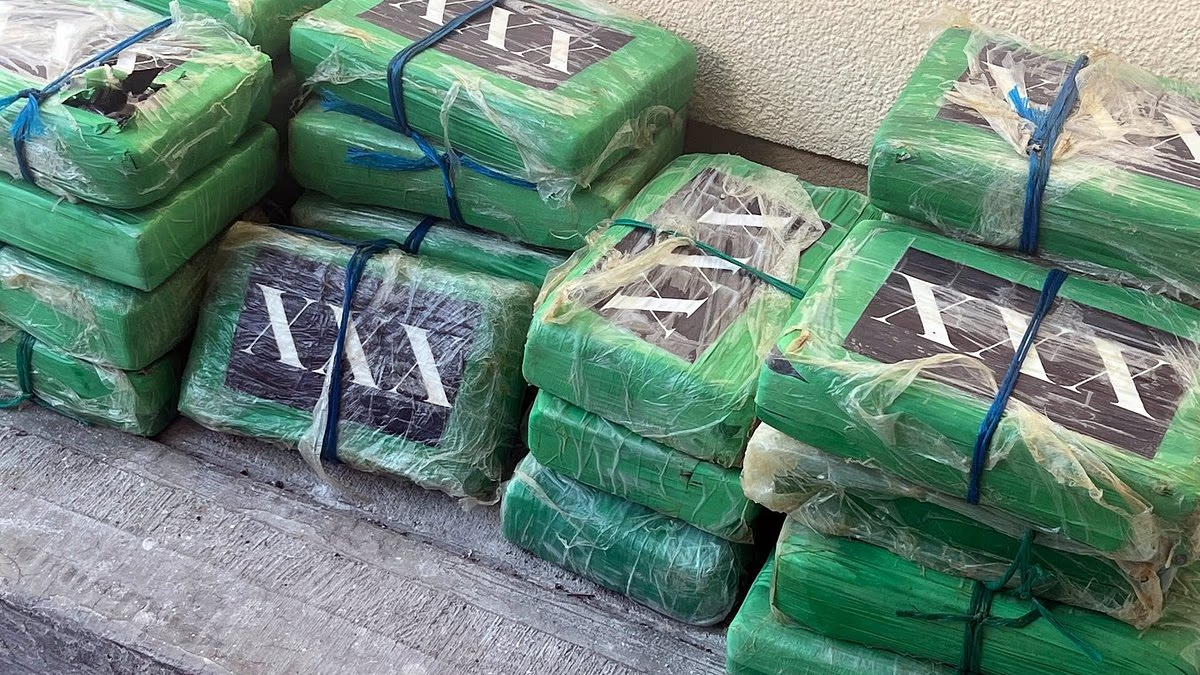

For some Florida Keys fishermen, a day on the water can yield far more than the red or black grouper they set out to catch.
Instead of fish, they sometimes pull up tightly sealed packages containing marijuana or cocaine. Locally, the floating bundles are known as “square groupers”—a tongue-in-cheek name for an unexpected and highly lucrative catch.
The bricks are illegal to possess, but authorities say some Florida Keys residents have been willing to risk lengthy prison sentences for a share of the profits.
That risk became clear in August, when three men received sentences of up to 10 years for their roles in a major cocaine distribution network operating throughout the Keys.
John Robert Strama Jr., 44, Pedro Luis Lugo Jr., 38, and Elvis Lazaro Ruiz, 34—all from Marathon—were among 27 people federally charged with distributing cocaine between 2020 and 2023.
According to the Justice Department, Strama led the operation and obtained much of his cocaine by recovering square groupers that had been found drifting at sea.
Prosecutors said his familiarity with the local waterways helped him retrieve dozens of cocaine bricks, which he later passed on to members of the trafficking group.
Bradford Picariello, a 65-year-old charter boat captain, was arrested in January on cocaine trafficking charges. He pleaded not guilty in September and could face between 10 years and life in prison if convicted.

Dozens of square groupers—cocaine or marijuana bricks wrapped in plastic—have been recovered from the water

Despite the serious criminal penalties, some residents are gambling with their freedom in pursuit of the illegal profits
Picariello allegedly sold one kilogram of cocaine to an undercover detective for $10,000. According to a police report, he instructed the agent to carry a cooler so the meeting would appear to involve a fishing trip. He also allegedly claimed that he had 100 pounds of cocaine available.
His arrest led investigators to uncover 23 kilograms of cocaine, NBC 6 reported.
Picariello’s attorney, Joseph Rosenbaum, said the defense intends to contest the allegations.
“Every old fisherman that I talk to tells me he’s got a sterling reputation,” Rosenbaum told The New York Times.
Monroe County Sheriff Rick Ramsay told Our News Outlet that someone bringing another drug brick to his office has become a weekly event.
He said many of the packages are discovered by people fishing offshore.
Ramsay estimates that only about half of the square groupers found in the county are handed over to law enforcement. He believes most of the rest are transported to Miami.
“It’s a lot of money—a kilo is potentially $20,000. So people want to get rich quick,” he said. “At some point in time, greed gets in place.”

Sheriff Rick Ramsay said his office receives another report of a square grouper nearly every week


Authorities believe the packages originate in the Caribbean, Colombia and the southern Bahamas, while the markings on the bricks may indicate their intended recipient
DON’T MISS: UK Distributes 1,000 Hijabs to Migrants Crossing the Channel
In the past year he estimates that 40 to 50 kilos of uncut cocaine have made it to his office, where it will eventually be passed off to federal authorities.
Authorities believe it is coming from the Caribbean, Colombia and the Bahamas. And the symbols they are marked with, such as numbers or photos, indicate the recipient, not the owner.
The county, which encompasses the Keys and the southwest tip of the mainland, has also seen a ‘significant’ increase in recent years as US-Mexico border security ramped up.
‘Now that that southwest border is shut down, we’ve seen more dope floating up the last couple years, which would give us an indication that more dope is starting to come back in through the water,’ Ramsay said.
Unlike in the 1970s through 1990s, where hundreds of kilos washed up, today it is usually 50 to 100 kilos, Ramsay said.
This is partly due to the vessels changing. Decades ago, smugglers had high-speed boats that could out-race police. Now, smugglers have changed tactics, including using hidden compartments in sailboats, Ramsay said.
In the 1970s, the bricks largely contained marijuana. This changed in the 1980s, when cocaine became the dominant drug, Local Historian Brad Bertelli told Our News Outlet.
‘For a lot of local fishermen, that used to be their side gig,’ he said. ‘[Fishermen] came back to shore with more than the catch of the day.

The area has gained a reputation and a popular restaurant is named after the phenomenon
‘A lot of people knew what was going on.’
Places like the Everglades and the Keys were notorious for it, Bertelli said.
‘It became a way to make a living. It was risky, but it was good money.’
Sometimes square groupers are exchanged boat-to-boat, while others are offloaded by smugglers if they feared federal authorities were nearby, the historian said.
In the 1980s, Sea Oats Beach on Islamorada saw plenty of square groupers wash ashore, lending it the nickname Bale Beach, Bertelli said. A bale is another term for the packages.
In 2024, $1.6 million worth of drugs washed ashore on the island after Hurricane Debby tore through, ABC 7 reported.
Twenty-five packages of cocaine worth $1 million were found by one individual. A week later, boaters found a 56-pound batch worth $625,000 near Everglades City.
The frequency of finding a square group became so common that the islands have embraced their reputation.
A restaurant was named after a square grouper and is one of the most popular in the Keys, Bertelli said.
‘It’s definitely an embraced culture for sure,’ Bertelli said.
Our News Outlet has reached out to Rosenbaum for comment.