
Police used tear gas and charged at demonstrators on Saturday as tens of thousands joined anti-government protests across France.
The Interior Ministry estimated that about 106,000 people marched nationwide, including in Paris, during the fifth consecutive Saturday of so-called Act V demonstrations.
At least 120 people were arrested, marking another turbulent day in a protest movement that has shaken the country.
Demonstrators jeered at police and called for President Emmanuel Macron to resign as his approval ratings have fallen to their lowest point since he took office in 2017.
Video from Paris showed riot police clashing with young protesters near Place de la Nation, on the eastern edge of the capital, as the march drew to a close.
Armoured officers were also filmed pursuing demonstrators through streets elsewhere in France, with some protesters struck by batons as confrontations intensified.
Remi Durand, a trade union activist, said: ‘The police response was outrageously heavy-handed. They were attacking anyone they could reach with their weapons.’
The movement began with anger over higher fuel taxes and the rising cost of living. It has since expanded into a broader challenge to Mr Macron’s government and its economic programme.

Protesters clash with riot police during a demonstration against rising living costs and cuts to public services in Montpellier, France, on Saturday, November 14, 2026

Police intervene as fire breaks out on the street during a demonstration as the people march from the Manufacture des Tabacs to Place Jean-Mace on Saturday, November 14, 2026 in Lyon, France

A riot police officer looks on in front of a burning barricade during riots after a demonstration as part of a nationwide protest over the rising cost of living and inequality organised by the Yellow Vest movement in Lyon on November 14, 2026
By 6pm, a French Interior Ministry spokesman said: ‘A total of 121 people have been arrested across the country so far following disturbances in numerous cities and towns.’
Adrien, a 20-year-old cello player performing with a volunteer orchestra at the Paris rally, said the main focus was a bill before parliament that would give police officers who use their weapons a presumption of legitimate self-defence.
‘We are already frightened when we attend protests, and this proposal would make us even more afraid by strengthening their impunity,’ he said. Tear gas had struck protesting musicians during demonstrations the previous month.
Supporters of the legislation, including Marine Le Pen’s hard-Right party, argue that it is needed to prevent officers from being automatically accused of using disproportionate force.
Opponents say the measure would create a ‘licence to kill’ and make it even more difficult to hold security forces accountable in a country where alleged police brutality cases seldom reach criminal court.
Across the country, protesters also called for improved education, stronger children’s rights and a better future, while some rallies were punctuated by songs.
In Bordeaux, 72-year-old Josette sang a protest anthem titled ‘I have two passions: brass bands and revolution’.
‘My children did not want me to come,’ she said. ‘But I am incredibly grateful to young people for starting this movement.’
‘They are giving us hope at a time when it feels as though we are heading towards disaster, with the planet growing hotter and far-right movements becoming increasingly unapologetic.’

Riot police officers charge to disperse demonstrators during a nationwide day of protests in Paris on November 14, 2026

Protesters walk amid a cloud of tear gas during a demonstration in Marseille, southern France, on November 14, 2026 as part of a nationwide day of protests

Demonstrators set up a makeshift barricade during a demonstration as part of a nationwide mobilisation against violence, amid a protest movement by high school students, in Nantes on November 14, 2026
The unrest began weeks ago with a campaign by high school students demanding the equivalent of about £9 billion for the education system.
It has since grown into a mass mobilisation involving trade unions, Black Bloc anarchists and Yellow Vest activists, whose movement began in 2018 in opposition to fuel tax increases.
The Interior Ministry said 106,000 people demonstrated across France on Saturday, including 24,000 in Paris, making it the smallest nationwide turnout in recent weeks.
Student unions gave a much higher estimate of 200,000 protesters, including nearly 100,000 in the capital.
‘No justice, no peace,’ one protester shouted through a megaphone in Paris, where students, union members and Yellow Vest supporters marched for a fifth straight Saturday.
Other demonstrators demanded the president’s resignation or chanted, ‘Everybody hates the police.’ One group carried a giant puppet wearing a hat labelled ‘Lord Macron’.
Although most demonstrations in recent weeks have remained peaceful, isolated violence has been reported alongside allegations of police brutality, including incidents involving young teenagers.
Saturday’s arrests brought the number detained during disturbances over the past month to at least 4,000. Hundreds of people have also been injured.

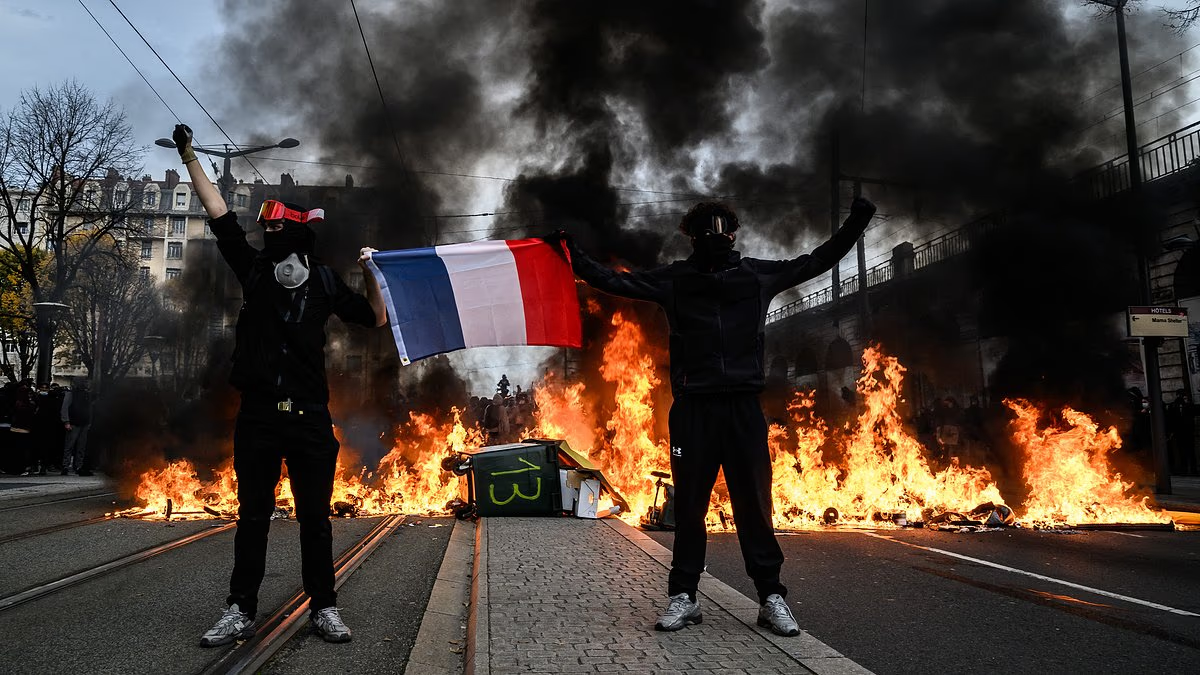
Two masked demonstrators hold a French flag in front of a burning barricade during riots after a demonstration as part of a nationwide protest over the rising cost of living and inequality organised by the Yellow Vest movement in Lyon on November 14, 2026

A protester kicks back a tear gas canister during a demonstration in Bordeaux, south-western France, on November 14, 2026

Police intervene as demonstrators gather during a protest against the rising cost of living, organized as part of Act V of the social movement, in Strasbourg, France on November 14, 2026
Around 70,000 police officers and gendarmes have been deployed each Saturday under the direction of Interior Minister Laurent Nunez.
Mr Nunez also warned that social media posts were circulating that called for violence against police officers and public buildings.
He promised ‘an extremely firm response’ to any such acts.
An attempted murder investigation was opened after petrol bombs were thrown at gendarmes during a Paris march at the end of last month, he said.
Arson has become an increasing concern, with several public buildings targeted during the unrest.
The 19th-century town hall in Limoges was nearly destroyed by fire last month, while a historic tourist office in Lyon was also set alight.
Left-wing politicians have been accused of inflaming tensions, while they maintain that paramilitary police units have provoked protesters.
Jean-Luc Melenchon, the presidential candidate for France Unbowed, said excessive amounts of tear gas had been used against peaceful demonstrators.

Police detain demonstrators during a demonstration to protest children’s rights and police violence in Paris, France, on November 14, 2026

Protesters take part in a demonstration against rising living costs and cuts to public services as a sign reading ‘Class struggle’ is displayed in Montpellier, France, on Saturday, November 14, 2026
He said: ‘It appears that confrontation is the central purpose of this public-order strategy. It is pathetic.’
The unrest comes just months before France is due to hold a presidential election in April.
Recent polling suggests Mr Macron’s popularity is at its lowest level since he became president in 2017. His government also has limited room to meet protesters’ demands as it works to bring down the country’s debt.
Surveys indicate that Marine Le Pen, the hard-Right National Rally candidate, could face hard-Left contender Jean-Luc Melenchon in the second round.
Ms Le Pen is appealing against a conviction for embezzling European Parliament funds. If the conviction stands, she could become the first convicted criminal to enter the Élysée Palace.
In Toulouse, Kenza, a 28-year-old specialist in asylum law, condemned the government’s handling of the unrest.
‘The repression of protesters is unacceptable, especially when children are among those affected,’ she said.
Lawyers said last week that police violence during recent demonstrations had caused ‘mutilations’, including injuries to hands, feet and eyes.
Saturday’s rallies were largely peaceful, although police used tear gas to disperse crowds in Paris, Bordeaux and Nantes.
Unions have called another day of strikes for Tuesday after rejecting a government offer to raise the minimum wage by 0.6 per cent, dismissing it as ‘crumbs’.
The biggest demonstrations in recent weeks took place during a union-backed strike last Thursday, when official figures put nationwide participation at more than half a million people.