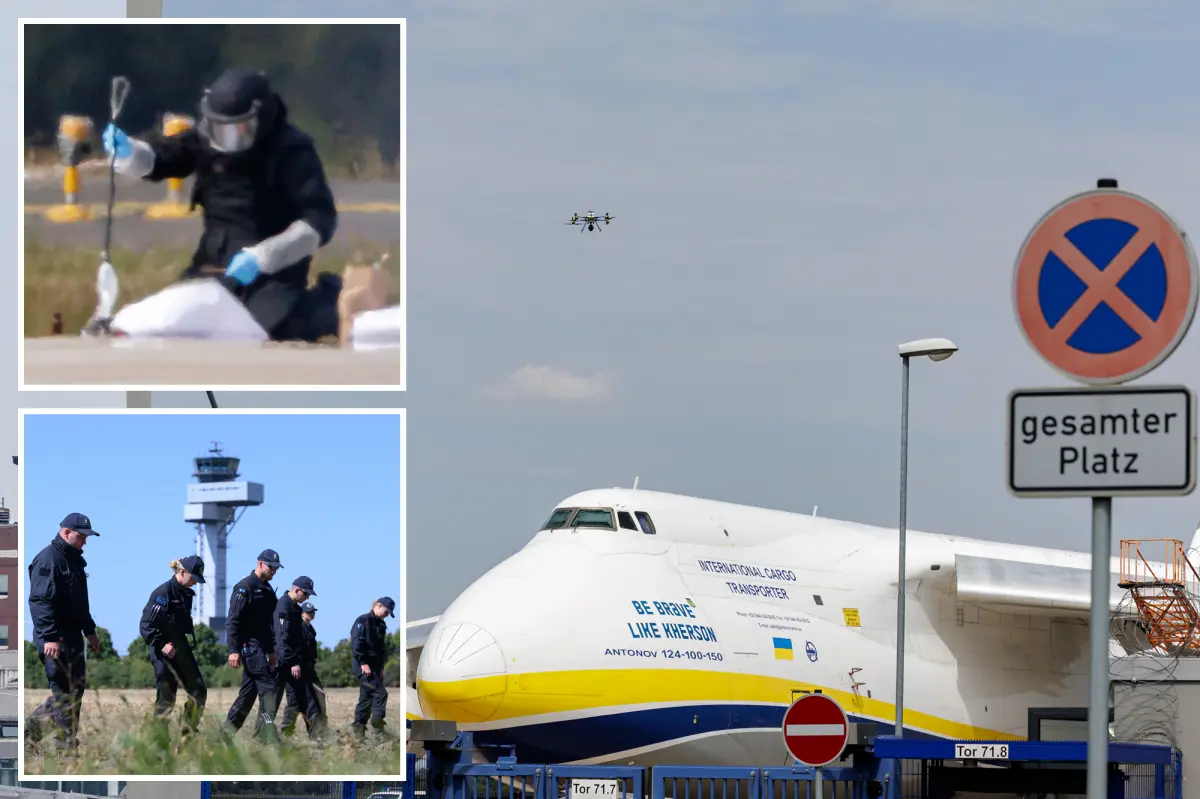

BERLIN — Germany is preparing to formally point the finger at Russia over an alleged attempted drone strike targeting a Ukrainian cargo aircraft at Leipzig/Halle airport in August, and Berlin may work with international partners on a fresh round of sanctions against Moscow, two people familiar with the matter said Tuesday.
The incident came to light after airport staff discovered a drone fitted with explosives and a detonator at the eastern German airport, a major civilian freight center that also serves as a NATO logistics hub and hosts several massive Ukrainian Antonov An-124 transport planes.
Until now, German officials had avoided directly accusing Russia, while describing the episode as part of a broader hybrid warfare campaign aimed at Europe.
Tensions between Moscow and Western governments have deteriorated sharply since Russia launched its full-scale invasion of Ukraine in 2022.
The two sources, who requested anonymity because of the sensitivity of the issue, backed up German media reports that Berlin intends to attribute responsibility to Russia and is weighing additional punitive measures.
They did not provide specifics on what the potential sanctions package might include.
Foreign Minister Johann Wadephul, speaking Tuesday during a visit to Algeria, did not fully confirm the reports but indicated that further action against Russia was under consideration.
Wadephul is expected to return to Germany later Tuesday, where he is scheduled to appear at a press conference with Interior Minister Alexander Dobrindt.
“There is no overreaction on our part, but there is a response when we are attacked,” Wadephul said. “Russia must understand that Germany is a stabilizing force in Europe — one that is always ready to negotiate but will not be intimidated in any way.”
The Russian embassy had no immediate comment, but it has previously dismissed accusations about its possible involvement as a “fabricated provocation” and as “a new wave of anti-Russian hysteria in Germany.”
European intelligence officials have long monitored what they describe as Russian sabotage incidents in Europe aimed at weakening NATO’s unity and its member states’ willingness to support Ukraine against Russian aggression.
Marie-Agnes Strack-Zimmermann, the German chair of the European Parliament’s Committee on Security and Defence, called for Russia to be clearly identified as the mastermind behind the attempted attack.
“I believe we need to call a spade a spade and acknowledge that Russia is behind this,” she said on Tuesday.
She argued that the focus should shift away from describing such incidents as “hybrid attacks,” as these constitute “actual attacks.”