
Share this @internewscast.com
President Donald Trump has deployed U.S. Navy vessels to establish a blockade in the Strait of Hormuz, a move experts caution could endanger American personnel.
On Sunday, Trump revealed the decision on Truth Social, stating that naval forces will “initiate the process of blocking any and all ships attempting entry” into the strategic strait.
The president asserted that the U.S. military’s actions since February 28 have nullified the threat from the Iranian Navy in this vital maritime passage.
Nevertheless, specialists advise that while the larger ships of the Islamic Revolutionary Guard Corps (IRGC) have been largely neutralized, smaller vessels maintaining control of the Strait remain operational.
This situation leaves U.S. military forces in the narrow channel—measuring only about 35 kilometers across—vulnerable to potential attacks from the IRGC.
According to Farzin Nadimi, a senior fellow specializing in Iran at the Washington Institute, over 60 percent of the IRGC’s swift attack boats and speedboats are still active, as reported by the Wall Street Journal.
David Des Roches, a former director responsible for Persian Gulf policy at the Defense Department, also noted that Iran’s ‘asymmetrical strategy is working.’
The smaller, more nimble boats are well versed in controlling the crucial chokepoint by deploying missiles and mines, and by harassing commercial ships.

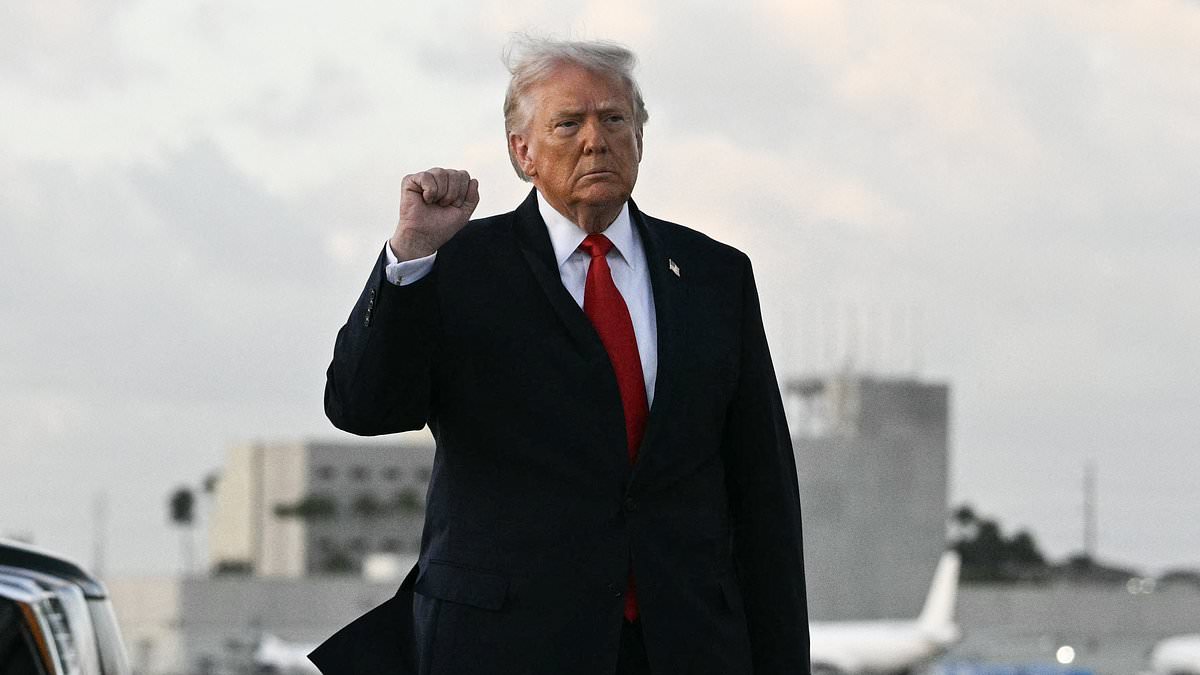
US President Donald Trump makes a fist upon arrival at Miami International Airport in Miami, on April 11, 2026. Trump is traveling to Florida to attend a UFC event and spend the weekend at his Mar-a-Lago residence

This handout natural-colour image acquired with MODIS on NASA’s Terra satellite taken on February 5, 2025 shows the Gulf of Oman and the Makran region (C) in southern Iran and southwestern Pakistan, and the Strait of Hormuz (L) and the northern coast of Oman (bottom)

An Iranian Revolutionary Guard jet boat sails around a seized tanker in Bandar Abbas, southern Iran, July 2019 (reissued August 2019)

U.S. Marines, with the Battalion Landing Team 3rd Battalion, 1st Marines (3/1), 31st Marine Expeditionary Unit (MEU), conduct a live fire evolution on the flight deck of San Antonio-class amphibious transport dock ship USS New Orleans (LPD 18), while underway, February 11th, 2026
‘Effective immediately, the United States Navy, the Finest in the World, will begin the process of BLOCKADING any and all Ships trying to enter, or leave, the Strait of Hormuz,’ Trump announced via Truth Social Sunday morning.
‘Any Iranian who fires at us, or at peaceful vessels, will be BLOWN TO HELL!’ he added.
‘Iran knows, better than anyone, how to END this situation which has already devastated their Country.
‘Their Navy is gone, their Air Force is gone, their Anti Aircraft and Radar are useless, Khamenei, and most of their “Leaders,” are dead, all because of their Nuclear ambition. The Blockade will begin shortly.’
It comes amid a tenuous two-week ceasefire deal Trump struck with Tehran, which agreed to stop fighting in exchange for the opening of the strait.
Iran warned by marine radio that any unauthorized ships trying to cross the strait in the meantime would be destroyed.
Only four ships passed on day one, and Iran plans to limit traffic to about a dozen daily, down from more than 100.
Tehran has also warned of possible antiship mines, urging vessels to follow new coastal routes with Revolutionary Guard guidance.

U.S. Central Command (CENTCOM) forces began setting conditions for clearing mines in the Strait of Hormuz, April 11, as two U.S. Navy guided-missile destroyers conducted operations

A vessel at the Strait of Hormuz, off the coast of Oman’s Musandam province, April 12, 2026
White House spokeswoman Anna Kelly told the Journal that the U.S. had completed ‘the largest elimination of a navy over a three-week period since World War II.’
She also noted that the ‘U.S. military has destroyed Iran’s ability to shoot ballistic missiles or produce more, which will help secure the free flow of energy in the long term.’
The USS Franklin Petersen and the USS Michael Murphy are the two American destroyers currently in the Strait.
Trump announced Sunday morning that the US will blockade the Strait of Hormuz after peace talks with Iran collapsed following 21 hours of negotiations in Pakistan carried out by three of his top lieutenants.
‘Effective immediately, the United States Navy, the Finest in the World, will begin the process of BLOCKADING any and all Ships trying to enter, or leave, the Strait of Hormuz,’ Trump posted on Truth Social on Sunday.
The President said that Iran was ‘unwilling to give up its nuclear ambitions’ as Vice President JD Vance returned from peace talks in Pakistan empty-handed.
A US official familiar with the deliberations told The Daily Mail that at the outset of the talks, it was clear that the Iranians did not properly apprehend America’s core objective, which was that any potential deal has and always would have at its center the fact that Iran would never obtain a nuclear weapon.

Vice President JD Vance, right, speaks during a news conference after meeting with representatives from Pakistan and Iran as Jared Kushner, left, and Steve Witkoff, Special Envoy for Peace Missions listen, on Sunday, April 12, 2026, in Islamabad, Pakistan

US Vice President JD Vance speaks to journalists as seen in a televised address before he leaves Islamabad, Pakistan, 12 April 2026. The United States and Iran did not reach a deal after long talks in Islamabad, and Washington says it has already made its final offer. The main disagreement is over Iran’s nuclear program, with the US demanding long-term limits and Iran insisting on its right to peaceful nuclear activity and relief from sanctions

U.S. Vice President JD Vance arrives for a meeting with Pakistan’s Prime Minister Shehbaz Sharif in Islamabad, Pakistan, for talks about Iran on Saturday, April 11, 2026

Vice President JD Vance, left, talks to Pakistan’s Chief of Defence Forces and Chief of Army Staff Field Marshall Asim Munir, right, and Pakistani Deputy Prime Minister and Foreign Minister Mohammad Ishaq Dar, center, before boarding Air Force Two after attending talks on Iran on April 12, 2026 in Islamabad, Pakistan

US Vice President JD Vance (R) walks across the tarmac during a scheduled refuelling stop at Ramstein Air Base in Germany on April 12, 2026 following his departure from Islamabad after talks on Iran. Iran and the United States failed to strike a deal on April 12 to end the war in the Middle East, but there was no immediate return to hostilities and the region clung to hope that a fragile truce would hold
Over the course of the deliberations, the Vice President corrected this misunderstanding and used his time with his counterparts to probe their own assessments of their positions, per the US official.
The official also conveyed that the Iranians need to recognize that the realities on the ground do not reflect the assumptions they held when they arrived at the negotiations before they will be ready to entertain a serious offer.
The Vice President still believes that a deal remains on the table, and that it is on the Iranians to accept it.
Trump also noted on Sunday morning that he instructed the US Navy ‘to seek and interdict every vessel in International Waters that has paid a toll to Iran,’ Trump added. ‘No one who pays an illegal toll will have safe passage on the high seas.’
‘Any Iranian who fires at us, or at peaceful vessels, will be BLOWN TO HELL!’ Trump said.
The President, speaking separately on Fox News Sunday Morning Futures, announced that NATO would ‘begrudgingly’ support the US in securing the Strait. He called NATO ‘shameful,’ claiming that ‘they weren’t there for us, and they won’t be there for us.’
Trump said he was ‘very disappointed’ in the UK, comparing Prime Minister Sir Keir Starmer to infamous Adolf Hitler appeaser Neville Chamberlain. ‘[Starmer] made a public statement: “We will send equipment after the war is over.” That’s a Neville Chamberlain-type statement,’ Trump told Fox.
A UK government spokesperson pushed back against Trump’s claims, noting that the UK will not be involved in the Strait of Hormuz blockade.
‘We continue to support freedom of navigation and the opening of the Strait of Hormuz, which is urgently needed to support the global economy and the cost of living back home,’ the UK government spokesperson noted.