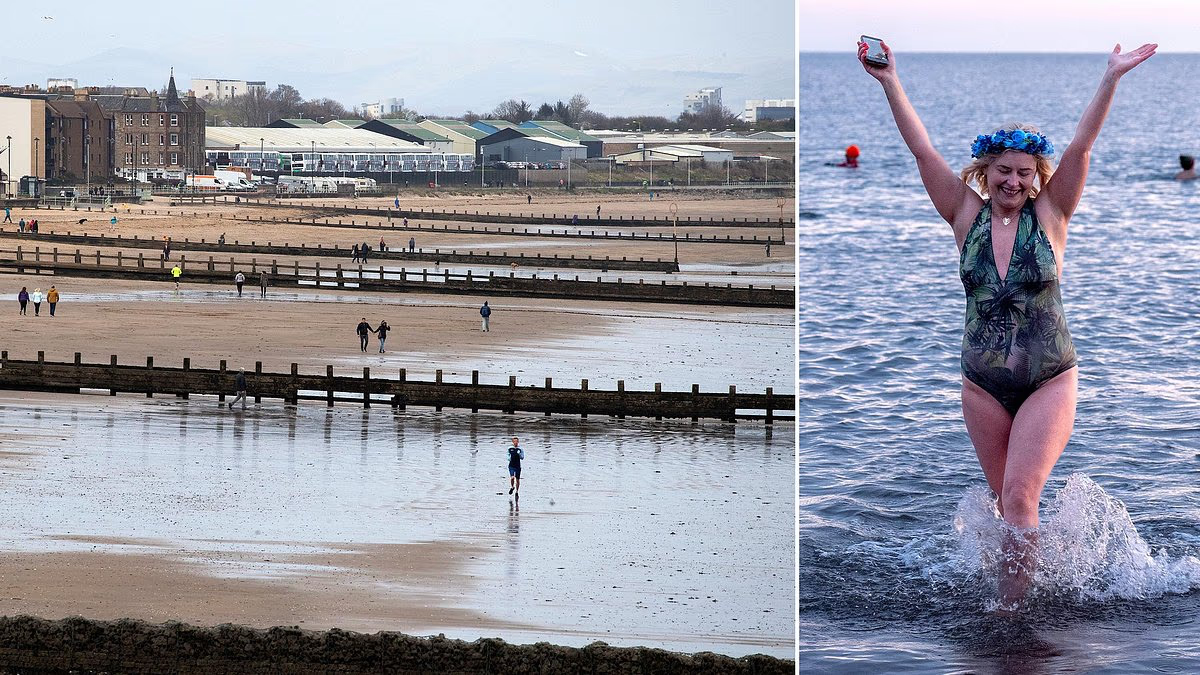

Wild swimming has become a much-loved pastime across Scotland, with people regularly braving the cold waters around the country’s coastline.
However, new figures show that almost half of Scotland’s designated wild swimming locations recorded pollution during the summer.
Between May and September, 44 of the 90 official bathing waters registered elevated levels of E-coli or intestinal enterococci (IE) at least once. Both bacteria can be found in human and animal waste.
Lower Largo in Fife, which remains classified as having ‘poor’ water quality, recorded the highest E-coli reading—at least 20 times above the recommended safety limit.
Portobello West beach in Edinburgh recorded the most significant reading for intestinal enterococci, with levels reaching 47 times the safe limit.
Exposure to these bacteria can lead to stomach illnesses, vomiting and other potentially serious health problems.

Portobello beach was one of four locations placed under no-swim orders earlier this summer

Lower Largo in Fife recorded an E-coli level at least 20 times higher than the safe limit
Lib Dem MSP Sanne Dijkstra-Downie, whose party secured the data, said the findings were ‘simply not good enough’ and urged the SNP Government to take the effects of sewage pollution in Scotland more seriously.
She said: ‘Thousands of Scots visit our bathing waters every year, including swimmers and pet owners. They should be able to enjoy the coastline without having to fear what may be in the water.
‘Pollution has contributed to repeated beach closures throughout the summer, yet regular water-quality testing is limited to those months, even though many of these sites attract visitors all year round.
‘This is simply not good enough. Whatever the time of year, people need reassurance that Scotland’s bathing waters are safe.’
Wild swimming has continued to expand in popularity, attracting increasing numbers of people to Scotland’s beaches, lochs and rivers. Those who take part say the outdoor activity can support both physical fitness and mental wellbeing.
Portobello beach, Kinghorn Harbour in Fife and Saltcoats beach in Ayrshire were among the locations issued with no-swim warnings earlier this summer.
The figures come after earlier reports revealed that sewage entered Scottish waters at least 23,672 times last year. In total, around 22 billion litres of wastewater were discharged into rivers, lochs and seas—enough to fill almost 9,000 Olympic-sized swimming pools.

Lib Dem MSP Sanne Dijkstra-Downie
The Scottish Environment Protection Agency, which is responsible for monitoring bathing-water quality, said official classifications are calculated using results gathered over a rolling four-year period. The assessment considers both average water quality and the full range of readings recorded.
A spokesman said: ‘For the 2026 bathing-water season, 86 of the 89 waters with an existing classification were rated sufficient or better, with 73 receiving a Good or Excellent rating.
‘This is Scotland’s highest recorded number of bathing waters rated Excellent for water quality, with 50 achieving that status compared with 17 a decade ago.’
The agency added that individual test results offer only a snapshot of conditions at the moment a sample is collected and should not be confused with the statutory bathing-water classification.
Sepa said it was now in the process of analysing monitoring data collected during 2026 to decide the classifications that will apply for the 2027 bathing water season, which will be published in November.
The Scottish Government said the country was ‘achieving good environmental outcomes’.
A spokesman added: ‘Ninety-seven per cent of bathing waters achieve the bathing water quality standard, with 82 per cent rated good or excellent. The water quality in our rivers and lochs is also improving with 86% of our entire water environment assessed by Sepa as having a ‘high’ or ‘good’ classification’.


