
Torrential hardly captures it. For the opening three months of the year, large swathes of the UK seemed to be trapped beneath an endless downpour.
In some areas, including Cornwall and the West Midlands, rainfall reached levels not seen in any winter since records began nearly 190 years ago. Across southern England, the total was 58 per cent above the seasonal average.
Yet, after the latest heatwave took hold last month, five water companies have brought in hosepipe bans — and further restrictions are expected to follow.
More than 11 million customers served by Southern Water, South East Water, Cambridge Water, Anglian Water and Affinity Water in the Home Counties have been told to stop using hosepipes, with possible fines of up to £1,000. Another 21 million people could soon be hit by similar curbs. Public anger has been sharpened by the revelation that water company executives have received £112 million in bonuses and incentive payments over the past ten years.
Even so, there are legal routes around a hosepipe ban. The Daily Mail, of course, would not encourage anyone to knowingly break the rules — although the threat of fines has so far proved largely theoretical. Since the Water Industry Act was introduced in 1991, no water company has actually imposed one.
In practice, it can still be lawful to use a hosepipe during a so-called “temporary use ban” because the rules contain a long list of exemptions. Much like Britain’s ageing water network — where leaks waste three billion litres a day, around 20 per cent of national supply — the system has plenty of gaps.
HEALTHY ALTERNATIVES
Customers can qualify for an exemption on a range of health grounds. Anyone who holds a Blue Badge, issued to disabled motorists, is automatically permitted to continue using a hosepipe without restriction.
Anglian Water is among the suppliers that also allow customers to effectively provide their own medical justification. Its Priority Service Register is open to everyone.

There are all sorts of ways to sidestep a ban on using hoses, while remaining within the law
Explaining their policy, Anglian say: ‘If you’re unable to make reasonable adjustments because of a health condition, disability or additional support need, you may be covered by an exception.’
A long list follows, covering some of the recognised exemptions: ‘A serious or long-term health condition; Dementia; A developmental condition; Dialysis treatment; A physical impairment; Restricted hand movement; A visual impairment; A temporary condition following a hospital stay; Additional support needs that make it difficult to make reasonable adjustments.’
They add: ‘If any of the above apply to you, you are automatically exempt. You do not need to apply for this or to let us know.’
Some of those exemptions cover very serious health problems. Others are more nebulous. The NHS classes both dyslexia and ADHD as ‘developmental conditions’, for instance. As for ‘a visual impairment’, this could arguably cover short-sightedness.
TRY BEING BOLD
If you are going to self-identify as a special case, you might need a thick skin. One contributor on the online MumsNet community complained at the weekend: ‘My NDN [next-door neighbour] has just demanded to see proof that we are exempt from the local hosepipe ban! I have said to them I won’t be showing them anything as it’s private but they can report me if they want and the water company can check.
‘We literally have just been filling a small paddling pool daily for the dc [darling children] for after school and today have a little sprinkler toy as it’s boiling. I’m so shocked they demanded proof!’
The responses to this indignant post last Saturday were varied: some reckoned the neighbours were busybodies and best ignored, others felt we should all ‘obey the spirit of the law’.
RECYCLING PROFICIENCY
It’s fine to run a hose from the bottom of a waterbutt, to recycle rainwater. You can also reuse bathwater, sometimes called ‘greywater harvesting’ and transfer it with a watering can or bowls – though the chemicals in soap and shampoo might harm plants. You could also consider placing a bucket under your shower while it warms up to catch water for reuse in the garden.
DIG FOR VICTORY
Useful exceptions apply in the garden. Food is regarded as more important than inedible plants, so companies won’t protest if allotments or home gardens need a hose for their vegetables, especially if the size of the plot makes a watering can impractical.
MORE STORY: Fittest US Cities: Democrat-Led Metros Top Health Rankings
PIPE UP
A fixed irrigation system, one that sprays water from holes in a pipe, is also permitted. It might seem strange that a handheld hosepipe is banned, while one that doesn’t move is allowed, but that’s all in the rules.
However, gardeners employing this system are expected to confine use to off-peak hours (usually the middle of the day), and to fit a pressure-reducing valve that slows the flow.
SPLASH IT ON ALL OVER
There is no limit to the number of times you can fill up the watering can to ensure flowerbeds don’t bake dry.
And you can even use a hosepipe on young trees, saplings, whips and hedging planted within the past three years.
New lawns, too, can be watered with a hose sprinkler for 28 days after being laid. This is to help the grass seedlings bed in and take root.
HIGHLY CONSTRUCTIVE
Builders are able to use the hose to mix cement but not to wash down walls and paving stones. Professional cleaning companies are allowed to wash down paths and patios, providing this is done for health and safety reasons.
IN THE SWIM
Paddling pools can still be topped up by buckets and swimming pools by a hosepipe but only if they are being filled for the first time following construction. Using a bucket to wash the car is also allowed. Commercial car washes are not affected either, so it’s all right to pay for a pressure wash and wax.
SINKING FEELING
Sad news for boat lovers: cleaning your tub with a hosepipe is banned in most affected areas. The exception is enclosed spaces on your private leisure boat – a handy loophole if you need to clean the indoor spaces, cabins or engine rooms – but no hosing down the decks.
CANNY CARAVAN
If you own a motorhome, you’re allowed to use a hose to top up the water tank, to ensure you have enough for flushing the toilet, filling a sink and so on. Washing the vehicle with a hose is not allowed, though.
DOWSE AND HOME
If you have your own private water supply, you can legally extract up to 20 tons a day. That’s roughly 5,000 gallons. The drawback is you’ll have to locate the source first and then probably sink a borehole. One surprisingly effective way to find underground water is to do as people have done for thousands of years and dowse for it.
Clip two lengths of wire from old coathangers and bend them into L-shaped rods.
Loosely holding one in each hand, parallel to each other like pretend ray-guns, walk up and down the garden. If you go over running water, the rods will twitch in your hands and cross over at the tips. It’s even worked for people who think it’s nonsense!
Once you’ve found the water, you’ll have to dig for it. Psychics gifts won’t be much use here. You’ll need a spade.
OPEN DAY
Gardens that are open to the public are allowed to use as much water as needed to keep blooming. This includes sprinklers and hosepipes.
There’s nothing to stop you from proclaiming your pocket handkerchief of lawn to be a national treasure and welcoming visitors – though don’t start charging for tickets. That’ll get you in all sorts of trouble with the council.
PET WHEEZE
Perhaps most importantly of all, hoses can be used to keep animals safe, clean and healthy.
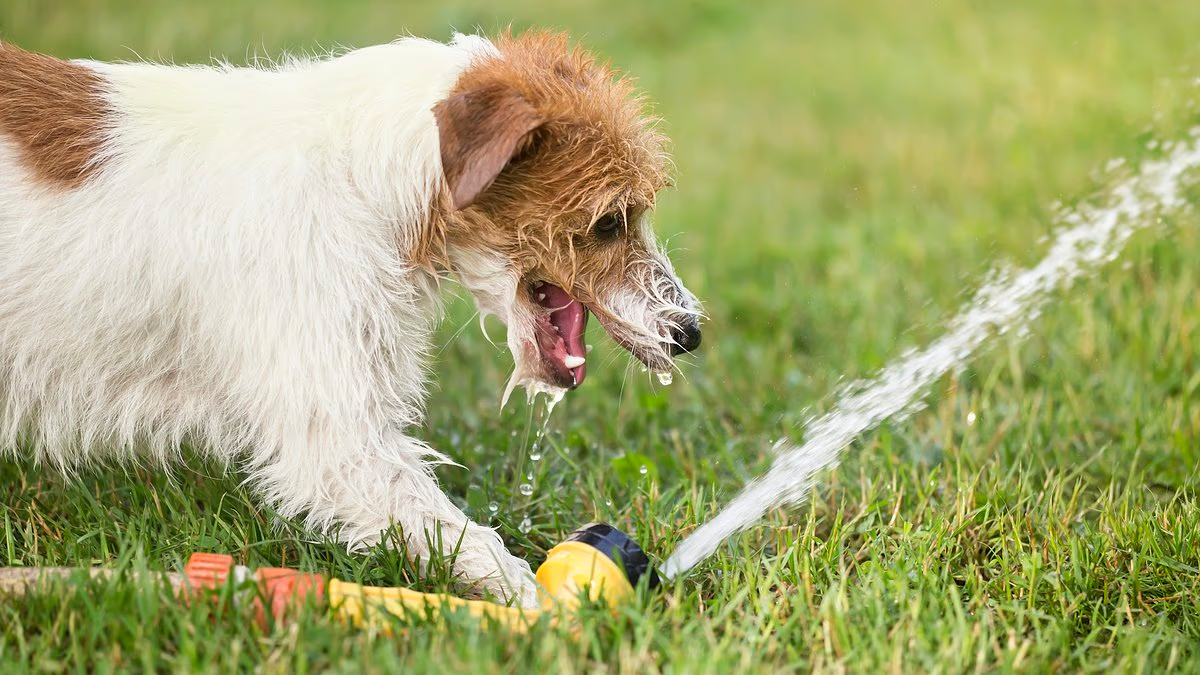
This means water troughs and other drinking containers can be filled and pets can be hosed down to help them keep cool – or to keep them clean. This includes sluicing out pens and stables with a hose.
OFF THE HOOK
The rules also allow for fishponds to be topped up with hoses. Some ponds use fountains to keep the water oxygenated and this is also permitted. However, merely ornamental fountains need to be switched off.
Here, as in so many other cases, there’s a crafty workaround. Fountains may be kept splashing if they have a religious or spiritual significance. You can be quite sure no one from the water company is going to challenge that.


