
The US Army has released dramatic footage of preparations to destroy nearly 10,000 pounds of dangerously unstable explosives in Iowa, as officials warn that toxic material could spread beyond the detonation site.
Two controlled blasts are scheduled to begin at about 9am CT on Wednesday at the Iowa Army Ammunition Plant near Middletown.
Officials say their goal is to achieve a “zero release” of toxic compounds. However, Army projections indicate that hazardous lead particles could spread across about 150 square miles of Midwestern farmland and potentially reach Missouri.
Middletown residents and people living within a five-mile cone southwest of the plant have been told to leave temporarily. Those farther southwest, in areas that could be affected up to 20 miles away, have been advised to shelter indoors.
Iowa health officials are urging people in potentially affected areas to remain inside with all windows and doors closed for 24 to 48 hours after the blasts. The guidance could keep some families indoors through Thanksgiving.
The risk does not end once the airborne plume has passed. Lead particles could settle on outdoor surfaces, and Army guidance advises residents to wet-clean children’s play equipment, patios and other frequently touched areas once officials say the airborne exposure period has ended.
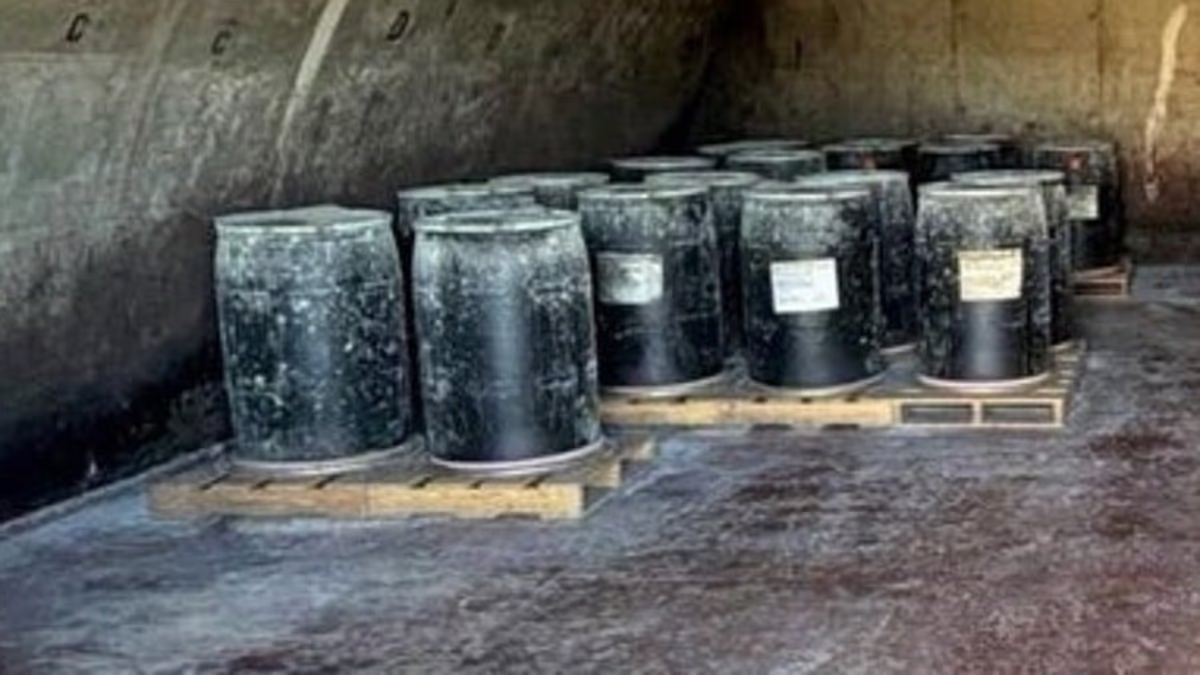
The Army footage shows preparations to destroy 68 drums of degraded lead azide inside earth-covered concrete bunkers. The structures are surrounded by towering sand-filled barriers intended to absorb the explosions and reduce the escape of debris and dust.
In one bunker, more than two dozen barrels are arranged in rows on wooden pallets beneath an arched concrete roof. Black drums line both sides of a central aisle, with pale residue visible on their lids and sides. A pallet jack is positioned near the entrance, while patches of white material cover parts of the floor.

The US Army has released images of barrels containing the explosive material scheduled for detonation on Wednesday morning

More than two dozen barrels sit in rows on wooden pallets inside one of the bunkers, beneath an arched concrete ceiling

An emergency alert urged residents five to 20 miles from the Iowa Army Ammunition Plant in Middletown (pictured) to remain indoors with windows closed ahead of Wednesday’s 9am detonation
The Army said on Tuesday: “Deposition of lead-containing dust may occur after the detonation on surfaces within certain areas affected by the detonation’s dispersion.”
“All people, but especially infants, children, pregnant women, adults and children with chronic diseases such as heart disease, kidney disease, or dementia, should avoid outdoor activities within affected areas until further guidance.”
Exposure to sufficiently high levels of lead can cause permanent damage to children’s developing brains, contributing to learning difficulties, lower intelligence and behavioral problems. It can also cause miscarriages.
The Army’s latest projection shows that hazardous dust from the detonation could travel as far as Clark County, Missouri, about 50 miles southwest of Middletown.
All Middletown residents are being asked to leave temporarily. FEMA is providing transportation, meals and hotel accommodation through Friday, covering the Thanksgiving holiday.
The Army said lodging would be available through Friday, November 27.
Evacuees will receive phone calls when officials issue the all-clear. Residents in potentially affected areas outside the evacuation zone are being encouraged to shelter indoors.
Farmers face additional concerns involving livestock, animal feed and water supplies that may be difficult to protect. Iowa agriculture officials have advised moving cattle, feed and equipment indoors or to alternative locations whenever possible.

The earth-covered concrete bunker holding the explosives is covered with black sheeting and surrounded by towering, tiered walls of sand-filled barriers intended to absorb the blast and limit the spread of debris and lead dust

The Army plans to destroy the explosives inside reinforced concrete bunkers surrounded by sand barriers about two stories high
The Army said it had established extensive safeguards for Wednesday’s detonation of nearly five tons of unstable explosives in southeast Iowa, with federal and local agencies assisting in the operation.
Military personnel will destroy the explosives inside reinforced concrete bunkers enclosed by sand barriers that rise roughly two stories.
A “water wall,” gel blocks and water-based foam are intended to contain particles and absorb heat. Misters will also soak the surrounding soil before and during the detonation to reduce the amount of lead dust that becomes airborne.
The Army said the lead azide recrystallized during decades of storage, making it too sensitive to move safely and increasingly vulnerable to an uncontrolled explosion as temperatures drop.
Maj Gen Eric Shirley said at a news conference on Tuesday that “inaction is no longer an option,” adding that military specialists had been rehearsing the operation.