Share this @internewscast.com
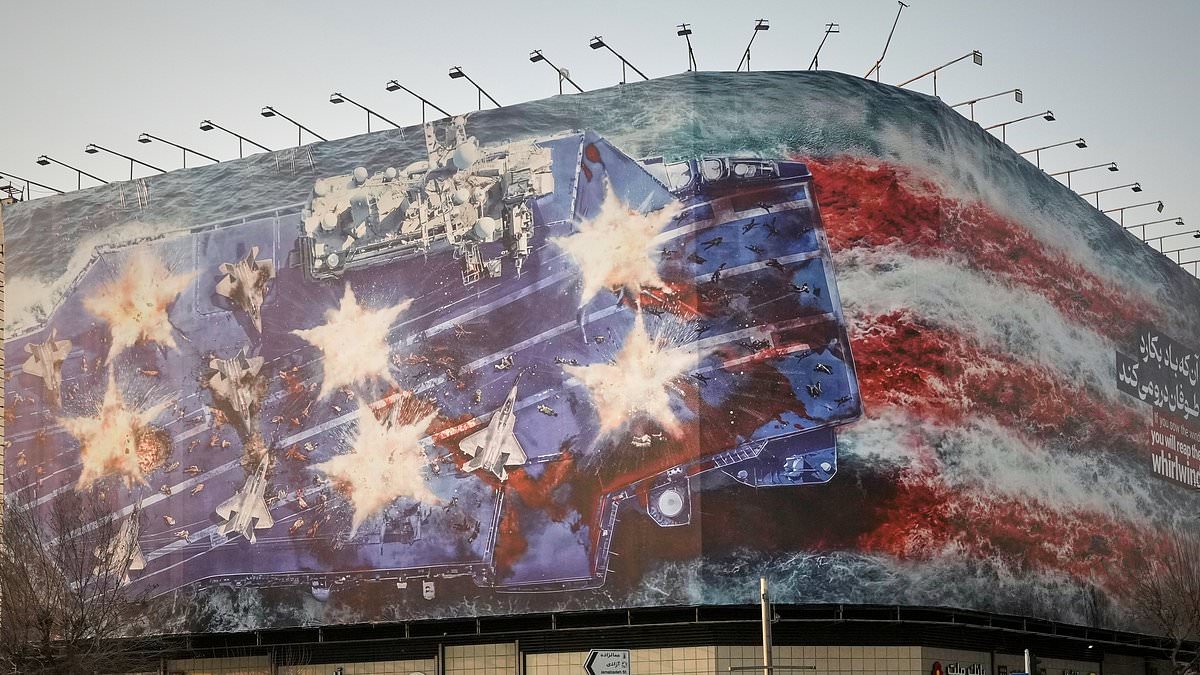
On Sunday, Iranian officials introduced a striking new mural in a central Tehran square, delivering a stern message to the United States: think twice before considering a military assault on Iran.
This bold artwork provides a dramatic aerial perspective of an aircraft carrier, its flight deck chaos-stricken with damaged and exploding fighter jets. The scene is further intensified by the depiction of lifeless bodies and blood flowing into the ocean, forming a pattern eerily reminiscent of the stars and stripes of the American flag.
Accompanying this vivid imagery is a prominent slogan: “If you sow the wind, you will reap the whirlwind,” underscoring the warning’s gravity.
The mural’s unveiling in Enghelab Square occurs amidst heightened tensions, as the USS Abraham Lincoln, along with its fleet of warships, edges closer to the region. President Donald Trump has stated that their presence is precautionary, should he choose to take action.
The unveiling of the mural in Enghelab Square comes as the USS Abraham Lincoln aircraft carrier and accompanying warships move toward the region.
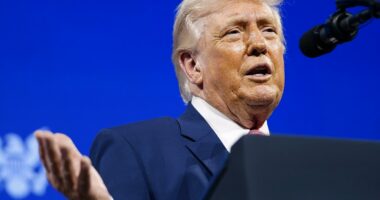
US President Donald Trump has said the ships are being moved ‘just in case’ he decides to take action.
‘We have a massive fleet heading in that direction, and maybe we won’t have to use it,’ Trump said Thursday.
Enghelab Square is used for gatherings called by the state, and authorities change its mural based on national occasions. On Saturday, the commander of Iran’s paramilitary Revolutionary Guard warned that his force is ‘more ready than ever, finger on the trigger’.

A billboard depicting a damaged US aircraft carrier with disabled fighter jets on its deck and a sign reading in Farsi and English, ‘If you sow the wind, you’ll reap the whirlwind,’ is seen at Enqelab-e-Eslami (Islamic Revolution) Square in Tehran, Iran, Sunday, January 25

US President Donald Trump has said the ships are being moved ‘just in case’ he decides to take action against Iran

Families and residents gather at the Kahrizak Coroner’s Office confronting rows of body bags as they search for relatives killed during the regime’s violent crackdown on protests
Tension between the US and Iran has spiked in the wake of a brutal crackdown on nationwide protests that saw thousands of people killed and tens of thousands arrested.
Trump had threatened military action if Iran continued to kill peaceful protesters or carried out mass executions of those detained.
There have been no further protests for days, and Trump claimed recently that Tehran had halted the planned execution of about 800 arrested protesters — a claim Iran’s top prosecutor called ‘completely false’.
But Trump has indicated he is keeping his options open, saying on Thursday that any military action would make last June’s US strikes on Iranian nuclear sites ‘look like peanuts’.
US Central Command said on social media that its Air Force F-15E Strike Eagle now has a presence in the Middle East, noting the fighter jet ‘enhances combat readiness and promotes regional security and stability’.
Similarly, the UK’s Ministry of Defence said Thursday that it deployed its Typhoon fighter jets to Qatar ‘in a defensive capacity’.
The protests in Iran began on December 28, sparked by the fall of the Iranian currency, the rial, and quickly spread across the country. They were met by a violent crackdown by Iran’s theocracy, which does not tolerate dissent.
The death toll reported by activists has continued to rise since the end of the demonstrations, as information trickles out despite a more than two-week internet blackout — the most comprehensive in Iran’s history.

Protesters set fire to a car in Tehran. Even by the regime’s own estimates, between 2,000 and 3,000 have been killed – but new figures have put the death toll at more than 33,000

Supreme Leader Ayatollah Ali Khamenei attends a meeting in Tehran, Iran, last week

A woman holds up a placard as she stands in front of a pre-1979 Islamic Revolution Iranian flag during a demonstration in solidarity with Iranian protestors, in Israel’s central city of Holon on January 24, 2026
It comes after it was revealed last night that more than 33,000 protesters had been killed in Iran following the regime’s brutal crackdown on anti-government demonstrations, Time reports, quoting two senior officials working for the country’s Ministry of Health.
The death toll from the anti-government protests, which began on December 28, was previously estimated to be between 16,500 and 18,000.
Alongside the death toll, 97,645 have been wounded, with 30 per cent suffering eye injuries, according to research by Professor Amir-Mobarez Parasta.
The German-Iranian ophthalmic surgeon added that the regime was executing protesters.
Hospital admissions data showed 468 were put to death in the capital Tehran alone, with more than 500 across the country.
Heavily armed trucks were seen patrolling Tehran on Saturday after being deployed to protect government sites.
Alongside the prospect of a military attack from the US, the Iranian regime is in danger of suffering further financial pain.
Trump has warned that any country doing business with Iran will pay a 25 per cent tariff on trade with the US, effective immediately.

Heavily armed trucks seen patrolling Tehran on Saturday after being deployed to protect government sites

Exiled crown prince Reza Pahlavi says he wants to ‘turn power back’ to Iran’s citizens
The UK has also applied pressure on the regime.
Earlier this month, Foreign Secretary Yvette Cooper spoke to Mr Araghchi and called on the Iranian government to ‘immediately end the violence, uphold fundamental rights and freedoms and ensure British nationals are safe’.
But ministers have come under pressure to act as more than 100 protesters gathered outside Downing Street on Saturday to call on the Government to proscribe the Islamic Revolutionary Guard Corps (IRGC).
Keir Starmer has refused to make it illegal to support the group because he believes it will have no effect and would only make Britain feel ‘better about ourselves’.
Downing Street said the prime minister ‘utterly condemns’ the violence being used by the authorities in Iran.
Meanwhile, the country’s exiled crown prince of Iran has vowed to seize the power ‘taken by this regime’ and put it back into the hands of its citizens.
Reza Pahlavi, whose fatally ill father fled Iran just before the country’s 1979 Islamic Revolution, reiterated his ‘unwavering commitment to democracy and human rights’.
During a press conference on January 16, he told reporters: ‘This has been my position the day I started and remains my position to this day.
‘They [the Iranian people] know they can trust me because I’ve never wavered from this and ultimately what I’m trying to make sure is the final element that will prove to the Iranians that are in full control of their own destiny is to turn power back to them – a power that has been taken away from them by this regime which we are fighting today.
‘That’s my commitment, and they can trust me on that.’
Mr Pahlavi also encouraged protesters, who have chanted slogans including ‘Death to the dictator!’ and ‘Death to the Islamic Republic!’ – to make their voices heard.
‘Great nation of Iran, the eyes of the world are upon you. Take to the streets and, as a united front, shout your demands,’ he said in a statement earlier this month.
‘I warn the Islamic Republic, its leader and the (Revolutionary Guard) that the world and (US President Donald Trump) are closely watching you. Suppression of the people will not go unanswered.’