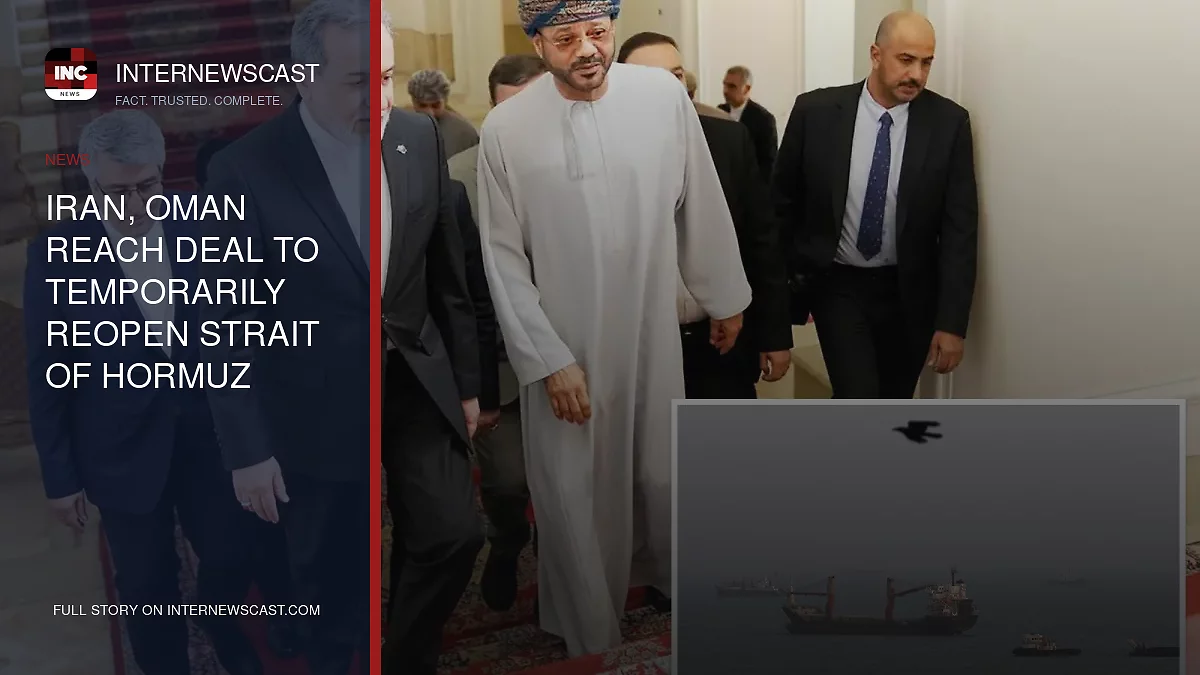

Iran and Oman have agreed to a temporary reopening of the Strait of Hormuz, according to an Iranian official, as the two neighbors prepare to keep diplomatic talks moving in hopes of securing a longer-term arrangement for the vital maritime route.
In a joint statement issued Tuesday, the countries outlined how vessel movement would be handled through the strategically important waterway, where officials have previously floated the possibility of operating traffic under a toll-based system.
“The proposed framework includes the establishment of a joint temporary navigational corridor through the Strait of Hormuz and an agreement to implement a joint project to clear the Strait of mines,” the two governments said.
They added that “technical negotiations between the two sides would continue with a view to agreeing on a permanent navigational corridor and future administration of the Strait, as well as a mechanism for information-sharing, traffic management, and the provision of relevant navigational and security services.”
Under the temporary plan, ships entering the Persian Gulf from the Gulf of Oman would travel through Iranian territory. Vessels heading out would use a route that runs partly through Iranian waters and partly through Omani waters.
Iranian Deputy Foreign Minister Kazem Gharibabadi told state television that Tehran and Muscat would continue discussions over the coming months as they work toward “an understanding on a new permanent and sustainable route.”
Omani Foreign Minister Sayyid Badr bin Hamad al-Busaidi struck an upbeat tone, saying he remained hopeful the Strait of Hormuz — which had been freely open to navigation before the war — could reopen soon. He also described his talks with Iran’s foreign minister as constructive.
Still, Iran cautioned that the agreement with Oman does not mean shipping through the Strait of Hormuz will immediately return to normal, arguing that the waterway will only be fully open once the United States accepts Tehran’s peace conditions.
That would include lifting the naval blockade on Iranian ports and removing the sanctions barring Iran from selling oil at market prices.
President Trump has warned against such a move, and even threatened to bomb Oman, a US ally, if it “gets in the way.”
The joint statement from Tehran and Muscat comes as Pakistan army Chief Asim Munir and Interior Minister Mohsin Naqvi met with Iranian officials in Tehran as part of Islamabad’s mediation efforts.
The officials claimed the talks led to major progress to end the war in Iran, which is approaching its seventh month.
“Significant progress was made, and the meeting concluded on a highly positive note. We remain hopeful that this momentum will help pave the way for further progress and lasting peace in the region,” Naqvi wrote on X.
Munir had spoken with Trump ahead of the talks in Tehran, Reuters reported.
Trump on Tuesday announced that “every square inch” of the Strait has been completely de-mined and that the waterway was being monitored by the US Space Force for potential new explosives.
“There is a Zero Tolerance policy on mine placement in full force and effect,” Trump added. A source told The Post that the number of mines, their types and locations were a closely held secret.
With Post wires


