
An Iranian militia commander accused of coordinating a series of antisemitic attacks in Britain has continued plotting terrorist operations from prison, according to US authorities.
Mohammad Baqer Saad Dawood al-Saadi allegedly orchestrated at least 18 terror attacks across Europe and North America since February.
Prosecutors say he was the mastermind behind the firebombing of a London synagogue and the stabbing of two Jewish men in Golders Green.
Al-Saadi was arrested in Turkey and later transferred to the United States. Authorities now allege that, despite being behind bars, he has attempted to recruit additional proxies amid fears of further attacks.
Officials have warned that the 32-year-old uses “coded language” during telephone calls from detention to pass on instructions. They also allege that he has directed more than $1 million in financial transfers.
The FBI has further accused al-Saadi of approving propaganda videos intended to inspire other militants.
Al-Saadi, who holds Iranian and Iraqi citizenship, faces eight terrorism-related charges over his alleged work as an operative for the Iraqi militia Kataib Hezbollah and Iran’s Islamic Revolutionary Guard Corps.

Mohammad Baqer Saad Dawood al-Saadi, accused of planning an attack on a synagogue, appears in federal court in Manhattan
He is also charged with conspiring to provide material support to Harakat Ashab al-Yamin al-Islamiya, known as Hayi. The Iran-backed Iraqi Shia militant group is alleged to have carried out nearly 20 attacks across Europe in less than three months.
The US government has designated all three organisations as foreign terrorist organisations.
Al-Saadi is additionally accused of supervising a plot to kill Jewish people at synagogues in the United States.
During questioning, he reportedly told FBI agents that he was a “leader of the resistance”, a network that included the IRGC and its proxy groups.
The suspect is expected to stand trial next summer.
The FBI claims that, while in detention, al-Saadi used telephone calls to communicate with Iranian proxy groups, The Times reported.
During a FaceTime call with a woman believed to be his mother, he was reportedly heard saying: “We shall not care whether we fall upon death or death falls upon us as long as we are on the path of truth.”
The same quote later appeared on social media accounts known for sharing IRGC propaganda and was viewed more than 96,000 times.
In another call with relatives in July, al-Saadi was allegedly heard asking about a senior member of the Kata’ib Hezbollah militia.
He also allegedly instructed his family to transfer more than $1 million to unidentified recipients.
One conversation was interrupted by the FBI after agents heard references to a gun and al-Saadi saying: “Give him money so we can do it.”
The Department of Justice said it was concerned that al-Saadi may be using the calls to plan additional terrorist attacks in Europe or North America.
Al-Saadi has complained about his ‘illegal capture’ and his subsequent detention, which involves near-solitary confinement and restricted contact with family.
Authorities say the measures are necessary to stop him from engaging in terrorism.
He also complained about the quality of the halal food in jail and his lack of Arabic reading materials.
Federal Defenders of New York, his lawyers, said: ‘By keeping Mr al-Saadi in extreme solitary confinement and aggressively curtailing his access to information, the government is violating his rights under the constitution and the third Geneva Convention. We will continue to vigorously challenge these inhumane conditions.’
Al-Saadi’s defence lawyers claim that he was joking with his sister when he referenced the gun, saying his brother-in-law was being forced into a shotgun wedding.
DISCOVER MORE: Bar Plans Watch Party for Livestreamed Terrorist Execution
They argued he should be treated as a prisoner of war rather than a criminal detainee.

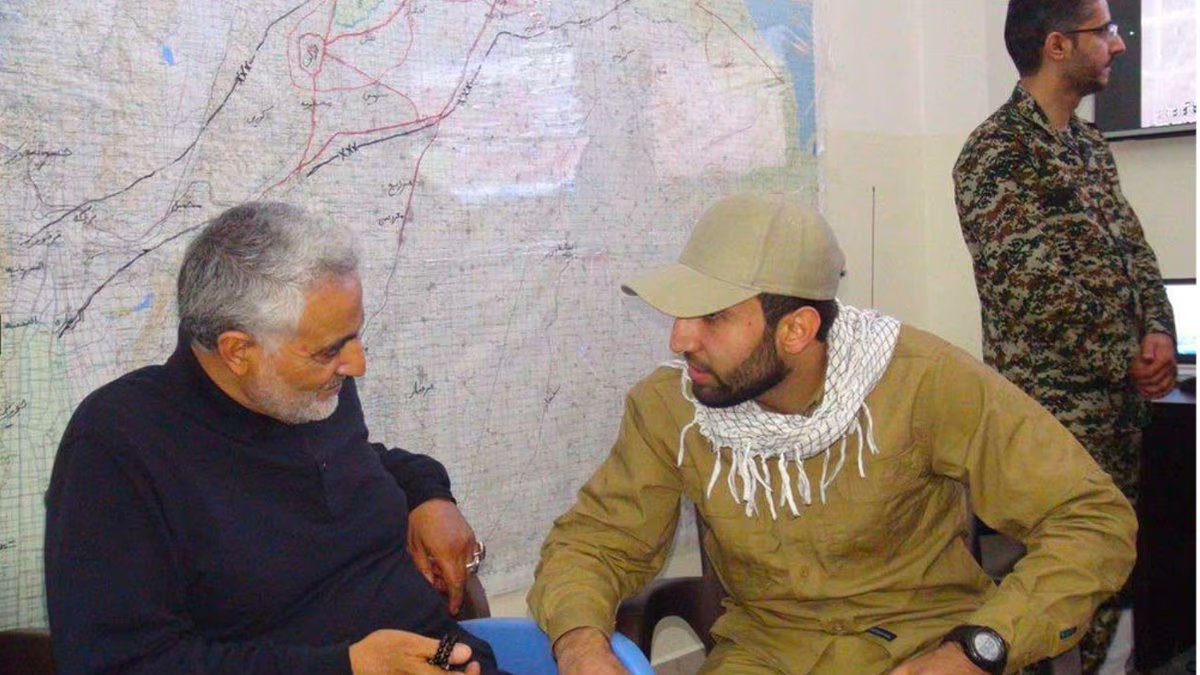
Mohammad Baqer Saad Dawood Al-Saadi, right, with Qasem Soleimani, former commander of the Iran’s Islamic Revolutionary Guard Corps’ Quds Force
Al-Saadi was captured in Turkey through phone calls with an FBI informant who he believed was a fellow jihadist.
He provided the law enforcement officer with photos and maps of Jewish centres in Los Angeles and Scottsdale, Arizona, that he planned to target.
The informant connected him to someone he claimed was a Mexican cartel member and gun for hire who could carry out bombings of Jewish targets for money.
He offered the FBI agent, posing as a cartel member, $100,000 to attack a synagogue and told him the attack should be recorded.
FBI Director Kash Patel described Al-Saadi as a ‘high-value target responsible for mass global terrorism’ and said his arrest was the product of ‘a righteous mission executed brilliantly’ by the agency’s agents and law enforcement partners.
In his statement, Patel thanked U.S. Ambassador to Turkey Tom Barrack, calling him ‘instrumental in bringing this successful mission home to the United States.’
His lawyers claim Al-Saadi is being persecuted for his relationship with former IRGC leader Qasem Soleimani.
Soleimani was killed by the US in a drone strike in Baghdad on President Trump’s orders.
Al-Saadi had a picture with the former IRGC leader on his social media and had previously promised to avenge his death.
In 2021, he wrote: ‘An eye for an eye, a tooth for a tooth. And coming to Washington and Florida.’
Al-Saadi allegedly posted claims of responsibility for attacks on Snapchat and Telegram in the name of Hayi.
The terror group claimed responsibility for a wave of crimes across the west as they unfolded, but officials believe Hayi was ‘designed to carry out and further the terrorist goals of Kata’ib Hezbollah, and the IRGC’.
Hayi claimed responsibility for arson attacks including an Israeli restaurant in Munich and a synagogue in Skopje, Macedonia.
In the UK, a drone with the group’s logo was flown towards the Israeli embassy in London.
Kenton United Synagogue in Harrow, northwest London, was firebombed in April.
The Metropolitan Police arrested a 17-year-old boy and a 19-year-old man in connection with the attack.
Counter-terror police began investigating whether Iranian proxies were behind the attacks.
Harakat Ashab al-Yamin al-Islamia – the Islamic Movement of the Companions of the Right – claimed responsibility for the Kenton ‘firebomb’ attack. The pro-Iran group, also known as Hayi, released video footage of a man walking up to the building with what appears to be petrol bomb and hurling it at the site.
The Amsterdam attack caused a fire and significant damage to the building, but no injuries, according to local media reports.
It followed an explosion outside a Jewish school in Amsterdam, which Al-Saadi celebrated on Snapchat with an Ashab al-Yamin-branded video showing the blast and the assailants fleeing on a motorcycle, the criminal complaint said.
In Paris, police found a homemade bomb consisting of a gasoline-filled container taped to a powerful firework.
Forensic experts said the device contained 650 grams (about 23 ounces) of explosives and that it could have produced a large fireball and ignited a significant blaze.