
After Tiger Woods walked away with what many will see as an extraordinarily generous plea agreement, one response is hard to shake: anger.
For an ordinary driver with the same history on the road, would the outcome look anything like this? Would a reduced charge, no jail time and a potential path back to a driver’s license really be on the table?
Or would a regular defendant be facing a cell instead?
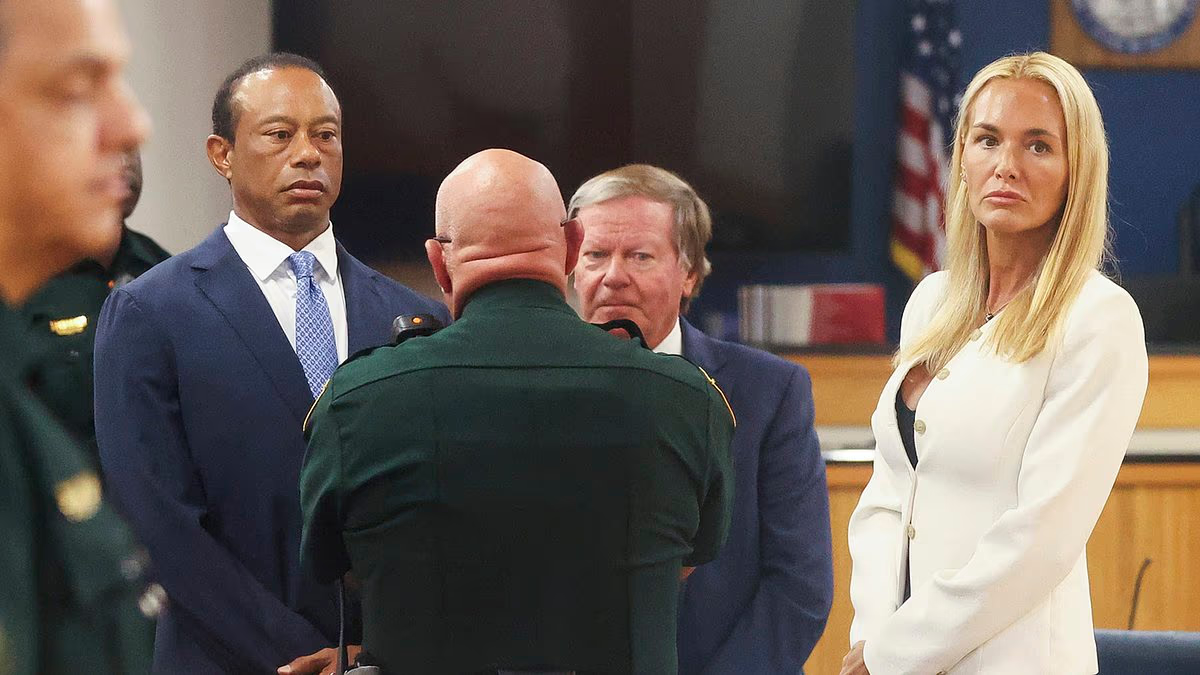
On Wednesday, Woods, the 50-year-old golf icon and five-time Masters winner, appeared in a Martin County, Florida, courtroom with his girlfriend, Vanessa Trump, at his side.
The case stemmed from a frightening rollover crash in March near his home in Jupiter Island, Florida, after which Woods was initially charged with driving under the influence.
Under the deal, Woods pleaded no contest to reckless driving, received a $1,500 fine and saw a separate charge tied to his refusal to provide a urine sample reduced. His driver’s license was also suspended for five years.
Judge Darren Steele told Woods the suspension was imposed “for the safety of the public.”
Precisely.

On Wednesday, the 50-year-old, five-time Masters champion appeared in a courtroom in Florida’s Martin County with girlfriend Vanessa Trump by his side

Woods had initially been charged with driving under the influence in connection to a terrifying rollover crash near his home in Jupiter Island, Florida in March (Pictured: Police body camera video released by the Martin Sheriff’s Office)
But why should he ever be allowed back in a driver’s seat?
Driving is a privilege and a two-ton vehicle can become a lethal weapon. The rest of us have rights, too, including the right to drive home without a speeding SUV hitting our car out of nowhere.
That is what appears to have happened in March, when Woods reportedly attempted to overtake a truck towing a trailer on a two-lane road, clipping the trailer and causing his Land Rover to roll over. Woods had to climb out of the passenger door to escape the accident.
Thankfully, nobody was killed or injured.
Outrageously, rather than showing abject remorse, Woods appeared to play up his celebrity and political connections.
In a moment captured on police bodycam shortly after the crash, the golf icon hung up his cellphone and told a deputy: ‘I was just talking to the president.’
It has never been publicly confirmed that he meant President Donald Trump, but the two men are longtime friends and Woods is, of course, dating Trump’s former daughter-in-law.
Asked about Woods after the arrest, Trump said, ‘I feel so badly… He’s got some difficulty. There was an accident and that’s all I know. A very close friend of mine. He’s an amazing person, amazing man.’
Police said Woods had bloodshot eyes and dilated pupils and struggled with field sobriety exercises. Two hydrocodone pills were found in his pocket. Woods, who had a prescription for the opioid, admitted taking medication, passed a Breathalyzer and refused a urine test.

In a moment captured on police bodycam shortly after the crash, the golf icon hung up his cellphone and told a deputy: ‘I was just talking to the president’

Woods reportedly attempted to overtake a truck towing a trailer on a two-lane road, clipping the trailer and causing his Land Rover to roll over
Prosecutors ultimately concluded they could not prove beyond a reasonable doubt that he was impaired, citing, among other factors, his tolerance to hydrocodone. And so the DUI charge went away.
Legally, perhaps prosecutors made the deal they believed the evidence warranted. But the rest of us are allowed to look at the bigger picture.
The March crash was not Tiger’s first alarming accident. Not his second. Not even his third. It was his fourth major driving incident in 17 years.
In 2009, Woods smashed his Cadillac Escalade into a fire hydrant and tree outside his Florida home at 2.25 in the morning. He was cited for careless driving and fined $164.
That surprising car crash became the opening scene of an even more spectacular personal implosion. His serial infidelity was exposed, his marriage to Elin Nordegren collapsed and the former world number one subsequently spent weeks in treatment.
Surely, that would have been enough of a wake-up call.
In 2017, police found Woods asleep behind the wheel of his Mercedes on the side of a Florida road with the engine running.
The golf great reportedly appeared confused and unsteady and failed field sobriety tests. A toxicology report later showed Vicodin, Dilaudid, Xanax, Ambien and THC in his system. Woods said he had been trying to manage severe back pain and insomnia and later sought professional treatment for his use of prescription medication.

In 2009, Woods smashed his Cadillac Escalade into a fire hydrant and tree outside his Florida home at 2.25 in the morning (above)

In 2017, police found Woods asleep behind the wheel of his Mercedes on the side of a Florida road with the engine running
He was charged with DUI. And once again, the DUI charge disappeared.
Woods pleaded guilty to reckless driving, entered a court-supervised treatment and probation program and avoided jail.
Second chance? Fine. But how many second chances can one person have?
Four years later came the crash that nearly killed him.
In February 2021, Woods was driving a Genesis SUV in Southern California when he veered off the road at high speed, crossed the median and plowed through landscaping before the vehicle came to rest, badly mangled.
Firefighters had to extricate him from the vehicle. His right leg was shattered.
Authorities found no evidence that Woods was impaired, but investigators did find something else alarming: The father of two had been driving as fast as 87 mph on a road with a 45-mph speed limit. Nearly twice the limit.
He wasn’t cited for speeding because sheriff’s officials said the black-box data alone was not enough to issue a citation.
So once again, no criminal consequences.
If almost losing a leg after driving at nearly twice the speed limit doesn’t persuade a person to hand over the car keys for good, what does?
Of course, Woods deserves help, and I hope he gets it. Substance dependency and chronic pain are serious medical issues, and the 15-time major champion has endured an almost unimaginable number of surgeries and injuries. But having sympathy for those struggles and responding to repeated incidents of dangerous behavior with little consequence are two entirely different things.
A five-year license suspension may sound like a serious punishment on paper.

In February 2021, Woods was driving a Genesis SUV in Southern California when he veered off the road at high speed (above)

Firefighters had to extricate Woods from the vehicle. His right leg was shattered
For Tiger Woods, it seems to me, it is barely an inconvenience.
For most Americans, losing a driver’s license is devastating. It could mean losing a job because you can no longer get to work. It could mean struggling to take your children to school, go to a doctor’s appointment or buy groceries.
For Woods, it means sitting in the back of an SUV instead of the front. This is a man Forbes has declared a billionaire. He could employ a full-time chauffeur around the clock and barely notice the expense. So what exactly is the hardship here?
That reality makes this decision by Florida prosecutors even harder to understand. Tiger will be 55 when he is eligible to drive again.
What exactly are we expecting to change by then that public humiliation, divorce, rehabilitation, a previous DUI arrest, a reckless-driving conviction and almost dying in a catastrophic crash did not?
Maybe this time he’ll finally learn his lesson?
We’ve been saying some version of that since 2009.
Take away his license permanently. In fact, someone may want to keep an eye on the golf cart keys, too.
Frankly, after this many crashes, reckless decisions and second chances, maybe jail time is the only penalty that will finally get through to him.
At some point the question stops being how many chances Tiger Woods deserves. It becomes how many chances the rest of us should be expected to take.