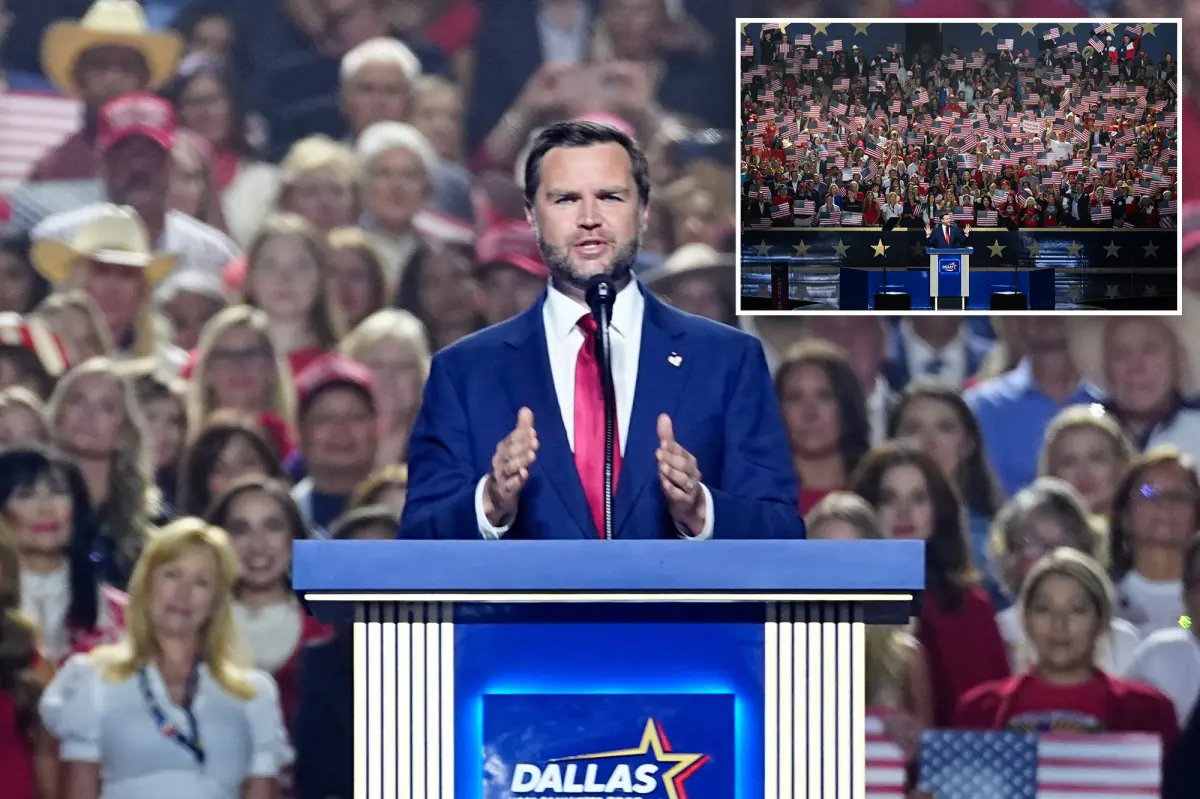

Vice President JD Vance told The Post Monday that the Trump administration’s agenda will be at stake in the 2026 midterm elections, urging Republicans to turn out at presidential-year levels to keep the “crazies” at bay.
During an exclusive interview aboard Air Force Two, Vance said voters in President Trump’s coalition have not yet turned out for Republicans in off-year elections at the rate needed to preserve the party’s control of Congress. He is working to change that pattern ahead of the midterms.
“I really think it’s important to kind of get people to think that … in many ways the president is on the ballot. Yes, I’m on the ballot too, but the entire agenda is on the ballot,” Vance told The Post. “Hopefully that will generate some enthusiasm.”
“The enthusiasm normally just isn’t there among a lot of our voters for midterm elections; we’re hoping we can get it there this time around,” the vice president added.
Republicans are confronting the traditional disadvantages faced by the party in power. The latest RealClearPolitics polling average shows Democrats leading by more than eight percentage points on the generic congressional ballot this election cycle.
That margin is similar to the Democratic Party’s advantage before the 2018 midterms, when Democrats led by more than seven percentage points heading into Election Day during Trump’s first term.
Before Republicans flipped the House in 2022, the GOP held an average two-and-a-half-point advantage over Democrats.
“The Republican coalition has two different turnout realities,” said Brent Buchanan, CEO and data and insights pollster at Cygnal.
“Trump Republicans are still highly engaged, while traditional conservatives are 26 points less likely to say they are excited to vote, and they are the group Republicans cannot afford to leave behind,” Buchanan added.
“They do not need another recap rally of what has already happened,” Buchanan said. “They need to hear what the party will do next to make life more affordable, more stable, and more workable for their families. That is the turnout fight Republicans have to win.”
Trump is seeking to overcome those headwinds by holding the first-ever GOP midterm convention in Dallas last week to build enthusiasm. He has also launched an unusual mid-decade redistricting effort that could give Republicans roughly 11 additional seats under new congressional maps. Democrats need only three more seats to take control of the House.
Midterm elections typically draw fewer voters than presidential contests. University of Florida data show that 64.3% of the voting-eligible population participated in the 2024 presidential election, compared with 46.1% turnout in the 2022 midterms.
According to projections shared by a national GOP strategist familiar with Trump’s political operation, the former president does not need every one of his 2024 voters to keep Republicans in control of the House and Senate. But if he increases turnout by 2 to 4 percentage points in each competitive race above typical midterm levels, the party will hold both chambers.
“We’re very bullish” about reaching that turnout target, the strategist told The Post.
Trump made the same appeal during his convention speech, urging members of the GOP base to “pretend” that he is on the ballot this year.
The Post asked Vance whether voters should start thinking about him at the top of a presidential ticket someday too, but the 2028 GOP frontrunner deflected: “I like the way the president puts it.”
“The good news is: a lot of new voters, a whole lot of excitement, enthusiasm from a broad group of people, I mean, frankly, a much more diverse group of people than traditional Republicans have gotten,” the vice president said of the MAGA base.
“The bad news is they show up for Trump; they haven’t yet shown up for Republicans,” he added. “And I think what the president’s trying to do is remind them that the Trump agenda doesn’t work if you elect a bunch of crazy people to Congress.”
In his own speech at the midterm convention, Vance urged the GOP to send the “crazies … packing” on Nov. 3, claiming Democrats were no longer “just the party of a little higher taxes, maybe some dumb regulations.”
“They’re not the party of FDR or JFK. Hell, they’re not even the party of Bill Clinton anymore,” he said. “The Democrats are the party of hatred. They’re the party that despises America and the people who built it.”
The vice president’s rhetoric indicated a play for the swing vote, in addition to the Republican base, according to Henry Olsen, a political analyst and senior fellow at the Ethics and Public Policy Center.
“I don’t believe it’s a base election,” Olsen said. “Turning out Republicans is necessary but not sufficient.”