
President Donald Trump’s global tariffs were declared illegal and blocked by a federal court on Wednesday in a massive blow to his administration.
The decision from a three-judge panel at the New York-based Court of International Trade followed multiple lawsuits by Democratic-led states and a coalition of small businesses, which contended that Trump improperly used an emergency law to legitimize the tariffs.
The court agreed, barring most of the restrictions that the president has announced since taking office.
Following the ruling, Asian stocks rose and U.S. futures surged, with the S&P 500 futures up 1.6% and the Dow Jones Industrial Average futures climbing 1.2%.
‘The Worldwide and Retaliatory Tariff Orders surpass any authority granted to the President by IEEPA to regulate importation by implementing tariffs,’ stated the court, referencing the 1977 International Emergency Economic Powers Act.
The White House blasted the decision, arguing that ‘unelected judges’ have no right to weigh in on Trump’s actions to address what the administration frames as a ‘national emergency.’
‘Foreign countries’ nonreciprocal treatment of the Unites States has fueled America’s historic and persistent trade deficits. These deficits have created a national emergency that has decimated American communities, left our workers behind, and weakened our defense industrial base – facts that the court did not dispute,’ White House spokesman Kush Desai said.
‘It is not for unelected judges to decide how to properly address a national emergency. President Trump pledged to put America First, and the Administration is committed to using every lever of executive power to address this crisis and restore American Greatness.’

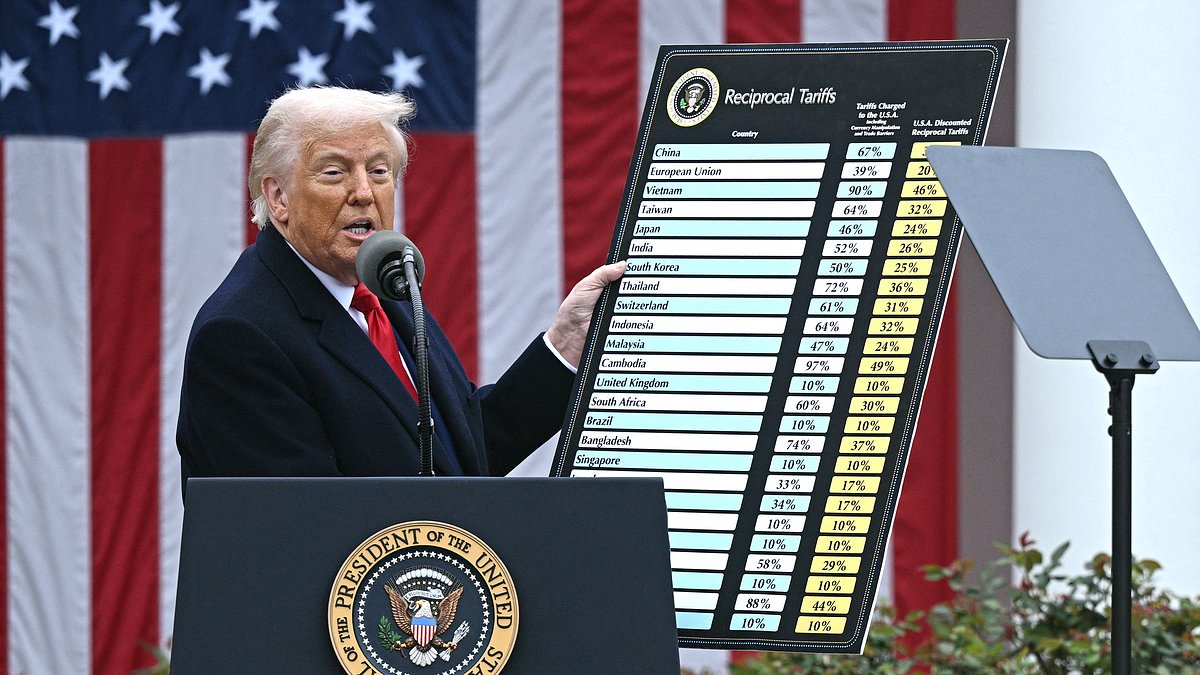
President Donald Trump’s tariffs dealt massive blow – above he announces his plan

A cargo ship loads and unloads foreign trade containers at Qingdao Port in China
One of Trump’s closest White House aides, Stephen Miller, was less diplomatic as he took to social media to decry a ‘judicial coup’ that he said was ‘out of control.’
The Trump administration is expected to appeal and the legal battle is likely to end up in the Supreme Court.
The ruling focused on the sweeping 10% tariffs the president put on virtually every U.S. trading partner last month, with higher tariffs threatened for dozens of countries.
The president used a 1977 federal economic emergency law to justify a range of levies – from duties on Canada, Mexico and China imposed over fentanyl smuggling to the reciprocal tariffs levied in early April on virtually every U.S. trading partner.
Trump later paused the reciprocal tariffs for 90 days to allow for negotiations.
But at least seven lawsuits challenged the tariffs, which the centerpiece of Trump’s trade policy.
The federal trade court ruled in two separate cases – brought by businesses and a coalition of state governments – arguing that the president’s actions violated the power of purse given to Congress under the constitution.
‘The question in the two cases before the court is whether the International Emergency Economic Powers Act of 1977 (‘IEEPA’) delegates these powers to the president in the form of authority to impose unlimited tariffs on goods from nearly every country in the world,’ the three-judge panel wrote in an unsigned opinion.
‘The court does not read IEEPA to confer such unbounded authority and sets aside the challenged tariffs imposed thereunder.’
The court, which adjudicates civil cases arising from trade disputes, said that any interpretation of the IEEPA that ‘delegates unlimited tariff authority is unconstitutional,’ according to court documents.
After the ruling, Japan’s Nikkei 225 index jumped 1.5% to 38,263.36. American’s largest ally in Asia has been appealing to Trump to cancel the tariffs he has ordered on imports from Japan and to also stop 25% tariffs on steel, aluminum and autos.
The ruling also pushed the dollar sharply higher against the Japanese yen. It was trading at 146.06 yen early Thursday, up from 144.87 yen late Wednesday.
Australia’s S&P/ASX 200 gained 0.3% to 8,418.90.
In South Korea, which like Japan relies heavily on exports to the U.S., the Kospi surged 1.4% to 2,707.77. Shares also were helped by the Bank of Korea’s decision to cut its key interest rate to 2.5% from 2.75%, to ease pressure on the economy.
The president, in a massive Rose Garden ceremony in April that he dubbed ‘Liberation Day,’ imposed tariffs on most of the countries in the world in an effort to reverse longstanding trade deficits.

The screens show the Korea Composite Stock Price Index (KOSPI), left, the foreign exchange rate between U.S. dollar and South Korean won, center, and the Korean Securities Dealers Automated Quotations (KOSDAQ) at a dealing room of Hana Bank in Seoul, South Korea, on Wednesday

The screens show the foreign exchange rates are seen at a dealing room of Hana Bank in Seoul, South Korea, Wednesday, May 28, 2025
That came after he slammed levies on imports from Canada, China and Mexico to combat the illegal flow of immigrants and the synthetic opioids across the U.S. border.
Some countries hit back with their own taxes on U.S. goods while others began negotiations with the administration.
Markets have risen and fallen in the days since as the financial world struggled to deal with the fallout.
Tariffs must typically be approved by Congress, but Trump argues he has the power to act because the country´s trade deficits amount to a national emergency.
The judges said it would be unconstitutional for a law to give the president blanket authority to set tariffs.
The ruling was a massive setback from the president who is facing numerous lawsuits challenging his use of his executive power.
And he’s faced some mocking on Wall Street for his trade policy as it unleashed economic chaos and resulted in a new acronym making the rounds on Wall Street about the ‘TACO trade’, which stands for ‘Trump Always Chickens Out.’
Trump has made a habit of threatening massive tariffs on nations and industries around the world, which send markets plunging, before he ‘chickens out’ days later and doesn’t actually go ahead with the levies.

Trump (pictured on Wednesday) blasted the decision, arguing that ‘unelected judges’ have no right to weigh in
And Trump fumed when confronted with the mocking TACO Trade term on Wednesday by CNBC reporter Megan Cassella.
He denied that he had buckled and said he won concessions due to the pressure of his tariffs.
He then slammed Cassella for the bold question, saying: ‘Don’t ever say what you said.’
‘That’s a nasty question. To me, that’s the nastiest question,’ he said.
‘It’s called negotiation. You set a number, and if you go down, you know, if I set a number at a ridiculous high number, I go down a little bit, you know, a little bit they want me to hold that number, 145 percent tariff even. I said man, that really got up.’
The ‘TACO’ term was reportedly coined by Financial Times columnist Robert Armstrong in his criticisms of Trump’s tariff approach.
Despite Trump’s defense, for some Wall Street traders, his tariff threats and sudden reversals are becoming as predictable as TACO Tuesday.
That’s the new acronym that has been making the rounds among investors after the president once again threatened to impose a shock 50 percent tariff on the European Union – sending markets dropping – only to announce a sudden ‘pause’ on Sunday.
‘Trump Always Chickens Out’ is the acronym that has been proliferating online and among Trump critics on the airwaves.


