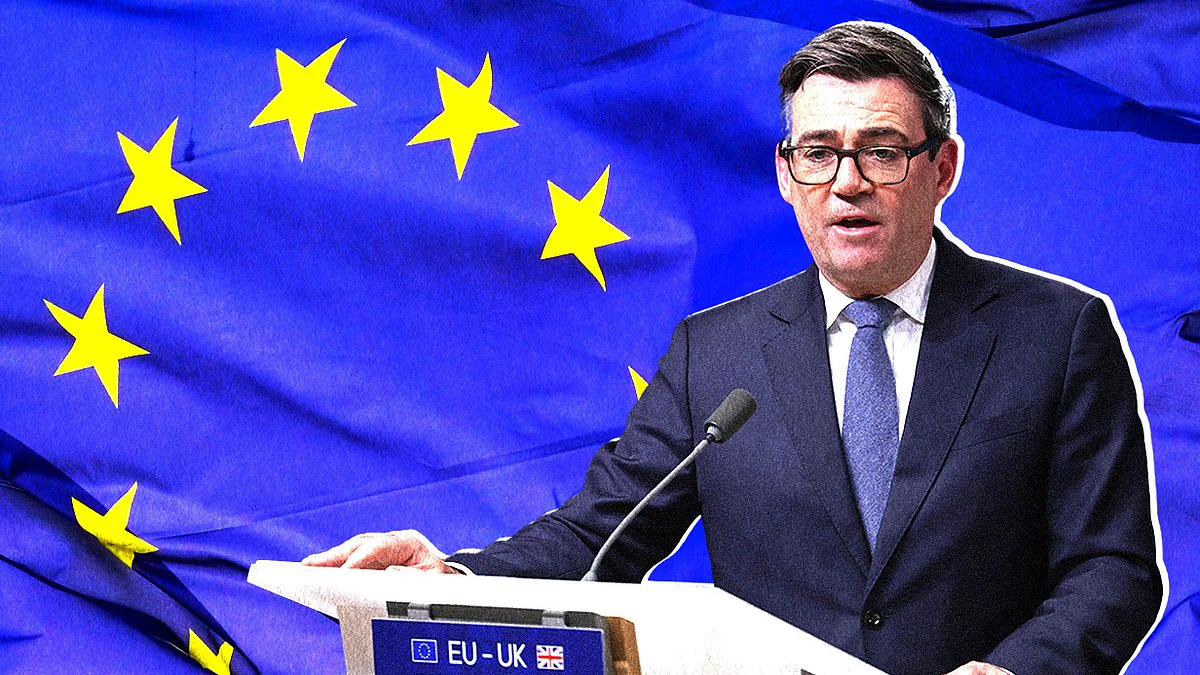

The past may be another country, but Andy Burnham appears most comfortable looking back towards it.
The ‘deal’ he agreed with the European Union yesterday would, in this view, take Britain backwards: towards higher EU migration, renewed Brussels influence over British businesses and an open-ended process through which the bloc extends its reach into daily life.
The Prime Minister seems to yearn for the era when the highest praise a British leader could receive was to have his hair ruffled by the president of the European Commission and be congratulated for accepting her demands.
Mr Burnham may wish to return to the period before 2016, when the British public had yet to decide its future. But events around the world are moving so quickly that his attempt to reverse course looks less like harmless nostalgia and more like a historic misjudgment.
The week’s most important economic development did not take place in Europe’s stagnant economy or emerge from Brussels’s innovation deficit. In the United States, AI company Anthropic offered shares to the public and raised more than $80billion, valuing the business at $1.5trillion.
Even the most optimistic assessment of Mr Burnham’s agreement puts the possible gain for the whole British economy at £17billion – roughly one hundredth of Anthropic’s valuation – at best.
In reality, the agreement may not deliver even the modest benefits its supporters promise. It signals a decision to turn away from the growth opportunities of the future and return to an economic model that has already failed.
At its centre is the concept of ‘dynamic alignment’ with the EU. Put simply, Britain would accept large areas of new EU regulation without the ability to reject, amend or veto them.

The ‘deal’ Prime Minister Andy Burnham agreed with the European Union yesterday would take Britain backwards, writes Michael Gove

It is difficult to imagine a more obvious rebuff to voters, or a poorer use of the responsibilities of high office, says Gove
The European Commission would be able to impose a rulebook on the British economy that Parliament would then have to copy into UK law without changing a single word.
Protectionist interests across Europe could lobby Brussels for tougher rules aimed at industries in which British companies might gain an advantage or outpace their continental competitors.
French farmers and German bankers could persuade their governments to press for laws affecting British firms. Britain would then have to accept both those rules and their interpretation by a European Court whose stated purpose is to advance European integration, rather than protect British interests. The result would be less freedom and weaker growth – a direct blow to economic dynamism.
One of the least discussed but most important areas in which Britain has been out-innovating the Continent is agritech. British researchers have been developing gene editing and precision breeding, technologies that could raise crop yields, reduce chemical use and make food considerably cheaper over time.
British farmers are also currently free to use methods and products prohibited in the EU, giving them a potentially significant productive advantage.
Mr Burnham’s agreement would immediately limit Britain’s ability to pursue measures that could make farming more efficient, either now or in the years ahead.
At a time when food security is increasingly important and global demand for high-quality produce is expanding, Britain would be surrendering the ability to strengthen its food supply or secure a leading position in a growing market.
The EU is also looking closely at other successful parts of the British economy.
Freed from the EU’s bureaucracy, Britain has built on its strengths in technology, data and artificial intelligence. Although the United States and China dominate these fields, the UK currently ranks third, reflecting the work of scientists and entrepreneurs including DeepMind’s Demis Hassabis and Mustafa Suleyman.
The EU has openly indicated that it wants to bring more of the British economy within the reach of its single market. Mr Burnham has been equally clear that he wants the public to debate not whether Britain should accept greater EU control – that direction appears settled – but how much authority should be handed over.
Yesterday, he promised a ‘brainstorming’ meeting with the EU next year to discuss still closer relations.
Only months after telling voters in Makerfield that he did not want to reopen the arguments of the Brexit years, he now appears ready to make 2027 one prolonged debate about how far, and how quickly, that democratic decision can be reversed.
It is difficult to imagine a clearer snub to voters or a more damaging use of the authority entrusted to the Prime Minister.
The problem is not simply that every hour spent negotiating directives, framework agreements, protocols and shared rulebooks with the EU is an hour not spent reforming welfare, improving schools or strengthening defence procurement.
Uncertainty over Britain’s eventual relationship with the EU is itself a serious obstacle to growth – more poisonous to investment than paraquat.
A US technology investor may hesitate to establish a business here if future legislation could threaten its viability within a year. Financial and professional services firms considering expansion will not know whether to prepare for new EU requirements or expect to avoid them.
Businesses will also be uncertain about how the EU’s energy policies and commitment to Net Zero will affect their plans.
Many will decide that investment and jobs are safer in countries without the same regulatory uncertainty.
British workers could also lose employment opportunities. The EU youth mobility scheme agreed yesterday would allow more European workers to come to Britain in search of jobs, despite almost one million young people in the UK being outside education, employment or training.
Because Britain is growing faster than France or Germany, thanks in part to its innovators, it is likely to attract workers from those countries. That would increase competition for every vacancy.
A persistent weakness of the British economy has been its reliance on importing low-cost labour instead of raising productivity at home. Rather than training British workers, employers bring in cheaper overseas labour, placing additional pressure on public services while leaving domestic potential underdeveloped.

Michael Gove and Boris Johnson hold a press conference at Brexit HQ after Vote Leave’s victory in the 2016 EU referendum
The bitter irony is that British voters have repeatedly rejected an economic model based on greater migration, weaker control, more regulation and slower growth. Yet that is precisely what the new EU agreement appears to entrench, while Mr Burnham’s push for ever-closer union would reinforce it.
Nor is this process being handled with the ruthless, clear-eyed strategy for which EU leaders are known.
At each stage of Britain’s ‘reset’ with the EU, Brussels appears to have secured the stronger hand.
Britain has already agreed to pay substantially more to join the EU’s student exchange programme, Erasmus+. At £570million, it costs considerably more than the Turing scheme it replaced. The UK is also expected to make payments if it wants to participate in the EU’s energy and defence arrangements, despite possessing energy resources the bloc lacks and defence capabilities beyond those of many member states.
Brussels understands that Mr Burnham has defined success as moving closer to the EU. Britain is therefore approaching negotiations as a supplicant seeking more Europe, rather than as an equal prepared to walk away if the terms are unacceptable. That gives the EU every incentive to demand further concessions.
It has already linked additional ‘progress’ to cutting university fees for EU students to levels below those charged to other overseas undergraduates. British students – as well as Australian, Canadian and American students – could end up subsidising their education.
There is a reason this issue has been placed high on the agenda for the next concession. The UK has twice as many universities in the world’s top 50 as the EU as a whole. Despite its population of 450million and a $22trillion GDP, the bloc has not matched Britain’s level of educational excellence and now wants British taxpayers to help fund access to it.
That is unlikely to be the limit of either the EU’s ambitions or Mr Burnham’s plans. He has indicated that he would prefer Britain to rejoin the bloc, an outcome welcomed by Czech Prime Minister Andrej Babis, who said: ‘Yes, of course, we need more money.’ The money, naturally, would come from British taxpayers.
As EU growth slows and the bloc continues to pursue expansion, it will expect Britain to contribute. There is no indication that the rebate on membership costs secured by Margaret Thatcher would return. Under Mr Burnham’s approach, independent estimates put the potential bill at about £750million a week.
British history contains a recurring pattern of appealing, personable politicians who reach Downing Street after long apprenticeships and then seek to leave their mark through a major foreign-policy shift. Haunted by perceived failures of the past, they can become so focused on yesterday that they fail to recognise new realities.
Neville Chamberlain was shaped by the trauma of the First World War and embraced appeasement, culminating in the humiliating Munich agreement. Anthony Eden, haunted in turn by Munich, moved in the opposite direction and stumbled into the Suez crisis – a different mistake rooted in the same failure to understand the future.
John Major, meanwhile, campaigned for Britain to join the European Exchange Rate Mechanism and signed the Maastricht Treaty while determined to reverse what he viewed as Margaret Thatcher’s resistance to European integration. The result damaged Britain’s economy and reputation and left the country poorly positioned for the growth trends that followed.
Mr Burnham now risks joining that list of politicians whose promise was undermined by events overseas. Like Chamberlain, he was a respected municipal leader; like Eden, he is an accomplished television communicator; and like Major, he presents himself as someone focused on everyday frustrations rather than grand drama.
All three waited years in the corridors of power before reaching the top. Mr Burnham, too, now appears at risk of pursuing an improved version of yesterday instead of confronting and mastering the forces shaping tomorrow.
For Britain’s sake, he should recognise that the past – particularly the history of other countries – must not take precedence over the national interest and the future. His responsibility is not to surrender power, transfer money or open borders without limit, but to strengthen democracy, free the economy and put the interests of British citizens first.


