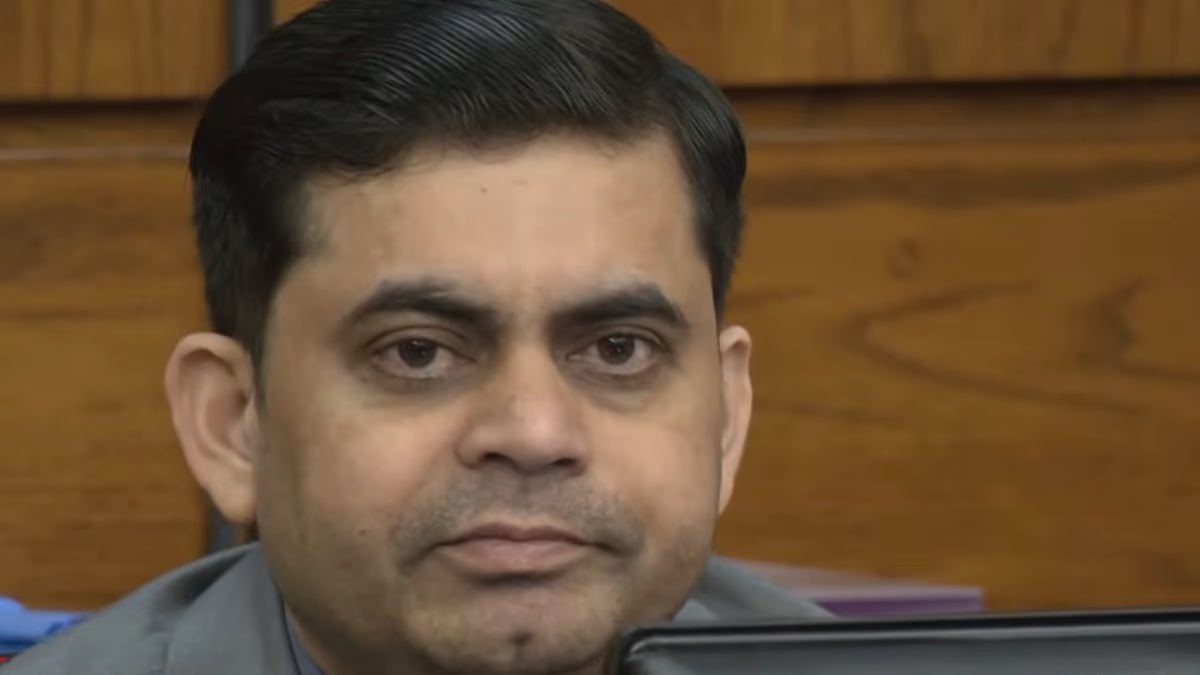

A Virginia man facing trial for his wife’s murder shocked jurors when he claimed she took her own life—before acknowledging that he panicked and dismembered her body.
Naresh Bhatt made the startling statement Thursday as he testified in his own defense in the case involving his wife, Mamta Kafle, who disappeared from their Manassas Park home in July 2024.
Kafle’s remains have never been recovered. Prosecutors allege that Bhatt killed her and cut up her body.
Taking the stand, Bhatt told jurors he found his wife dead on the floor of their main bedroom during the night.
He said pills appeared to be mixed with vomit on her body and on the nearby floor, while pesticides were also present in the room.
Instead of contacting police or emergency responders, Bhatt testified that he chose to hide her death and get rid of her remains.
“I’m gonna hide somewhere or throw somewhere else to, so nobody know it,” he told the court.
“What did you do next?” his lawyer asked.

A Virginia man on trial for his wife’s murder told jurors she died by suicide before admitting he panicked and dismembered her

Naresh Bhatt offered the startling testimony Thursday while defending himself in the case involving his wife, Mamta Kafle, who vanished from their Manassas Park home in July 2024

Kafle’s remains have not been found, while prosecutors accuse Bhatt of killing and dismembering her
“I tried to put in the trash can,” Bhatt answered.
His testimony drew audible gasps from the courtroom. Kafle’s mother also left the room briefly, NBC Washington reported.
The claim represented a sharp departure from what Bhatt told police and reporters shortly after Kafle disappeared.
At that time, he said his wife had left their Virginia residence and suggested she might have traveled to New York or Texas.
Bhatt has pleaded not guilty to charges of first-degree murder, defiling a dead body and concealing a dead body. He began giving evidence Wednesday.
His defense lawyer first asked him about his early life in Nepal. Bhatt described growing up in an overcrowded home perched on a steep cliff.
Several families lived on the property, which lacked heating and air conditioning and at times did not have sufficient food.
After relocating to the United States, Bhatt held a series of jobs before joining the Army.

Bhatt’s testimony was a dramatic reversal of the account he gave police and reporters after his wife disappeared

His lawyer also asked about his marriage to Kafle, which Bhatt admitted had worsened during the months before she vanished
DISCOVER MORE: Pete Hegseth Fires Back at Calls for Impeachment After Midterm Victory

Bhatt, who denies charges of first-degree murder, defiling a dead body and concealment of a dead body, began testifying Wednesday
Bhatt told jurors that he experienced mental health difficulties while serving in the military, including recurring nightmares that caused him to wake up screaming and drenched in sweat.
He also acknowledged that his marriage to Kafle had deteriorated in the months leading up to her disappearance.
According to Bhatt, the couple no longer treated one another with kindness, although he denied ever physically attacking his wife.
That denial followed emotional testimony from Kafle’s brother, Mahesh, who said he had cautioned his sister against marrying Bhatt after meeting him.
Mahesh testified that, several months before Kafle disappeared, she secretly sent him a photograph that appeared to show her with a black eye.
He told jurors that Kafle blamed Bhatt for the injury and asked him to keep the image in case she needed it as evidence later.
Kafle also said she intended to remove the photograph from her phone so Bhatt would not discover it, her brother testified.
A friend of the couple separately told the court that Bhatt gave him all of Kafle’s jewelry, along with his own wedding ring, just weeks after she went missing.
The friend also said Bhatt had raised the possibility of divorcing Kafle seven or eight months before her disappearance.
Prosecutors rested their case Monday after presenting forensic evidence they said connected Bhatt to Kafle’s disappearance.
A witness from the Department of Forensic Science testified that it was “beyond likely” that Kafle was the source of most of the blood found on a stained carpet in the couple’s main bedroom, according to the outlet.
Forensic evidence analyst Iris Dalley Graff also described signs that someone had tried to remove blood from the bedroom and reposition furniture, apparently to hide evidence.
“There are patterns that are missing,” Graff told jurors.
She said blood detected beneath the carpet must at some point have passed through its upper surface.
The absence of corresponding stains on the carpet’s top layer, she explained, would “generally indicate some type of cleaning.”
Earlier testimony also linked Kafle’s blood to an electric saw that prosecutors believe played a role in her death.
A forensic scientist testified last week that DNA and blood recovered from the tool were very likely to have come from Kafle.
Prosecutors said Bhatt bought the saw months before the alleged killing and later gave it to a landscaper, who ultimately turned it over to police.
Bhatt has gone through several lawyers during the past two years and sought to remove his current court-appointed attorney from the case in September.
He has continued to maintain that he is innocent, even after acknowledging Thursday that he tried to dispose of his wife’s body.


