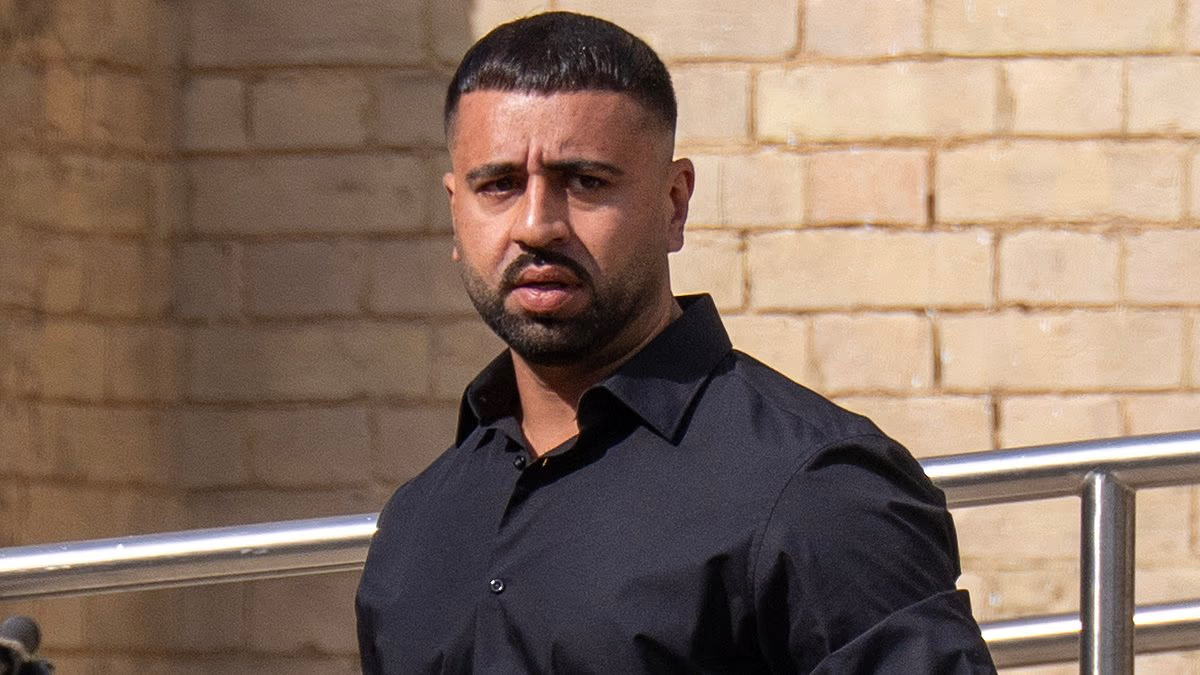

A mechanic who secretly photographed thousands of women and children—including girls as young as seven—and used artificial intelligence to create sexualised images was repeatedly allowed to return on bail to a flat overlooking a playground.
Zafer Dogan, 32, took the photographs without the subjects’ knowledge or permission as they went about their everyday lives.
He was sentenced to two years and four months in prison at Wood Green Crown Court on Thursday after admitting a series of image-related offences, including making indecent images of children.
Despite concerns about the risk he posed in the local community, Dogan was granted bail several times during the legal proceedings.
Metropolitan Police Commissioner Sir Mark Rowley has criticised the way victims of sexual offences are treated, saying: “The children should have been put first, not the paedophile.”
Dogan was initially arrested on July 16 on suspicion of offences involving indecent images of children, the court heard.
During the arrest, he managed to slip out of his handcuffs and ran from officers. He threw his mobile phone into a nearby garden, but was caught shortly afterwards and the device was recovered.
Prosecutor Sarah Gabay told the court that detectives found thousands of images of women and children that appeared to have been taken secretly and without consent.

Zafer Dogan appears at Wood Green Crown Court

Dogan was arrested on July 16 over suspected offences involving indecent images of children
The people shown were simply “going about their daily business”, Ms Gabay said. Some of the images showed children playing on climbing frames.
Police said more than 5,000 photographs had been taken, with many captured from Dogan’s bedroom window, which faced a playground.
Investigators also found that images involving 33 adult women and two children, aged seven and 13, had been digitally manipulated with AI software to produce sexualised material.
Dogan was arrested for a second time on August 4. He was charged the next day and remanded in custody by police.
Appearing at Highbury Corner Magistrates’ Court on August 6, he admitted every charge brought against him.
Ms Gabay said Dogan had remained on conditional bail throughout the case before being sentenced.
The court was told that Dogan gave no comment when questioned following either arrest.
Impact statements were read from the mothers of the two child victims, who cannot be identified for legal reasons.
The mother of the 13-year-old said she felt as though she had been “punched in the gut” when officers explained what had happened to her daughter.
She said: “I’m really worried that my daughter’s photos are online and other paedophiles have them.”
The mother of the seven-year-old victim described feeling ‘helpless’, adding: ‘Our lives will never be the same again and I can’t do anything about it all because one man exploited my child.’
Joseph Carr, mitigating, said the defendant ‘recognises the profound seriousness’ of his offending.
He said the defendant had separated from his long-term partner in 2025 and subsequently ‘spiralled into depression’.
The lawyer said Dogan ‘fell down the rabbit hole and was unable to find his way out’, but added there is no excuse for his actions.
The judge described Dogan as a ‘Jekyll and Hyde’ character during the hearing having read multiple character references, which Mr Carr said ‘speak to positive character’.
Dogan, of Enfield, pleaded guilty to three counts of making indecent images of a child which included 900 category C images, 294 category B images and 653 category A images – which are the most severe.
He also admitted possessing extreme pornography, possessing a prohibited image of a child, creating purported intimate images of an adult, obstructing a constable in the execution of their duty and a further two counts of making indecent photographs of a child.
The Met Police said that alongside the CPS, it had opposed Dogan’s bail on three occasions but their attempts were unsuccessful and the offender was allowed to return to his flat.
Detective Chief Inspector Brian Kelleher described the force’s ‘frustration’ at the court’s decision to repeatedly bail Dogan, who had used the AI software to ‘nudify’ images.
The detective said the ‘whole details’ of the case were raised in court, ‘including the fact that he was being bailed to effectively the area where he had been offending’.
Mr Kelleher said: ‘The matters at court… went through a series of challenges where the police and CPS opposed bail, opposed his being bailed back to the address, but the courts continued to bail him, and that went through a series of three or four different hearings.’
He added: ‘There are certainly frustrations, especially where, like in this case, we identify an offender who’s moved beyond the normal pattern of slightly more passive collecting of material into producing it yourself, and when we then highlight the risk to the court to really try and challenge those systems to put someone into custody.’
Mr Keller said ‘barriers to entry’ in accessing images and using tools to create them are ‘low’.
He said: ‘We find that offenders are opportunistic.
‘The barriers to entry being so low in this world, effectively, so either accessing images or using tools to edit or create them, mean that people who have that latent interest, the thresholds for them being able to advance into actually using tools, they’re able to do so.’
Police Constable Natalie Scagliarini, who led the investigation, said: ‘This is a deeply distressing case. Dogan’s actions were predatory and dangerous. He targeted the most innocent of scenes – children playing or out walking with their parents – and manipulated the photos he took in the most sickening way.
‘The nature of his offending has understandably left those who have learned of it feeling unsettled and violated, not knowing when they might be being watched or photographed and for what purpose.’
The head of Metropolitan Police Sir Mark Rowley attended the hearing during the afternoon.
He said: ‘It is not often you will see me outside court following a sentencing, but this case is yet another example of victims being let down by a criminal justice system that too often fails to put their safety first – in this case children.
‘Ever increasing volumes of cases are raised with me by angry and sometimes upset officers who are doing all they can to protect victims and communities but feel hamstrung by a justice system that makes seemingly unfathomable decisions. ‘


