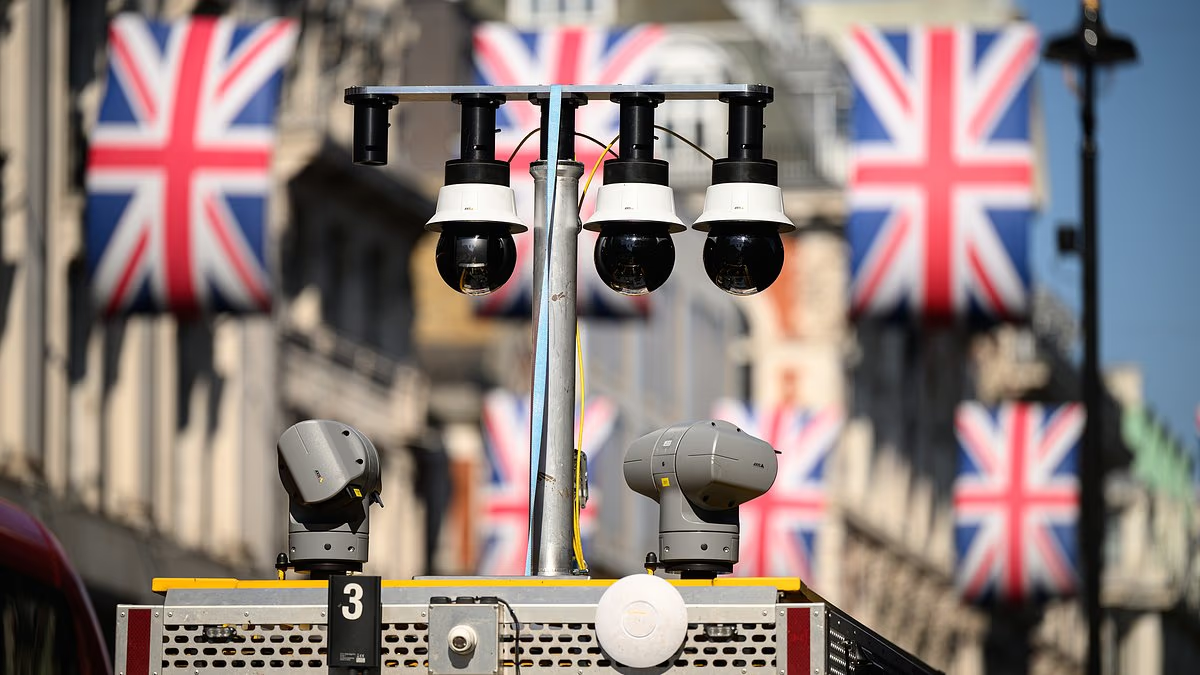

Millions of visitors to London’s West End could soon have their faces scanned under government-backed proposals to deploy live facial recognition cameras across the area.
The Metropolitan Police, the UK’s largest police force, has unveiled what it described as an “ambitious” plan to bring the technology to one of the capital’s busiest entertainment and shopping districts, following what it says was a successful six-month trial in Croydon.
Met Commissioner Sir Mark Rowley called the cameras “revolutionary,” saying they would be used to identify wanted suspects and registered sex offenders.
The force has not provided an estimate for how many people’s faces could be captured under the West End rollout, though it is understood that millions of faces were scanned during an earlier year of trials.
Unlike previous deployments that relied on highly visible police vans, the new approach would use more discreet fixed cameras mounted on lampposts. The plans have prompted concern from civil liberties campaigners, who argue that the positive framing of the technology obscures serious risks.
Jack Coulson, head of advocacy at Big Brother Watch, told the Daily Mail that while reducing crime in high-risk areas is in the public interest, the move toward permanent fixed cameras marks a troubling expansion of intrusive surveillance.
He said requiring people to pass through what amounts to a digital police line-up in some of the capital’s most crowded and popular locations undermines the principle that law-abiding members of the public should not have to identify themselves to police. He added that people should not have to give up their privacy simply to attend a West End show.
Coulson also noted that legislation governing police use of facial recognition is expected in the autumn, but warned that forces are pressing ahead with AI-driven public monitoring under rules they have set themselves.

Millions of people face having their faces tracked and scanned under government-backed plans to expand the use of live facial recognition cameras

The UK’s biggest police force today revealed its ‘ambitious’ scheme to introduce the technology to one of the capital’s busiest and most popular destinations. The West End is pictured
‘We are calling on the Met to stop this experiment until, at least, Parliament has spoken. Policing by consent is a cultural inheritance we must protect. Permanent biometric surveillance of the public square is incompatible with that ideal.’
Mr Coulson went on to give the example of one Asian man being mistaken for another.
He said: ‘Facial recognition surveillance makes mistakes. Just this February, Alvi Choudhury was arrested, held for ten hours, and only released at 2am for a crime committed in a city he’d never visited.
‘It is predictable, given the technology’s racial bias, that Mr Choudhury was confused for another Asian man.’
The Metropolitan Police has made more than 2,000 arrests using LFR (live facial recognition) cameras since the start of 2024.
Sir Mark Rowley has insisted the technology is supporting police officers rather than replacing them.
ALSO READ: Coogee Shark Attack: New Details Emerge About Victim’s Injuries
He said the six-month pilot in Croydon had delivered over 170 arrests, a reduction in crime and ‘significant fall in violence against women and girls’ – with only one false alert among hundreds of thousands of people.
But Akiko Hart, Director of Liberty, said the West End expansion represents a ‘major escalation in use’.

Commissioner Mark Rowley (pictured) described the cameras as ‘revolutionary’ – saying they would target wanted criminals and registered sex offenders
Ms Hart said: ‘Robust safeguards, oversight, and transparency on the use of facial recognition cameras should have been in place before they were ever introduced to our city centres and high streets.
‘To reach the level of fixed cameras across the capital before we even have a law in place is deeply concerning.
‘The Government has committed to a dedicated legal framework for facial recognition technology.
‘It is vital that this includes clear and consistent rules around how the police use facial recognition to ensure the rights of the public are protected at all times. Until this in place the Metropolitan Police should pause their use of the technology, not expand it.’
In April, Sir Mark warned the technology was necessary so police could keep tabs on criminals let loose on the streets under Labour’s social justice reforms.
The Met won a landmark High Court challenge the same month about the use of the technology, with judges rejecting claims that police broke human rights and privacy laws by scanning faces in public.
Sir Mark said there was a ‘mandate’ for expansion in the use of the ‘fabulous’ technology – which will be essential under Labour’s plans to jail fewer offenders by ditching shorter prison sentences and releasing inmates earlier.
He said: ‘It helps us as we’re going to have more offenders in the community, that’s the government policy.
‘Done well, if people are in the community and it’s well supervised and it’s rehabilitative, that could reduce crime.
‘If it’s not done well, then obviously the risks are there with that and time will tell.
‘But we’ve seen how facial recognition can help us in the supervision of offenders.’
During the Croydon pilot, the Met said more than 470,000 people walked past the camera – with one false alert generated.
The cameras work by taking digital images of passing pedestrians, feeding them into a computer using biometric software to measure facial features.
The image is compared with a watchlist and if a match is detected, an alert is sent to officers to review and consider making an arrest.
If a member of the public is not wanted by police, their biometrics are immediately deleted.


