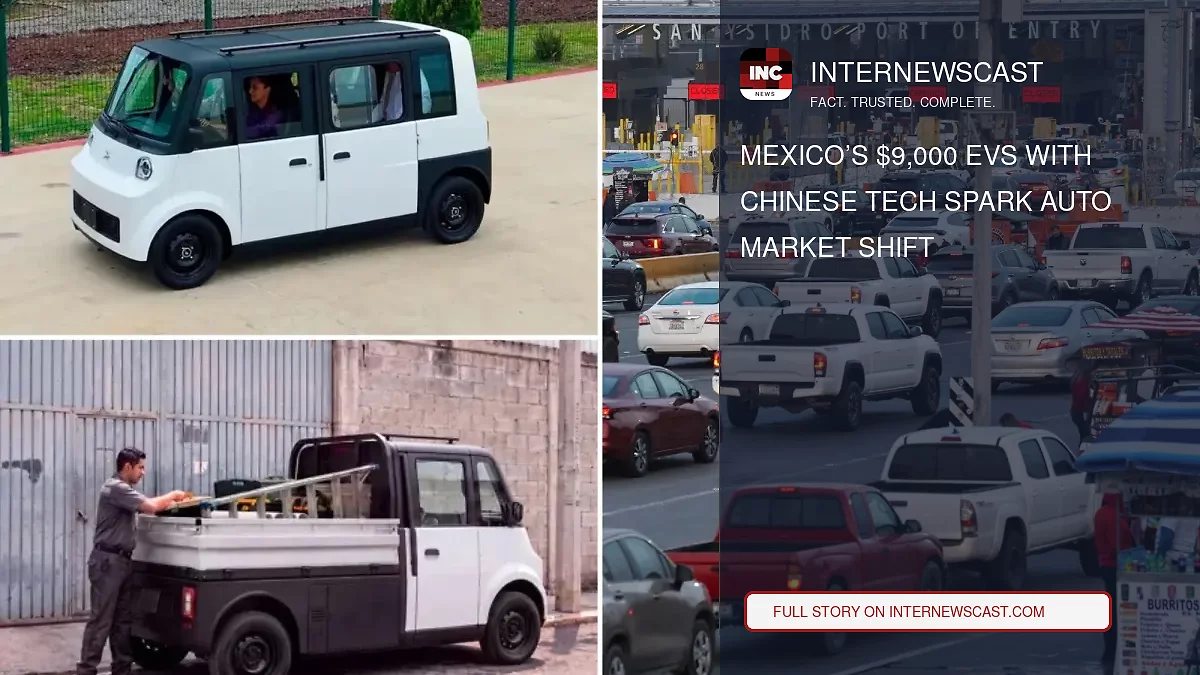

Southern California motorists hoping for a truly low-cost new car could eventually see a new ultra-compact option enter the conversation — if Mexico’s budget electric vehicles make the jump across the border.
Mexico has introduced Olinia, a domestically developed electric vehicle brand focused on small, inexpensive EVs meant for quick commutes, neighborhood errands, small businesses and city delivery routes, according to Marketplace.
The launch is tied to Mexico’s larger push to build its own electric vehicle sector, moving beyond its long-standing role as a production hub for international automakers.
President Claudia Sheinbaum has framed Olinia as a sign that the country can create and advance its own automotive technology.
“Olinia is proof that Mexico can go beyond merely being a recipient of investment,” she said. “It can generate knowledge, develop technology, and design solutions.”
With the first model expected to cost under $9,000, the tiny EVs could attract attention in car-reliant California, where affordable transportation is increasingly hard to find and even pre-owned vehicles often come with steep prices.
There is one major limitation: these vehicles are not intended for high-speed freeway travel on routes like the 405.
The Olinia Uno is a small city-focused car expected to deliver around 90 miles of range on a charge, with a top speed of about 30 mph. It plugs into a standard household outlet and is designed mainly for short, local trips.
That could make it more useful for short-distance errands, neighborhood trips, college campuses, retirement communities, delivery routes or as a second household vehicle.
Mexico’s government is also developing the Olinia Carga, a tiny electric truck aimed at small businesses, vendors and delivery operators, Electric Global. It can carry up to about 1,430 pounds and travel more than 75 miles per charge.
At an expected price of around $7,000, the Carga could be particularly interesting for businesses that need an inexpensive vehicle for making local deliveries.
Imagine a florist making deliveries around town, a landscaper hauling equipment between nearby jobs or a restaurant using a tiny EV for catering runs, all without spending tens of thousands of dollars on a conventional commercial vehicle.
There is, however, a major wrinkle. Chinese technology.
Mexico currently doesn’t have enough domestic battery production to supply the vehicles, meaning Chinese technology is expected to play a significant role. Batteries account for roughly 40% of a vehicle’s value, according to project leader Roberto Capuano Tripp.
That could become particularly important if Mexico eventually wants to sell Olinia vehicles in the US.
Chinese-made EVs have faced enormous political and trade barriers in America, including steep tariffs. The US has also pressured Mexico to prevent Chinese automakers from using the country as a backdoor into the American market.
So while an ultra-cheap Mexican EV might sound tailor-made for cash-strapped commuters, getting one legally onto California roads and selling it at anything close to its Mexican price could be another story.
The first Olinia vehicles are expected to enter production next year, with the Carga slated for a late 2027 launch.
Download The California Post App, follow us on social, and subscribe to our newsletters