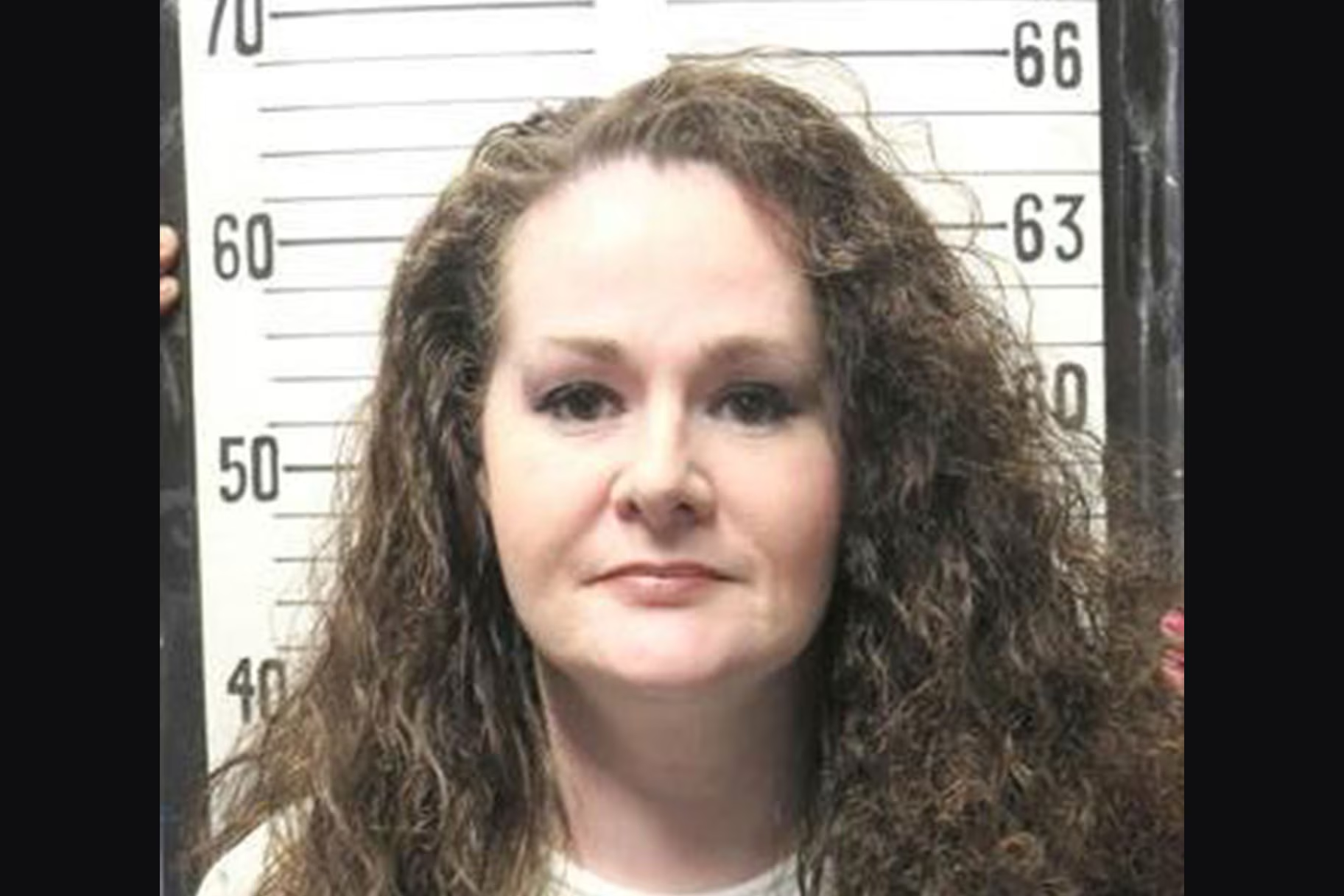

Christa Pike survived an attempted execution—but whether Tennessee could try to execute her again may ultimately depend more on politics than the law, according to a capital punishment expert.
“That is going to be a political decision and not necessarily a legal decision,” Corinna Barrett Lain, author of Secrets of the Killing State: The Untold Story of Lethal Injection, told Oxygen in an exclusive interview published Oct. 9. Lain, who was not involved in Pike’s case, said the Supreme Court ruled in 1947 that a state may make another attempt after a failed execution in which the prisoner survives. “It was an accident, accidents happen,” she said, adding that there is no clear legal barrier to a second attempt.
Pike had spent roughly 30 years on death row for the 1995 killing of 19-year-old Colleen Slemmer. Her lethal injection was scheduled for Sept. 30 at Tennessee’s Riverbend Maximum Security Institution, but she remained alive and critically ill after receiving two doses of pentobarbital.
Pike’s attorneys initially believed she was brain-dead. She has since regained consciousness, begun speaking and is walking with assistance, which her lawyers have described as a “medically unprecedented” recovery.
Her mental competency could become a crucial issue if Tennessee considers another execution attempt.
“Now, that’s a very low standard,” said Lain, who also holds the George E. Allen Chair in Law at the University of Richmond. A condemned prisoner only needs to understand that the state intends to kill them and why, she explained; they do not have to remember the crime for which they were sentenced.
As Tennessee Gov. Bill Lee investigates what went wrong, Pike’s medical condition and legal future remain uncertain.
Pike’s experience is unusual, Lain said, because the execution drugs were administered and she nevertheless survived. But it is not the first instance of a botched execution in which a prisoner lived through the process.
Lain pointed to the 2022 execution of Alan Eugene Miller, when officials struggled to establish intravenous access for the lethal drugs.
“They punctured him 18 times,” Lain said. After repeated attempts, officials abandoned the procedure, telling Miller they could not obtain IV access and would have to stop. Alabama later executed him using nitrogen gas.
Could Christa Pike Face Execution A Second Time After Botched Lethal Injection?
Because of Tennessee’s distinctive death penalty rules, Lain said it is “absolutely possible” that Pike could eventually face a different execution method. In some cases, the state allows death row prisoners to choose among certain options.
Between 2018 and 2022, Tennessee executed seven people, five of whom chose electrocution, Lain said. She described that preference as striking because the electric chair can cause an extremely gruesome death.
Witnesses have reported the smell of burning flesh during electrocutions, Lain said. Prisoners are also placed under a hood because bleeding can occur from the body’s orifices. The conditions raise a question, she noted: Why would someone choose the electric chair?
Death row prisoners have offered an explanation.
They have told Lain that both lethal injection and electrocution are likely to be agonizing, so the quickest option may seem preferable. Electrocution generally lasts two to three minutes, although a prisoner’s head may catch fire, while the average one-drug lethal injection takes about 18 minutes.
The realities of lethal injection also challenge its reputation as a compassionate punishment. Lain said the method’s failure rate is roughly twice that of other execution methods.
“The narrative is, this is the most humane death,” she said. The familiar image of prisoners peacefully drifting into sleep often overlooks the three-drug protocol used by states during the first several decades of lethal injection. One of those drugs was a paralytic, which also acts as a muscle relaxant.
That drug can create the appearance of a calm, sleeping prisoner, Lain said, “regardless of what is actually happening” internally.
Pike’s failed execution has intensified scrutiny of lethal injection and could fuel debate over what happens next to Tennessee’s only woman on death row.
“If I were behind those doors, I would be very nervous about, ‘Is this going to happen to me? What do we do when it does?’” Lain said. “This is a public relations nightmare.”


