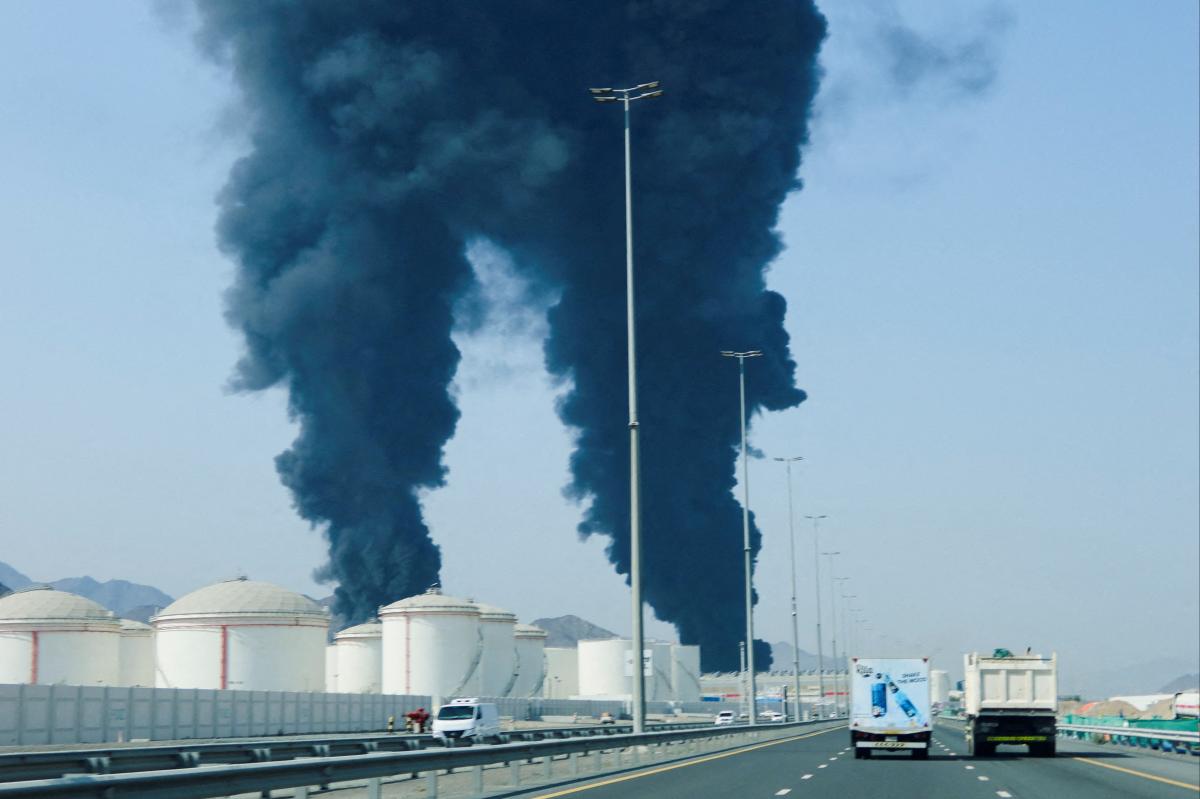


A massive blaze erupted at a crucial oil facility in the United Arab Emirates on Monday, following a volley of 19 missiles and drones launched by Iran. This act is being viewed as a significant intensification of tensions in the Middle East, according to local officials.
The UAE experienced its first attack since the US and Israel brokered a cease-fire with Iran last month. Tehran allegedly targeted the Fujairah Oil Industry Zone, renowned as the nation’s largest port and oil storage hub. This strategic site is pivotal, located beyond the Strait of Hormuz along the Gulf of Oman.
In the aftermath of the explosion, three Indian nationals suffered injuries. Abu Dhabi has strongly condemned the assault, labeling it a “dangerous escalation” as hostilities between Iran and the US flared in the Strait of Hormuz on the same day.
The UAE foreign ministry issued a stern warning, asserting, “We reserve the right to a full and legitimate response to attacks.” Abu Dhabi further emphasized that such actions represent a “dangerous escalation and an unacceptable transgression.”
“These attacks constitute a dangerous escalation and an unacceptable transgression,” Abu Dhabi officials added.
The Fujairah Oil Industry Zone, which opened in 1983, serves as the largest commercial storage hub for refined crude in the region strategically located along the Gulf of Oman beyond the Strait of Hormuz.
The plant has been repeatedly attacked by Iran during the war, with a large fire breaking out in March during the Islamic republic’s large-scale attacks across the region.
Along with hitting the Fujairah plant, a UAE tanker was hit by projectiles just seven nautical miles north of the facility, according to the UK Maritime Trade Operations (UKMTO).
Another UAE vessel traveling north of Dubai and one traveling by Mina Saqr both suffered fires on board, UKMTO reported.
The cause of the fires on the two ships was not immediately verified but came just before Iran allegedly began its attack on the UAE.
The UAE, which has maintained a strong relationship with the US and Israel, blared its emergency sirens throughout the morning, calling on residents to take shelter repeatedly as projectiles came in.
In total, Iran fired 12 ballistic missiles, three cruise missiles, and four drones on Monday, the UAE defense ministry said.
Tehran has claimed that there had been no plans to target the UAE, Iran’s state-run broadcaster IRIB said.
Oman, a neighbor to the UAE, also reported an attack on the coastal town of Bukha located just past the Strait of Hormuz.
The blast hit a residential building, leaving two people injured and four cars damaged, Omani officials said, without identifying the cause of the explosion.
It remains unclear how the attacks around the Strait of Hormuz will affect the fragile cease-fire with Iran, with Adm. Brad Cooper, the head of US Central Command (CENTCOM), maintaining that the truce is still in place despite Tehran’s active fire on shipping vessels and US warships operating in the waterway.
The US has so far sunk at least six of Iran’s fast attack boats patrolling the strait, Cooper said, with at least two American ships crossing the chokepoint.
Iran, which reportedly hit a South Korean vessel also trying to cross after the US announced its escort services through the strait, has warned that it will maintain its control on the Strait of Hormuz, which saw the transport of 20% of the world’s oil supply before the war began.


