
Nearly 1,500 migrants reached the Canary Islands on Saturday as Spain faced another sharp escalation in arrivals along the Atlantic route.
Spanish maritime authorities said around 2,200 people travelling aboard 14 boats were intercepted or rescued in the waters around the islands over the weekend, a popular holiday destination for thousands of British tourists each year.
The Maritime Rescue Service said 1,324 people had been brought to safety on Saturday alone, a total approaching the route’s daily record. In November 2020, 1,461 people arrived in the Canary Islands by boat in a single day.
The latest operation represented the largest one-day arrival in six years, matching the scale of the emergency recorded in November 2020, when 1,461 people were rescued in waters near the islands.
One vessel intercepted on Saturday was carrying approximately 240 people, including 12 women and 36 children, local officials said.
Most of those rescued were from Senegal, Gambia and Guinea-Conakry. They were taken to El Hierro, a small island that declared a state of emergency last week after a dramatic rise in migrant arrivals.
Twelve boats reached El Hierro, while another was diverted to Gran Canaria and a further vessel was taken to Tenerife.
The sea passage from West Africa to the Canary Islands is regarded as one of the world’s most dangerous migration routes.
Every year, thousands of people attempt the crossing in overcrowded boats, facing powerful currents, unpredictable weather and a journey spanning hundreds of miles to reach Spanish territory.

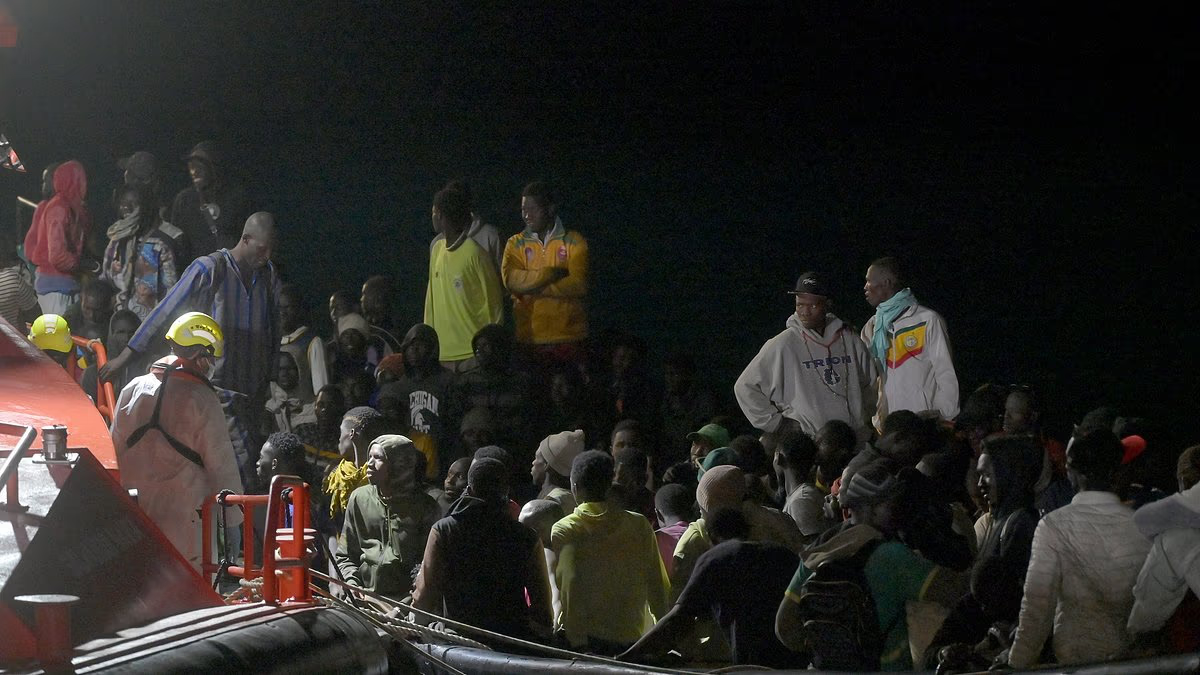
Spain’s Maritime Rescue Service helps migrants from a wooden boat near El Hierro in the Canary Islands on Saturday

Spanish coastguards rescued a total of 1,488 people travelling on 14 boats over the weekend; a vessel is pictured off El Hierro earlier this week

Migrants wait in lines overnight at the port of La Restinga on El Hierro on Saturday

The Canary Islands attract thousands of British holidaymakers each year
YOU MIGHT ALSO LIKE: Jean Ross, the real-life inspiration for Cabaret’s Sally Bowles
Arrivals typically increase during the autumn, when conditions at sea are often calmer and make the crossing more feasible.
Spain’s Territorial Policy Minister Angel Victor Torres is due to travel to El Hierro on Sunday to address the growing number of migrant arrivals.
More than 5,000 migrants are believed to have reached the island this month alone. El Hierro has a population of roughly 12,000 people.
Maritime officials on El Hierro said 3,261 migrants had been rescued during the first six days of November. Regional authorities warned on Friday that the scale of the arrivals had become “absolutely unsustainable”.
By Monday, Spanish media reports said the total was nearing 5,000 after 10 additional small boats carrying hundreds of people arrived over the weekend.
Earlier in the week, a spokesman for the island’s Unified Police Union said officials were “overwhelmed” and unable to cope with the influx. He warned that the situation was beginning to resemble the crisis in Ceuta, describing it as “out of control and overwhelming”.
Alpidio Armas, president of El Hierro’s governing council, told Spanish television over the weekend that officials were “very concerned” by the sudden surge in arrivals.
“This is precisely what led us to declare an emergency, so that we can establish a framework for cooperation with institutions at a higher level,” he said.
At least nine migrants have died in waters near the Canary Islands in recent weeks. A critically ill baby was airlifted to hospital after arriving, while thousands of others have been rescued by Spanish authorities.
The Spanish government is also under increasing pressure over its response to the migration crisis following a surge across the border into Ceuta in July.
The national government estimates that around 5,000 migrants remain in the enclave, while Ceuta’s mayor has put the figure as high as 15,000.
Local officials have accused Madrid of failing to act on warnings that preceded the border breach.
Many migrants in Ceuta, including unaccompanied children, are still sleeping on the streets as authorities work to provide shelter, complete registrations and return eligible people to Morocco.


