
The dog suddenly stopped, nose pressed close to the ground, and began pawing and sniffing at the packed dirt.
Its owner, Christine Ross, looked closer and saw what had caught Ruca’s attention: a large bone jutting out of the hardened earth. She photographed it and sent the image to her sister, a nurse, who immediately suspected it was human.
Police were called to Albuquerque’s West Mesa, where investigators soon uncovered a mass grave hidden beneath the desert scrub. Inside were the remains of 11 women and an unborn child — a grim discovery that launched the largest homicide investigation in New Mexico history and, 16 years later, remains among the most disturbing unsolved serial-killing cases in US history.
Now, a former officer who worked on the early stages of the case says a combination of police ego, bad timing and critical mistakes may have helped the killer avoid detection to this day.
Liz Thomson, a retired Albuquerque homicide sergeant, said rivalries and ambition inside the department created “tunnel vision” as officers raced to solve the case — and claim the credit that would come with breaking it.
“Every supervisor, every chief of police, every politician wanted that feather in the cap. Everyone wanted to be the one to break it,” Thomson, 67, told Our News Outlet, describing the intense pressure surrounding the hunt for the killer.
“It was like high school or a reality TV on steroids, like a competition around various ideas about the case that made it so people were getting voted off the island. Like a big d**k-measuring contest that really hurt the investigation.”
The West Mesa murders have shadowed Thomson, the Albuquerque Police Department and the wider New Mexico community since February 2009, when the first skeletal remains were found in the desert on the city’s western mesa.
The female victims were between 15 and 32 years old, most Latinas and all but one with arrest records for drugs or prostitution. Most had done sex work in the so-called ‘War Zone,’ a rough neighborhood on that city’s southeast side.
One, 22-year-old Michelle Valdez, was pregnant at the time of her killing.

A woman out walking her dog stumbled upon a human bone in a field on Albuquerque’s West Mesa in February 2009 – triggering a widespread excavation of the region that ultimately uncovered the remains of 11 women

The remains of 11 women and an unborn child were discovered in a mass grave on Albuquerque’s West Mesa back in 2009. The female victims were between 15 and 32 years old, most Latinas and all but one with arrest records for drugs or prostitution
Other victims were Jamie Barela, 15; Monica Candelaria, 22; Victoria Chavez, 26; Virginia Cloven, 24; Syllannia Edwards, 15; Cinnamon Elks, 32; Doreen Marquez, 24; Julie Nieto, 24; Veronica Romero, 28; and Evelyn Salazar, 27.
Some led such transient lifestyles that it’s hard to determine when they disappeared. In several cases, it took their loved ones months and even years to report them missing.
‘These were marginalized women who didn’t have a lot of contact with their families,’ Thomson said. ‘It’s still unclear, even all these years later, precisely when some of them vanished.’
Their disappearances started making headlines when dog owner Ross found the first bone in 2009, in a spot where a contractor had started moving dirt to build a subdivision but halted because of the housing crash.
The discovery quickly led to two other sets of human remains.
After weeks of using sniffer dogs, ground penetrating radar and excavators, authorities ultimately found 11 in total in a cluster within 20 yards of each other.
Satellite photos showed bare spots in the vegetation on the mesa, and tire tracks leading to the mass grave.
Because the bodies were buried without coffins or clothing and had badly decomposed, it took several more months to identify all of them through dental records and DNA. Thomson remembers that as ‘an anguishing time.’

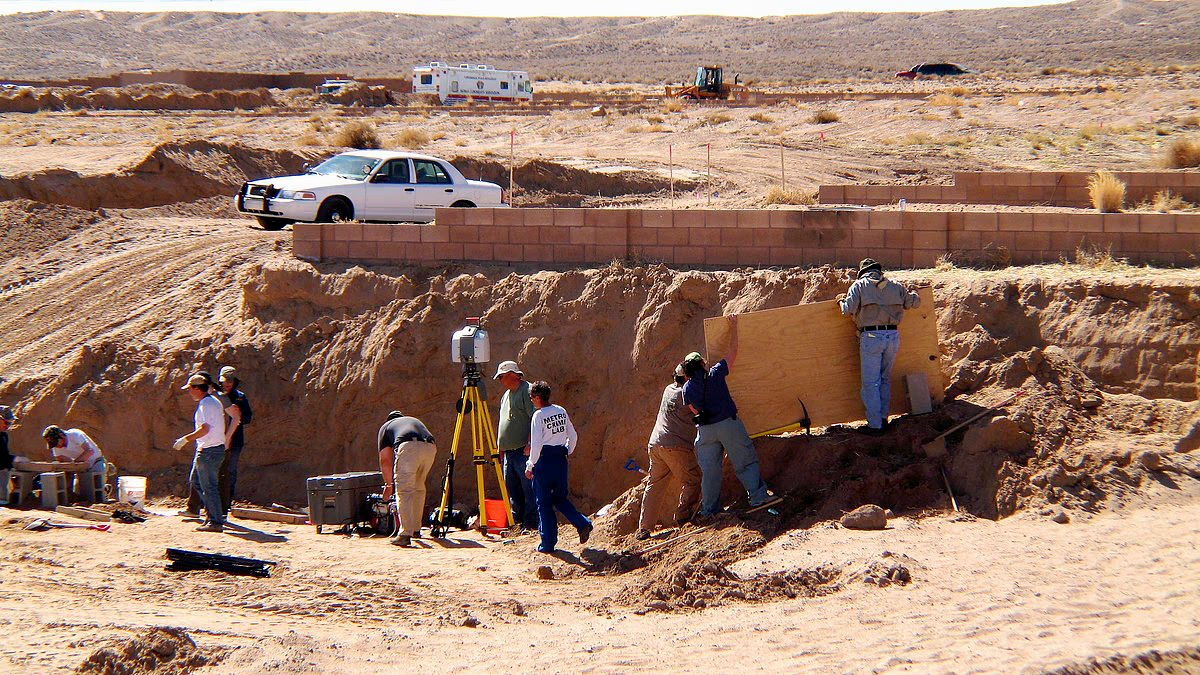
Crime scene investigators search for human remains in a large expanse of desert in Albuquerque, New Mexico shortly after the first bones were uncovered

After weeks of using sniffer dogs, ground penetrating radar and excavators, authorities ultimately found the remains of 11 women in a cluster within 20 yards of each other
Investigators believe as many as eight other women who vanished between 2003 and 2006 may be connected to the same serial killer or sex trafficking ring — possibly one operating through neighboring Texas that targeted women during large regional events like the New Mexico State Fair.
In December 2010, police released photos of seven other unidentified women who shared traits with the original 11 victims and were thought to possibly be linked to the case.
In 2018, construction workers found more human bones within a mile of the original West Mesa site, raising suspicions of a second burial ground, though police never confirmed the connection. A 2022 search for a second burial site also came up empty.
To this day, no arrests have been made, although two men did emerge as people of interest in the killings.

Liz Thomson, a retired Albuquerque homicide sergeant who investigated one of the most vexing unsolved serial killing cases in US history, believes it might have been cracked years ago had the timing been slightly different
One, Lorenzo Montoya, popped onto investigators’ radar because of the way he died in 2006.
Montoya – who authorities say had made a handful of disturbing sex tapes – strangled a sex worker inside his home, then was shot and killed by the woman’s pimp as he tried carrying her corpse to a car.
Grim footage later published by the Albuquerque Journal appeared to capture what sounded like duct tape being unrolled inside Montoya’s home.
Montoya also raised suspicions because he had lived about a mile from the West Mesa mass grave and the killings appeared to have stopped after his death.
‘Lorenzo Montoya committed a murder of a woman. Her boyfriend discovers that, Lorenzo Montoya tries to attack that boyfriend. He kills Lorenzo,’ Albuquerque Police commander Kyle Hartsock told KOAT News last year.
‘The women stop disappearing right around the same time, which makes Lorenzo an obvious person of interest.’
Still, no solid evidence ever linked him to the burial site. The case against him could never be vetted in court because he died before coming into suspicion.
Joseph Blea is the other main person of interest. He is known as the ‘Mid-School Rapist’ for his conviction in a series of home-invasion rapes of teenage girls near Albuquerque’s McKinley Middle School in the 1980s and ’90s.
The case broke after his DNA matched evidence from an old rape kit that authorities finally tested in 2010. He was separately convicted on four other counts of sex assault, including of a 13-year-old girl, and is now serving a 90-year sentence for both convictions.
Blea was a frequent customer of sex workers in Albuquerque, having been documented by police in the War Zone more than 125 times between 1990 and 2009. Although he repeatedly has denied any involvement in the West Mesa murders, he was potentially tied to the burial site by one piece of physical evidence. A tree tag found near one of the graves was traced back to a nursery that Blea, a landscaping worker, was known to frequent.

A memorial for 26-year-old Victoria Chavez was erected near the Southwest Mesa area shortly after bodies started being dug up back in 2009

Investigators believe as many as eight other women who vanished between 2003 and 2006 may be connected to the same serial killer or sex trafficking ring
But as Thomson tells it, police have never firmly ruled out either man.
Still, the initial decision to identify Montoya and Blea as potential suspects early on is among the frustrations Thompson still harbors today.
In her opinion, law enforcement didn’t have nearly enough evidence to do so. Besides, she added, the announcement dissuaded people from coming forward with new tips, figuring police had it solved.
‘Naming their names was, to me, the worst thing that ever happened to this case,’ she told Our News Outlet.

To this day, no arrests have been made, although two men did emerge as people of interest in the killings, including convicted rapist Joseph Blea
Meanwhile, city officials have long been loath to discuss the case that, along with TV’s Breaking Bad, gave their community a black eye.
The mystery, in the meantime, has become the subject of several true-crime podcasts and documentaries – many espousing unproven theories about the killings and most of which Thomson called ‘garbage.’
She said listeners, especially young people, often hear about the cold case and just immediately figure it could have been solved through technology.
‘They’re thinking about it through the lens of now, modern cell phone data, not through the lens of how things were back then we didn’t have those leads to follow,’ she said.
Thompson believes the case might have been cracked long ago had the use of iPhones and Android devices been in full swing.
Just a few years after the slayings, GPS pings, geotagged photos, search histories and cell tower records had become routine tools for tying suspects to crime scenes.
It wasn’t until about 2007 that iPhones and Android phones had built-in GPS, apps, Wi-Fi location and constant data connections, making location leads far more granular, down to specific addresses, not just tower sectors. That’s when phones started logging web searches, photos with geotags, app usage and messages, turning them into much more fruitful tools to solve crimes.
Investigators increasingly relied on this kind of phone data to solve cases.
By the early-to-mid 2010s, pulling call records for homicide suspects was routine police work.
Whoever killed the West Mesa victims between 2003 to 2005 likely had no digital footprint and skirted that kind of surveillance.
‘All the electronic stuff was just on the verge of being really forensically useful, but sadly not so much in this case,’ Thomson, who has investigated hundreds of murders in her career, said.
‘The timing is really frustrating.’
‘Serial killing is a much harder business these days with all these clues from devices,’ Thomson, who worked the case as a detective and later as a cold case contract investigator, added.
‘It’s much tougher, if not impossible, to get away with crimes like this now.’
Today, the case is still active, with investigators still chasing down tips, which in 17 years have totaled more than 1,500 – some motivated by a $100,000 reward for information leading to an arrest and conviction.
‘Tips are still coming in, although not as often,’ said Thomson, who retired from the force in 2017, but stayed connected to the case as a contract investigator.
She likens the case to a puzzle in which police still ‘have so few pieces’ – even after all these years.
‘It’s so sad and so hard and hurtful that these women were treated like throw-away people, and these families, some of them have passed away themselves without having answers,’ she said.
Still, Thompson is adamant that the case will some day be solved.
‘You just never know. It may be on my deathbed. Or after my lifetime,’ she said. ‘You can’t do this kind of work without holding out some hope.’