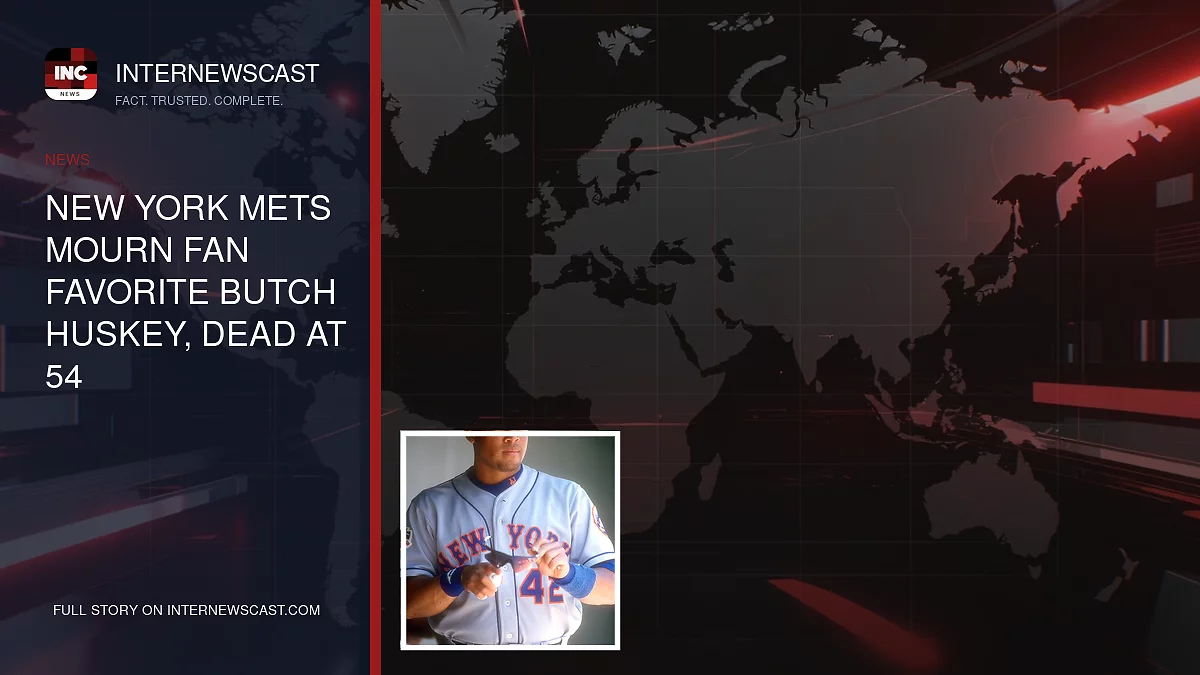

Butch Huskey, the former New York Mets power hitter remembered fondly by fans in Queens, has died at the age of 54, the organization announced Friday.
The cause of death for Huskey, an Oklahoma native, has not been disclosed.
‘We are saddened to learn about the passing of former Met Butch Huskey,’ the Mets wrote in a tribute shared on social media.
Huskey also holds a distinct place in baseball history as one of the final Major League Baseball players permitted to wear No. 42 after the league retired it in 1997 in honor of Jackie Robinson, the Brooklyn Dodgers icon who broke MLB’s color barrier 50 years earlier. Because Huskey was already wearing the number when it was retired, he was covered by a grandfather clause that allowed him to keep it for several more seasons.
That connection became especially meaningful on April 15, 1997, when Huskey wore No. 42 in front of Robinson’s widow, Rachel Robinson, on the day MLB formally announced the historic leaguewide retirement.
‘It was a great feeling [to get to continue] to wear that number,’ Huskey told MLB.com in 2022. ‘I also had [Robinson’s wife, Rachel] sign my jersey that I wore that day. I still have that jersey to this day. I’m ecstatic every year when I see everyone wearing No. 42. It puts a smile on my face. For the whole league to be wearing the jersey is amazing.’
Mo Vaughn, another player protected by the same grandfather clause, would eventually become the last Mets player to wear Robinson’s legendary No. 42.

Huskey was one of the final MLB players allowed to wear No. 42 after the league retired Jackie Robinson’s number in 1997 to commemorate the 50th anniversary of Robinson integrating Major League Baseball

A view from behind home plate displaying the art on the field in memory of Jackie Robinson during the Dodgers 5-2 win over the Mets in April of 1997. Huskey is at the plate wearing No 42

Jackie Robinson packs away his Dodger uniform, with the number 42 which he made famous, after the final game of the 1956 World Series
Huskey was a seventh-round pick out of Lawton, Oklahoma’s Eisenhower High School, where he was an All-State tight end on the football field. In fact, he was offered a scholarship to play for the home state Sooners, but instead went with the Mets’ offer and began his minor league career.
He wouldn’t reach the majors until 1993, and due in part to the 1994 MLB strike, he wouldn’t really get to enjoy life in the majors until 1995.
But things began to click for Huskey in 1996, when he finished with 15 home runs and a .278 average while platooning with the left-handed hitting Rico Brogna at first base.
He had his best offensive season in 1997, getting a career-high 505 plate appearances and finishing with 24 home runs and a .287 average. But Huskey was forced to play third that year, which did not go particularly well, and he was later shifted to right field and a reserve spot in favor of Edgardo Alfonzo.
Huskey would go from Seattle to Boston to Minnesota and Colorado over the next two years before leaving the game in 2001 as a member of the Rockies Triple-A affiliate.
Mets fans were crushed by the news and dealt with their grief by sharing some stories about Huskey.

Butch Huskey is seen with his former Seattle Mariners teammate, Ken Griffey Jr. in 2022
‘[In] 2000 my family and I (11 at the time) went to spring training,’ read a post from the popular Art But Make It Sports social media account. ‘[As] we were watching the players come through, Butch Huskey walked up to me and said “kid, hold this bat.”
‘I stood there while he went to talk to someone, and he came back two minutes later and said “what are you still doing here, that bat was for you to take,”‘ the post continued. ‘[Before] I could even process, he said “follow me” and proceeded to take me around Twins spring training to have every player sign the bat. core memory, rest in peace legend.’
Another Mets fan added: ‘One of those players you looked forward to getting his chance, enjoyed while he was doing his best for your team, and now and then looked back on fondly when his name crossed your mind. Thanks for the Met times, Butch.’