
Archaeologists have discovered a collection of stunning artifacts from the wreck of HMHS Britannic, the lesser-known sister ship of the Titanic, which was sunk during World War I.
Built by the same company as the Titanic, the Britannic was originally intended to be a luxury cruise liner but was converted into a hospital ship during the war.
The ship successfully completed several missions transporting the wounded before embarking on its final, ill-fated journey on November 12, 1916, which culminated just nine days later when the ship encountered a German mine and sank in the Aegean Sea.
This week, Greece’s Culture Ministry revealed that an 11-member deep-sea diving team conducted a weeklong expedition in May to retrieve invaluable artifacts from the wreck.
Among the items brought to the surface were the ship’s bell, its port-side navigation light and silver-plated first-class serving trays.
Divers recovered ceramic tiles from the ship’s elaborate Turkish bath, a pair of passenger binoculars, and a porcelain sink from second-class cabins, serving as poignant reminders of the ship’s dual role as both a luxurious ocean liner and a wartime hospital.
Once the largest hospital ship afloat, the Britannic sank in less than an hour.
Out of the more than 1,060 people on board, 30 lost their lives, many after their lifeboats were dragged into the massive, still-operating propellers as the ship descended.

Among the items brought to the surface were the ship’s bell

Built by the same company behind the Titanic, the Britannic was designed as a luxury cruise liner, but was requisitioned as a hospital ship during the war
The project to document the Britannic’s wreck and its contents was carried out by a team of professional deep-sea divers, using closed-circuit diving equipment.
That included gear that recycles a diver’s breath by removing carbon dioxide and adding fresh oxygen, letting them dive longer without bubbles.
‘Conditions on the wreck were particularly tough because of currents and low visibility,’ the ministry said.
Some objects listed in the original plan could not be recovered because of their condition or location.
The retrieved artifacts were placed in secure containers, cleaned of marine growth, and transported to the European University Association (EUA) laboratories in Athens, where conservation efforts will continue.
The artifacts pulled from the depths were nearly intact, featuring only signs of rust and some erosion.
The porcelain sink was perfectly preserved, still retaining its white finish, and a plate kept the bright blue stamp that read: ‘White Star Line.’
However, the silver serving trays that likely once shone have since rusted after more than a century under the sea.

Divers also recovered a port-side navigation light. The ship completed several missions ferrying the wounded before its final, tragic voyage on November 12, 1916

Divers also retrieved ceramic tiles from the ship’s ornate Turkish bath, a pair of passenger binoculars and a porcelain sink from second-class cabins (pictured)
The artifacts are currently being conserved in Athens and will become part of the permanent collection at the upcoming Museum of Underwater Antiquities in the port of Piraeus.
The museum will include a special World War I section, with the Britannic artifacts as its highlight.
The Britannic measured 882 feet nine inches long and 94 feet wide, with a gross tonnage of 48,158, making it Britain’s largest ship at the time.
The White Star Line’s Britannic set sail on its maiden voyage on December 23, 1915, departing from Liverpool and heading to Mudros, Greece.

A plate pulled from the wreck kept the bright blue stamp that read: ‘White Star Line.’

The silver serving trays that likely once shone have since rusted after more than a century under the sea

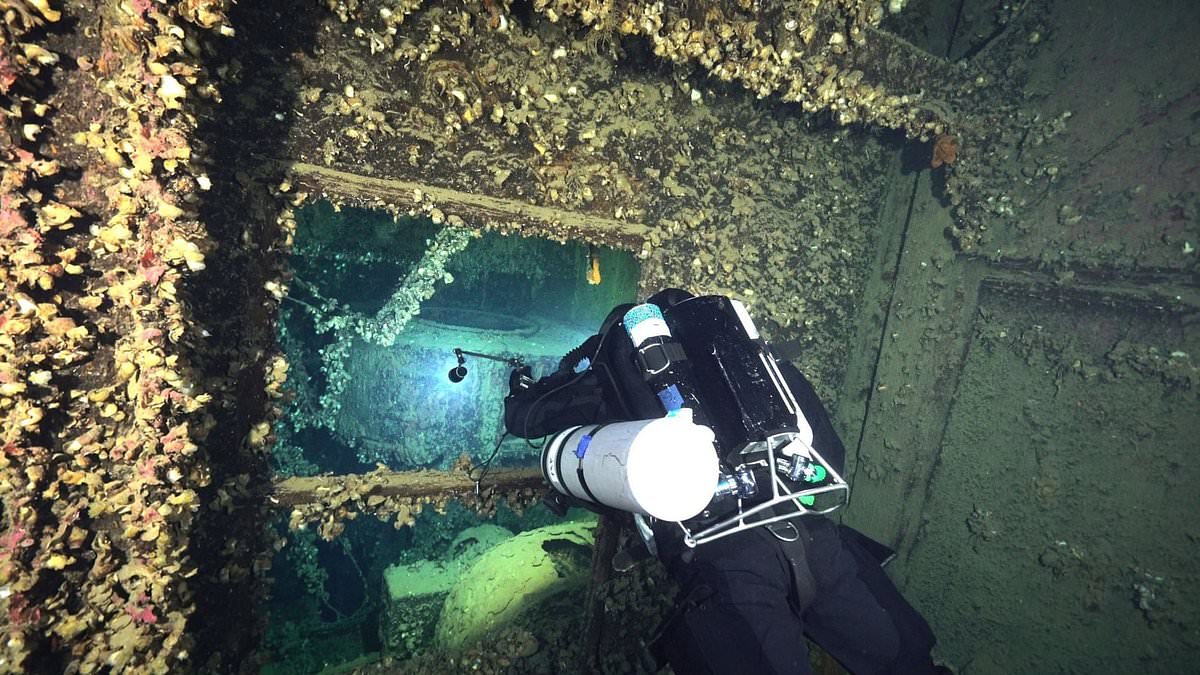
The technical divers traveled 390 feet below the sea surface to recover the artifacts and explore the wreck that sunk in 1916
The ship struck a German naval mine that had been laid by a submarine, and the explosion ripped open the starboard hull near the bow.
Despite watertight compartments, open portholes allowed water to flood in quickly.
The captain tried to beach the ship on nearby Kea Island to prevent sinking, but the flooding was too fast.
The ship then rolled to its starboard side and sank in just 55 minutes, remarkably fast for a vessel of that size.
In 1975, French ocean explorer Jacques Cousteau discovered the wreck of the Britannic.
The ship was found lying on its starboard side about 390 feet below the surface, largely intact except for a massive hole in its bow.