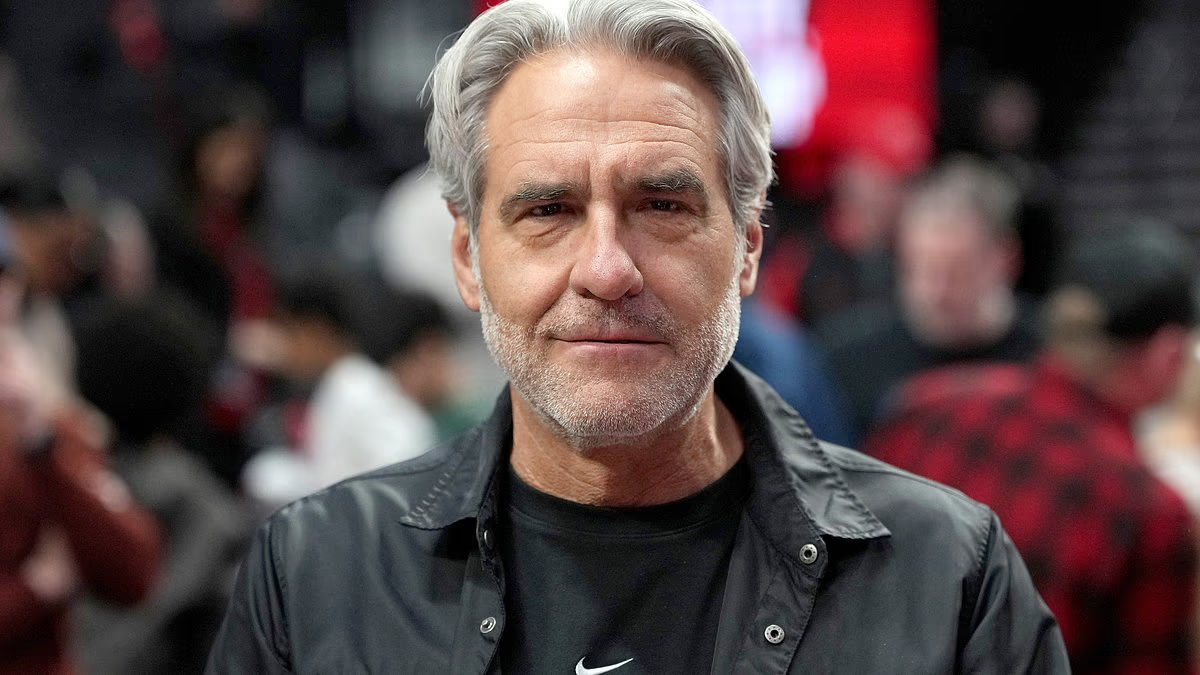

Nike’s embattled chief executive has offered one of the clearest signs yet that the sportswear giant may be stepping back from the cultural politics critics believe contributed to its recent troubles.
In a memo to employees this week, CEO Elliott Hill said Nike had spent the past year making “sport the center of everything we do.”
The message could easily be read as a straightforward business update. Yet with Nike shares hovering near their weakest point in more than a decade—closing at $33.87—it carried a significance that extended beyond corporate strategy.
The obvious question for investors was simple: if sport is being restored to the heart of Nike’s business, what had taken its place?
Many critics believe the answer lies in a brand identity that became increasingly tied to political and cultural issues, sometimes appearing to put social messaging ahead of the core business of creating products athletes and consumers wanted.
Nike has spent years associating itself with prominent social causes. The company’s decision to feature former NFL quarterback Colin Kaepernick in its 2018 “Just Do It” campaign turned the brand into a major target in America’s culture wars.
Its messaging after the death of George Floyd, high-profile LGBTQ and Pride campaigns, and its 2023 collaboration with transgender influencer Dylan Mulvaney to promote women’s sportswear further intensified that debate.
No single campaign can be held solely responsible for Nike’s financial difficulties. Still, detractors argue that the combined effect made the company seem more focused on expressing its values than on delivering the compelling athletic products that once defined its appeal.

Nike veteran Elliott Hill returned to the company as chief executive in 2024 and has launched an extensive turnaround effort following years of weak sales, tougher competition and sharply reduced investor confidence

Nike’s stock has dropped about 80 percent from its November 2021 closing peak of $177.51, while revenue has fallen from its record high. The company has also carried out multiple rounds of layoffs as it works to cut expenses and reignite growth

Nike featured Colin Kaepernick in its 2018 “Just Do It” campaign, issued strongly political advertising after George Floyd’s death and later expanded its Pride and LGBTQ-focused initiatives
Nike’s public image also faced a difficult contradiction in the way some of the female athletes wearing its logo said they had been treated.
Allyson Felix, the most decorated American track and field athlete in Olympic history, became a prominent critic of the company after becoming pregnant.
Felix said Nike proposed reducing her sponsorship compensation by 70 percent after her pregnancy and initially declined to guarantee that she would not lose income while taking time away to give birth.
She later emerged as a leading voice for stronger maternity protections for sponsored athletes.
Mary Cain, another former Nike athlete, joined the company’s elite Oregon Project as a teenager and was widely regarded as one of America’s most promising distance runners.
In a 2019 account, Cain alleged that the program’s intense focus on weight and body composition helped fuel a deeply damaging period in her life, leaving her with serious psychological and physical consequences.
Her claims sparked a wider examination of how female athletes were treated in elite training environments. Nike subsequently announced changes to the Oregon Project and its approach to athlete support.
The controversy was especially awkward for a company that had increasingly presented itself as a powerful advocate for women in sport.
FIND OUT MORE: Giancarlo Devasini Net Worth: Tether CFO and Italian Businessman

Conservative commentators, social media users and public figures including Olympic swimmer Sharron Davies criticized Nike and urged a boycott over Dylan Mulvaney’s promotion of women’s activewear

The company faces much more substantial commercial challenges, including weak demand in China, intensified competition, product problems and the consequences of an aggressive direct-to-consumer strategy from prior CEO’s like Mark Parker (pictured)

WNBA basketball player Caitlin Clark’s signature Nike shoe was also picked up on by social media commentators, who demanded to know why the highly coveted shoe release was put on hold
Critics therefore began to spot a glaring disconnect, Nike could produce glossy campaigns celebrating female empowerment while some prominent female athletes were publicly describing experiences that painted a very different picture.
That disconnect matters when considering Nike’s current attempt to reconnect with women.
While Nike expanded its women’s offerings, competitors such as Lululemon and Hoka built dominant followings by identifying changing consumer tastes and creating products people actually wanted to wear every day.
Nike, meanwhile, became heavily reliant on familiar franchises and endless iterations of products such as the Air Force 1.
It also pulled back from parts of the wholesale market while betting heavily on its direct-to-consumer strategy.
That strategy helped create a more exclusive image – but critics argue it also meant Nike became less accessible to ordinary families shopping for sneakers and sportswear.
Parallel vulnerabilities were manifest in women’s sports more recently. Nike’s delayed execution of Caitlin Clark’s signature shoe release attracted substantial criticism, with the highly anticipated release occurring only after she had achieved status as a dominant figure in American athletics.
For a company supposedly obsessed with athletes, critics wondered why Nike had not moved faster to capitalize on one of the biggest names in women’s basketball.

For Hill, the answer is not to double down on the strategy of recent years but to put sport back at the center. Nike says its ‘Sport Offense’ is already showing encouraging progress, particularly in performance products. But the company admits there is much more work to do across Nike Sportswear, Jordan Brand and Greater China

Nike has also suffered a string of high-profile blows in elite sport. French superstar Kylian Mbappe recently left the company for Swiss rival On, while Spain’s World Cup winner Lamine Yamal (pictured) has moved to Adidas. For now, Hill is betting that a return to performance-led innovation can reverse the decline
Hill, the longtime Nike executive, who returned from retirement to take the top job in October 2024, now faces the unenviable task of rebuilding one of America’s most recognizable brands.
The company says it is concentrating investment on performance products, athletes, innovation and reconnecting with consumers.
Yet after years of controversy surrounding its corporate culture, marketing choices and relationships with athletes, the change in emphasis is impossible to miss.
The company’s problems are considerably broader: weak demand in China, fierce competition, product missteps, excess inventory, changing consumer habits and a costly restructuring all play a role.
But the timing of Hill’s message is hard to ignore and after years in which Nike frequently inserted itself into America’s fiercest cultural debates, the company is now trying to remind consumers why they fell in love with the Swoosh in the first place.
Our News Outlet has reached out to Hill for comment.