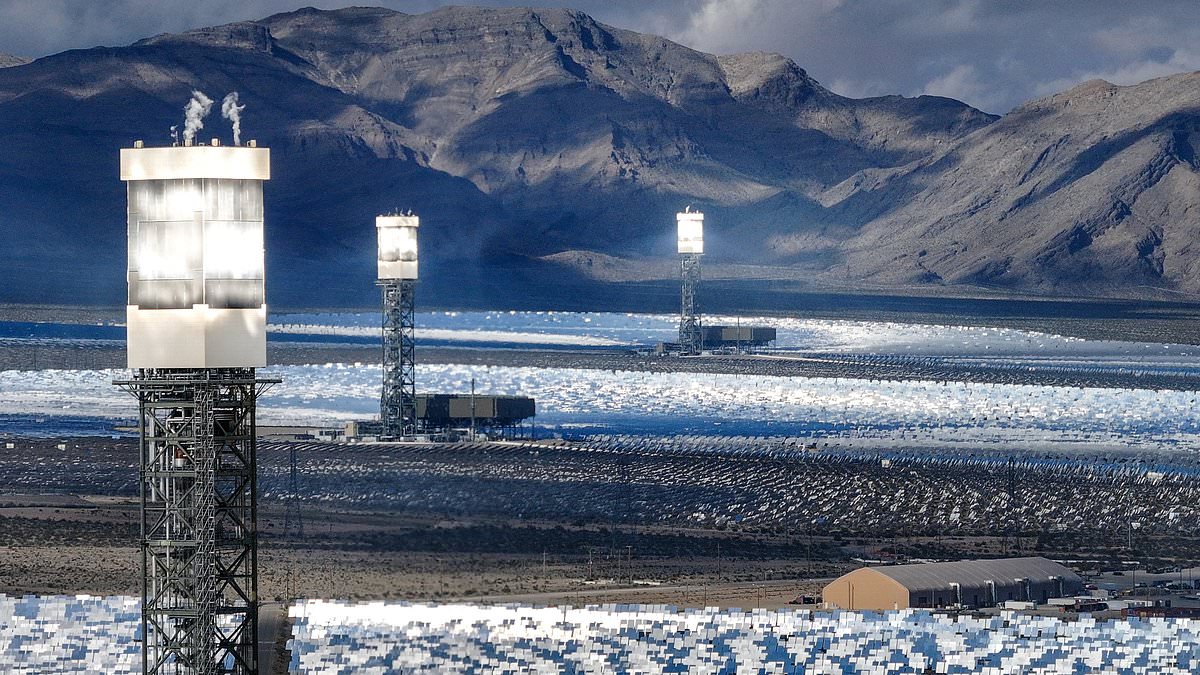

The Ivanpah Solar Power Plant, a $2.2 billion project in California’s desert, originally backed by the Obama administration, is now poised to potentially increase electricity costs for Americans. This development could add to the financial burden already shouldered by taxpayers who helped fund the facility.
Situated on a vast 3,500-acre expanse in the Mojave Desert near the California-Nevada border, the plant was established with federal support during the economic stimulus efforts under President Barack Obama’s first term. The initiative aimed to rejuvenate the American economy following the 2008 financial crisis while simultaneously promoting renewable energy sources.
Ivanpah is equipped with approximately 350,000 computer-operated mirrors and three towering structures each standing at 459 feet. The setup harnesses the sun’s energy to heat water in the towers’ boilers, generating steam to produce electricity.
According to federal data referenced by Fox News Digital, between $730 million and $780 million of the $1.6 billion government-backed loan associated with the project remains unpaid. Furthermore, the U.S. Treasury contributed a $539 million grant to the venture, covering around 30% of its construction costs.
Between $730 million and $780 million of a $1.6 billion government–backed loan tied to the project remained unpaid, according to federal data cited by Fox News Digital.
The US Treasury also provided a $539 million grant for the project, which covered roughly 30 percent of construction costs.
Both the Trump and Biden administrations have looked at shutting the plant down because of how it supposedly underperforms relative to its cost, but California regulators have blocked those efforts.
If the plant is closed, taxpayers could be left on the hook for hundreds of millions in losses tied to the loan. But if it remains open, consumers could face about $100 million more in annual electricity costs compared to newer technologies.
The Ivanpah power plant in the Mojave Desert features about 350,000 computer–controlled mirrors with three 459–foot towers
The power plant was part of a push under Barack Obama’s first administration to help revive the US economy following the 2008 financial crisis
A $539 million grant for the project, which covered roughly 30 percent of construction costs, was provided by the US Treasury
Daniel Turner, who founded the energy advocacy group Power The Future, said the power plant made ‘no economic sense to keep afloat.’
‘This is a boondoggle, like most of California’s large projects are a boondoggle,’ he told the outlet.
Turner added: ‘At some point, you have to stop throwing good money after bad.’
Originally, the Ivanpah power plant stood as a sign of major expansion into relatively new solar technology.
The project had scaled up from smaller pilots to a nearly 400–megawatt facility, though it was uncertain how it would perform long term.
In the end, the solar industry moved faster than expected as cheaper and more efficient photovoltaic panels, often paired with battery storage, surpassed Ivanpah’s concentrated solar tech.
Ivanpah’s approach was described as ‘no longer really competitive’ by Severin Borenstein, an energy expert at the University of California Berkeley.
‘When this plant was planned, solar thermal looked like a promising approach, but photovoltaic costs fell much faster than anyone anticipated,’ Borenstein told Fox News Digital.
Join the discussion
Should taxpayers keep funding costly green projects that struggle to deliver promised results?
Experts have said that Ivanpah’s technology is ‘no longer really competitive’ and had been overtaken
Both the Trump and Biden administrations have supported shutting down the plant, which has been rejected by California regulators
In turn, that ‘changed the economics entirely’ of the project, which Borenstein added could not compete with new solar farms that use conventional solar panels.
However, he warned that doing away with the power plant would be difficult despite its inefficiency.
‘These are long–lived assets with long–term contracts,’ Borenstein said. ‘Even if they no longer make economic sense, you can’t easily just walk away.’
Both the Trump and Biden administrations have supported efforts to shut down the plant.
Pacific Gas & Electric, which buys electricity from Ivanpah, described the contracts as part of an effort to reduce ‘uneconomic resources’ in its energy portfolio, per regulatory filings.
Effectively, that means the company believes terminating the contracts would save customers more money than continuing to buy electricity from there.
Southern California Edison, which also buys power from the plant, was also in discussions about a buyout of its Ivanpah contract.
Roughly 6,000 birds die each year because of Ivanpah’s high towers and rays from its massive sprawl of mirrors

The California Public Utilities Commission rejected efforts to terminate the power plant’s contracts in December
However, California regulators have not allowed the power plant to shutter because it could supposedly strain the state’s power grid.
In December, the California Public Utilities Commission rejected efforts to terminate the power plant’s contracts.
A resolution said that closing Ivanpah could leave more than $300 million in ratepayer–funded transmission and infrastructure tied to the plant ‘stranded.’
It was also unclear how quickly new plants could be developed as a replacement, according to the resolution.
Ivanpah first began commercial operation in January 2014.
The plant has also faced criticism from environmentalists for harming local wildlife.
The plant’s high towers and rays from its giant mirrors have been blamed for killing thousands of birds.
Approximately 6,000 die each year because of Ivanpah, according to the Los Angeles Times.
Environmental groups have also claimed the site threatens tortoises.


