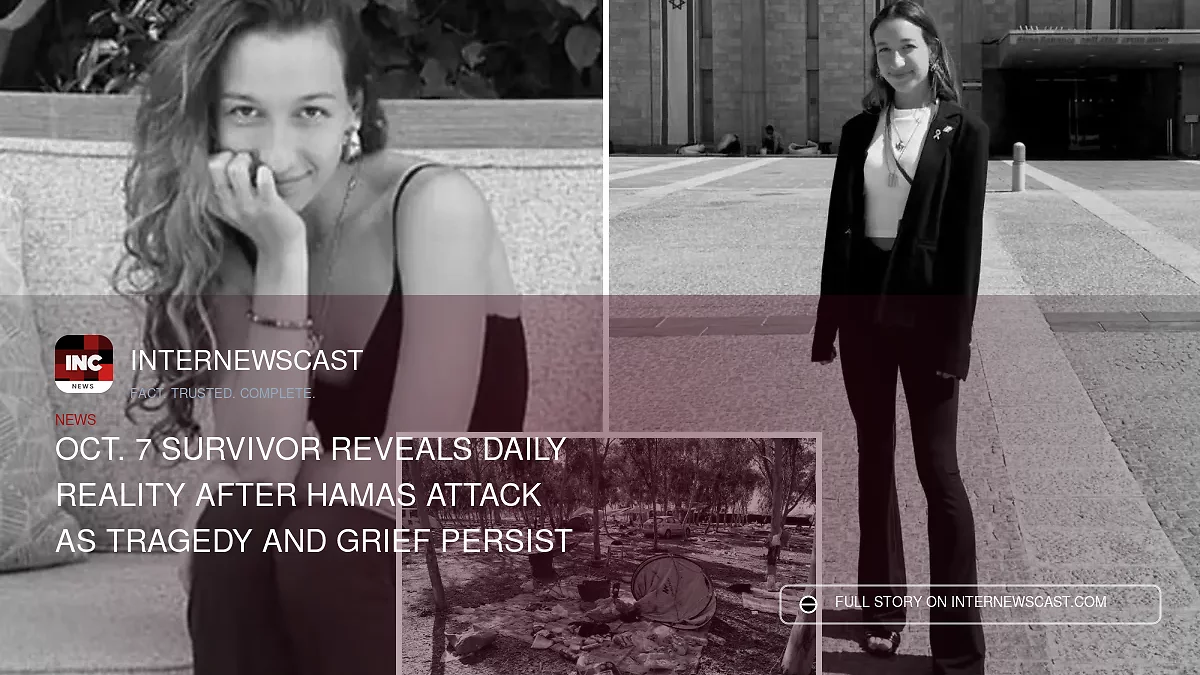

A woman who survived the Oct. 7, 2023, massacre has opened up about the crushing psychological toll she and other survivors continue to endure, speaking out just weeks after one fellow survivor died by suicide.
Maayan Dee, 26, was among roughly 3,500 people attending Israel’s Supernova music festival when Hamas terrorists stormed the gathering during the wider Oct. 7 attack, killing 378 festivalgoers and abducting 44 others.
“My life was cut in half,” Dee told The Post, reflecting on the day that left more than 1,200 people dead across Israel in the deadliest single-day attack in the Jewish state’s history.
“You have the previous life, and then life post-Nova.”
Dee was born in Israel and moved to the United Kingdom when she was 6, later developing a passion for martial arts and piano.
She left college after one year to enlist in the Israel Defense Forces in 2019, and she now credits that military training with helping her make the split-second tactical choices that saved her life — and the lives of others around her — nearly three years ago.
“I started hearing rockets, but it wasn’t apparent what was going on yet,” she said of the morning of Oct. 7, recalling that the incoming fire first sounded like “bass from the music, but offbeat.”
Once she identified the sound of automatic gunfire, Dee understood that it was not the IDF firing back at Hamas — and that the festival itself was under attack.
Dee said she knew it couldn’t be her country’s own troops because “we are trained not to use automatic weapons … they’re much less safe and accurate.”
Dee was speaking after an Oct. 7 survivor took his life earlier this month at the grave of his slain girlfriend.
“I had 14 friends who were with me who all — thank God — survived, but each of us is taking it their own way,” she said.
“It’s more difficult to find meaning in life now, because a lot of us say, ‘I got this life back as a gift. How do I go back to work?’ ” she said.
“You’ve got the extreme gratitude for being alive mixed with the desire to disappear and not feel this pain anymore.”
Dee quoted fellow festival survivor Roei Shalev, who ended up taking his own life on the second anniversary of the attacks in October 2025.
“The same night, he wrote on his Instagram story, ‘I can’t explain this feeling to anyone. I don’t expect you to understand, but I am burning from the inside,’ ” Dee said.
In the aftermath of Oct. 7, Dee was approached by SafeHeart, an Israeli organization that works with survivors, offering free therapy and support.
She has been with the same “amazing psychologist” ever since.
“Honestly, SafeHeart saved my life. I was in a very, very confusing place,” she said, describing how she was smoking weed daily to cope with survivor’s guilt.
“Why am I destroying my life now that I’ve got it as a gift?” Dee said she asked herself. “The psychologist helped me to put these things straight in my mind and let go of a little bit of guilt.”
Dee was also able to find peace in music again, reconnecting with the piano as an emotional outlet and a way to channel her energy.
She wrote a song, “Bring Them Home,” to support the hostages, raising money to send to their families.
Dee threw herself into advocacy, addressing Israel’s parliament in June and participating in May’s Israel Day March in New York City.
Thousands of people marched up Fifth Avenue in an event Dee described as a source of empowerment and unity for the Jewish community, after Mayor Zohran Mamdani chose to stay away.
“After the Holocaust, we didn’t have the strength or power or unity to show people, ‘You’re not just gonna kill us or get rid of us,’ ” she said.
“This ability to walk with pride after an event like [Oct. 7] and not just back down and say, ‘Oh my God, the world hates us. Oh my god, they’re gonna kill us again.’ … I think we need that inside strength,” Dee said.
SafeHeart has provided treatment to 2,500 Oct. 7 survivors and says many are still suffering from PTSD three years on.
“Recovery from trauma of this magnitude is a long and complex process requiring sustained, specialized support from professionals who understand … the extraordinary gap between the joy and freedom they experienced that morning and the extreme terror that followed,” SafeHeart CEO Efrat Aton told The Post.


