
Health authorities say thousands of travelers may have been exposed to measles after confirmed cases were linked to two major U.S. airports.
In Los Angeles County, officials confirmed a measles infection in a traveler who moved through Hollywood Burbank Airport, a hub that handled 6.2 million passengers last year, and may have visited other sites in the county.
The Los Angeles County Department of Public Health said Wednesday that the infected traveler arrived June 17 on Southwest Airlines Flight 4245 at Gate A4. Anyone who was at that gate between 8.45am and 9.45am may have been exposed, officials warned.
Potential exposure may also have occurred at the Thrifty Rental Car Service at 2627 N. Hollywood Way in Burbank, between 9.20am and 10.20am on June 17, and again from 10.25am to 11.25am on June 18.
Separately, the Chicago Department of Public Health issued an alert Tuesday after an international traveler who passed through Chicago O’Hare International Airport — which recorded 85.9 million passengers last year — was confirmed to have measles on June 17.
Officials said anyone who spent time in Terminal 5 between 5.50am and 9.30am that morning could have been exposed to the virus.
Authorities have not released identifying details about either traveler, including their points of origin or whether they had been vaccinated against measles.
California has reported 51 measles cases so far this year, while Illinois has recorded fewer than 10.

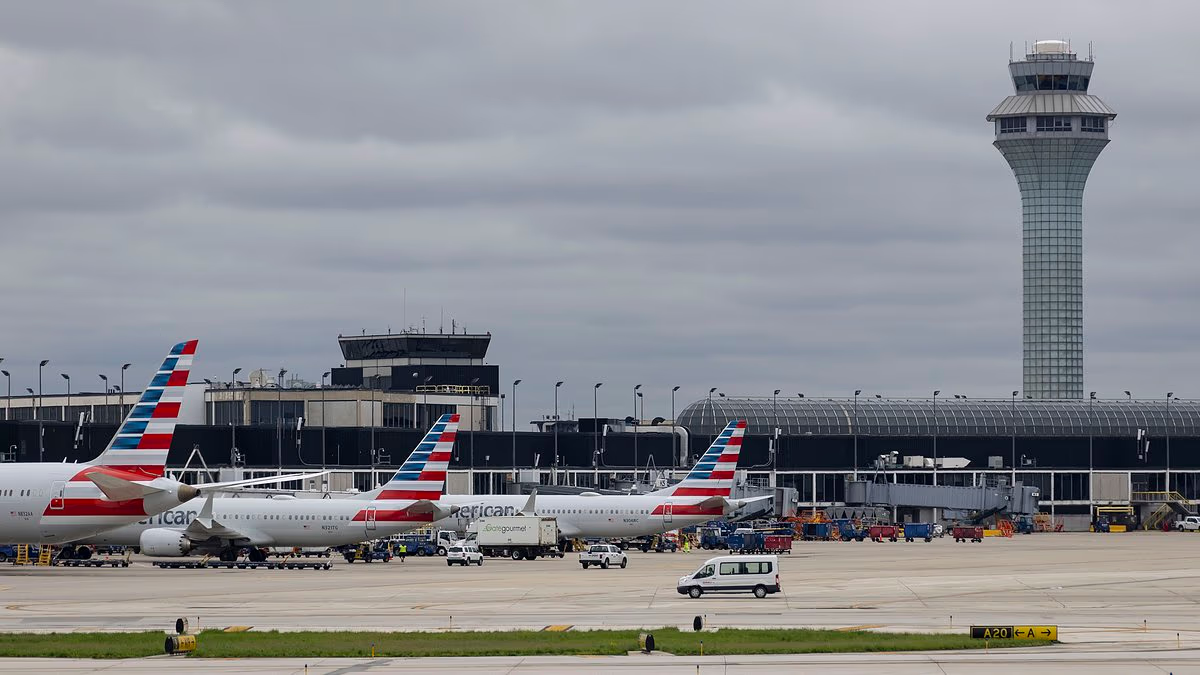
Passengers at O’Hare International Airport in Chicago (pictured above) and Hollywood Burbank Airport were warned of possible measles exposure
Health officials from both states said they are still working to identify anyone potentially exposed to measles.
They also urged the public to ensure they are up to date on the measles, mumps and rubella (MMR) vaccine. Two doses of the shot slash the risk of infection by 97 percent. For unvaccinated people, nine in ten of those exposed to the virus will get infected.
‘As measles cases increase, it is important that residents take steps to make sure they are fully protected,’ Dr Muntu Davis, Los Angeles County Health Officer, said in a statement.
‘The MMR vaccine is the safest and most reliable way to prevent measles and protect yourself, your family and your community.’
The MMR vaccine is typically given once between ages 12 and 15 months and again between ages four and six.
EXCLUSIVE: This 10-Second Finger Test Could Offer Clues About Your Dementia Risk
Nationwide, 92.5 percent of kindergarteners are fully vaccinated against measles, below the CDC’s 95 percent threshold for herd immunity.
Measles, which is highly infectious, is characterized by cough, fever, a distinctive, blotchy rash that starts on the face before spreading down the body and tiny white spots inside the mouth called Koplik spots.
The virus spreads through direct contact with infectious droplets or through the air. Patients with a measles infection are contagious from four days before the rash through four days after the rash appears. Enclosed areas like airports and planes are extremely risky locations for disease transmission.
It first invades the respiratory system, then spreads to the lymph nodes and throughout the body. As a result, the virus can affect the lungs, brain and central nervous system.

Measles causes a distinctive rash. In severe cases, it can also lead to pneumonia and brain swelling
While measles sometimes causes milder symptoms, including diarrhea, sore throat and achiness, it leads to pneumonia in roughly six percent of otherwise healthy children, and more often in malnourished children.
Though the brain swelling that measles can trigger is rare, occurring in about one in 1,000 cases, it is deadly in roughly 15 to 20 percent of those who develop it, while about 20 percent are left with permanent neurological damage, such as brain damage, deafness or intellectual disability.
Measles also severely damages a child’s immune system, making them susceptible to other potentially devastating bacterial and viral infections they were previously protected against.
Before MMR vaccines became available in the 1960s, measles caused epidemics with up to 2.6 million global deaths every year. By 2023, that number had fallen to roughly 107,000 deaths.
Nationwide, 2026 is already the second-worst year for measles cases in 34 years.
So far, the US has recorded 2,104 cases of the disease in 41 states, with four infections recorded in the week to June 14, according to CDC data.
This is already more than three times the 652 measles infections that were recorded by this time last year. In 2025, the US registered 2,285 measles cases.
Some 131 measles patients have been hospitalized, but no deaths have been recorded. There were three fatalities last year.