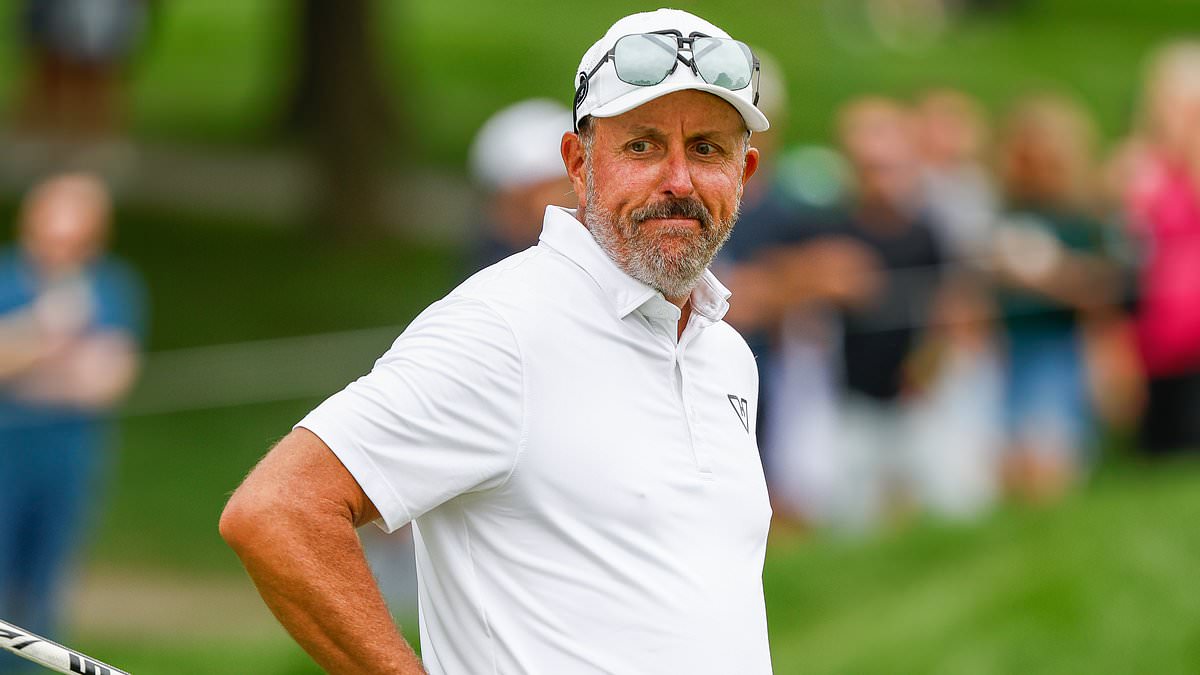
For years, Phil Mickelson has occupied a unique place in golf: part showman, part risk-taker, and rarely anything less than compelling.
Known as “Lefty” despite being naturally right-handed, Mickelson built an image that mixed wealth and celebrity with an everyman appeal. Even with the private jets and polished public profile, many fans still saw something familiar in him.
He was the player who stayed to sign autographs, greeted supporters with a handshake, handled disappointment with a smile and somehow made even his boldest misjudgments seem entertaining.
At Bethpage Black on Long Island, where he twice ended the US Open as runner-up, spectators embraced him like one of their own. His repeated near-misses only seemed to deepen that bond, making him feel more relatable in defeat than untouchable in success.
Now, however, that carefully sustained image appears to be fraying — and on Thursday, the decline in his standing was thrown into especially sharp focus.
According to Golf Digest, Mickelson, 55, has been banned from The Farms Golf Club, an exclusive course near his San Diego home where he had previously been a member.
A female employee of the club allegedly accused Mickelson of inappropriate unwanted physical contact in the clubhouse.
The report claims the unidentified woman rejected the six-time major champion’s advances, immediately alerted her supervisors and club officials confronted Mickelson on the course, mid-round, telling him to leave the premises.
For decades, Phil Mickelson has been golf’s favorite high-wire act. He’s rich, famous and private-jet polished, but fans have long bought into the idea that he is somehow one of them
Golf Digest reported that Mickelson, 55, has been banned from The Farms Golf Club , an exclusive property not far from his home in San Diego, where he was a member
Mickelson hasn’t personally commented on the allegation, though a spokesperson told Golf Digest that the allegation was false and ‘any misunderstanding has been cleared up’ but confirmed that Mickelson resigned his membership.
Even before the Golf Digest report it was becoming increasingly clear that Mickelson, who jumped ship from the PGA in 2022 after 30 years to help launch the short-lived Saudi-backed LIV Golf Tour, which announced in April that it will shutter unless new investors materialize, was running out of friends.
‘I can promise you one person that you’ll never see in any way in an official capacity with the PGA Tour is Phil Mickelson,’ former ESPN host Trey Wingo told the podcast Awful Announcing in May. ‘That bridge has been burned, detonated, destroyed, nuked, lasered to death. There is no building that bridge back.’
In hindsight, this all now seems like a long time coming.
The first rupture came with LIV Golf. To Lefty’s defenders, he was challenging the PGA Tour’s power and forcing change. To critics, he was taking Saudi money (reportedly $200 million) while torching the tour that had made a beloved figure.
It was the first time the old Phil charm met a story too big to gloss over. Suddenly, the people’s golfer looked less like a rebel and more like a mercenary.
Next came the gambling revelations. In 2023, ESPN reported allegations from professional bookmaker Billy Walters’ memoir that Mickelson had wagered more than $1 billion over three decades and had allegedly tried to place a $400,000 bet on the US team at the 2012 Ryder Cup that he played on.
Walters wrote that he talked Mickelson out of it and Mickelson denied ever betting on the Ryder Cup, saying he’d never undermine the integrity of the game. But Mickelson also acknowledged that his gambling had become reckless, embarrassing and addictive problem that he sought professional help to cure.
‘I can promise you one person that you’ll never see in any way in an official capacity with the PGA Tour is Phil Mickelson,’ former ESPN host Trey Wingo told the podcast Awful Announcing
And, of course, there are allegations from professional golfer, Pat Perez.
In 2022, on Claude Harmon III’s ‘Son of a Butch’ podcast, Perez said he had a ‘different hate’ for Mickelson than most people. He claimed Mickelson had crossed a line that was ‘uncrossable and unforgivable.’ He wouldn’t say publicly what the line was.
A year later, in a new afterword to Alan Shipnuck’s unauthorized Mickelson biography, ‘Phil,’ Shipnuck offered an alleged explanation.
According to Shipnuck, Mickelson invited Perez and his wife, Ashley, to dinner during the 2015 Barclays Tournament. When Perez left the table, Shipnuck wrote, Mickelson allegedly showed Ashley Perez a photograph of himself that she found offensive.
Perez declined to confirm the specifics, saying only that the matter had been handled between them. Mickelson’s side denied the account, with his attorney saying others present at the dinner called it ‘absolutely untrue.’
For a while, that story lived in golf’s gossip basement, weird and ugly but not quite central to the Mickelson narrative. Now, after The Farms report, it’s seeming harder to keep it there.
The new allegation doesn’t prove the old allegation. The old allegation doesn’t prove the new one. But reputations don’t collapse in neat legal compartments. They collapse when the public stops giving the benefit of the doubt.
For now, Mickelson is nowhere to been, at least publicly.

According to author Alan Shipnuck, Mickelson invited Pat Perez and his wife, Ashley, to dinner during the 2015 Barclays Tournament
In February, he announced that wouldn’t participate in LIV golf’s opening tournaments in Riyadh, Saudi Arabia, and Adelaide, Australia, citing a ‘family health matter.’
But his long absence from major golf has added to the eerie feeling that he’s disappearing from the sport in stages, absent from the Masters, absent from the PGA Championship, and now absent from the US Open field, while his playing future drifts into uncertainty.
The fall of Phil Mickelson isn’t one clean scandal. It’s a slow reputational cave-in. LIV cracked the foundation. The gambling revelations shook the walls. The Perez story lingered like smoke from another room. The Farms allegation brought everyone back to the same uncomfortable question.
What’s happening with Phil?
The answer may be that nothing happened suddenly. Maybe this was always the danger of building a public identity around risk and charm. For years, Mickelson made recklessness look like genius because the shots worked often enough and the sheepish smile did the rest.


