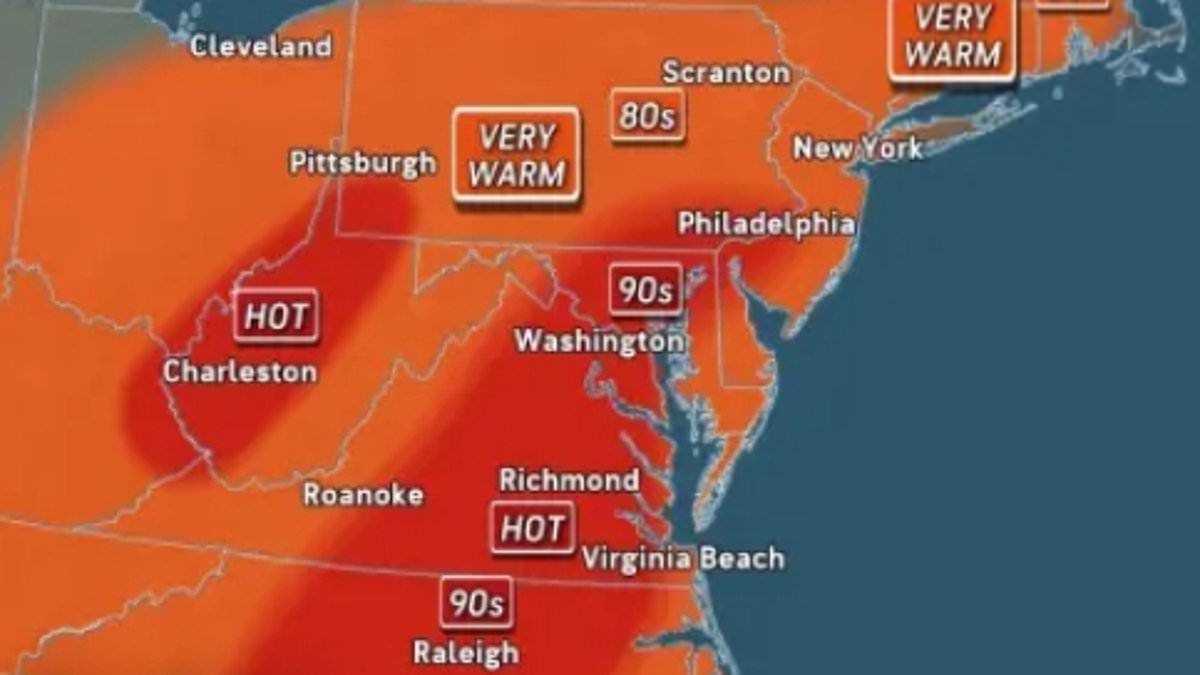

A formidable spring heatwave is currently engulfing the US East Coast, pushing temperatures to potentially historic highs and prompting advisories for residents to stay indoors.
Inhabitants of Washington, DC, and North Carolina are being cautioned to take special measures against heat-related health issues as temperatures are anticipated to soar into the mid-90s over the next three days.
Over 20 states, stretching from Massachusetts and New York in the Northeast to Georgia, Alabama, and Mississippi in the South, are bracing for this unusually early surge of heat, with temperatures expected to climb into the high 80s through Friday.
AccuWeather forecasts indicate that cities like New York City, Philadelphia, Washington, Providence, Rhode Island, and Raleigh, North Carolina, will experience temperatures on Wednesday that are more than 20 degrees above the usual April highs, which are typically in the 60s.
Matt Benz, a senior meteorologist at AccuWeather, commented, “The peak of the warmth across most areas in the Northeast will occur on Wednesday afternoon.”
“Even coastal regions can anticipate temperatures significantly exceeding the historical average for mid-April on Wednesday,” he added.
The widespread scorcher has triggered warnings from the National Weather Service (NWS) in certain areas to avoid outdoor activity or strenuous work whenever possible this week, as the sudden temperature spike could lead to dehydration.
They have advised Americans, especially those vulnerable to heat, such as the elderly and children, to stay in the shade, hydrate constantly and avoid sitting in parked cars, as the heat can be amplified inside these tight spaces and lead to fatal accidents.

Temperatures have skyrocketed throughout the East Coast, including in major cities like New York (stock image)

A massive high pressure system near the Carolina Coast has been pushing heat north this week
The heat has been caused by a large area of high pressure that has moved in along the Carolina coast.
This system has acted like a giant pump, pulling very warm air northward from the South.
It is the same kind of weather pattern that often brings hot summer days later in the year, which meteorologists refer to as a ‘Bermuda High,’ but this one has shown up weeks ahead of schedule.
As a result, temperatures that would be normal for mid-summer have arrived this week, and are now challenging records that have stood for nearly a century in some cities.
The predicted Wednesday high in New York of 88 degrees Fahrenheit would be the hottest the ‘Big Apple’ has been on this day since 1941.
With temperatures expected to reach the low to mid-90s in Washington, Baltimore and Richmond, Virginia, it will be the earliest 90-degree day in the region since 2013.
Meanwhile, temperatures are expected to reach 91 on Wednesday, breaking a 24-year-old record for the earliest 90-degree day in the city, set on April 16, 2002.
‘Early-season heat can hit harder than people expect because it arrives before routines, clothing and outdoor plans have adjusted to summerlike conditions,’ Benz cautioned.

Residents in New York sit in the hot sun as an unusual spring heat wave broke out on Tuesday

Temperatures on Wednesday were expected to reach record highs for April in many areas
The hot streak throughout the East is expected to last into the weekend, with the warmest days coming between Wednesday and Friday.
Cooler air finally moves in at the start of next week, and the AccuWeather team warned Americans to have their jackets ready for temperatures plunging back to seasonal norms – meaning a drop of up to 30 degrees.
The East Coast heatwave has struck just one month after a historic winter heatwave blasted half the country, from the West Coast to the Midwest.
The mid-March spike in temperatures sent thermometers above 100 degrees in California, Nevada, Arizona and Texas for multiple days.
While this spike in the East will not reach the same danger level, NWS officially called the event a ‘Moderate Heat Risk’ in a warning on social media.

Elderly Americans and children have been urged to stay in the shade this week as temperatures soar in over 20 states (stock image)

New Yorkers were seen enjoying the unseasonable weather on Tuesday, which was nearly 30 degrees above normal
‘The hot conditions will be impactful to many, even though humidity is low. Be sure to stay hydrated and wear light colored clothing when outdoors. Highs could reach their all-time April records,’ NWS officials in Maryland posted on X.
In areas exceeding 90 degrees this week, Americans may need to take action immediately if they experience symptoms of heat exhaustion or heat stroke.
Heat exhaustion often starts with heavy sweating, fatigue, developing cool, pale, clammy skin and a fast, weak pulse, muscle cramps, dizziness, nausea and headaches.
As for heat stroke, which is far more deadly and can develop within 15 minutes in extreme conditions, the first symptoms are often a throbbing headache, confusion, slurred speech, nausea, dizziness, and a fever above 103 degrees Fahrenheit.
Sufferers may also develop red, dry, or damp skin, a rapid pulse, and lose consciousness.
Move anyone affected by these conditions into a cool, shaded spot right away and call 911.


