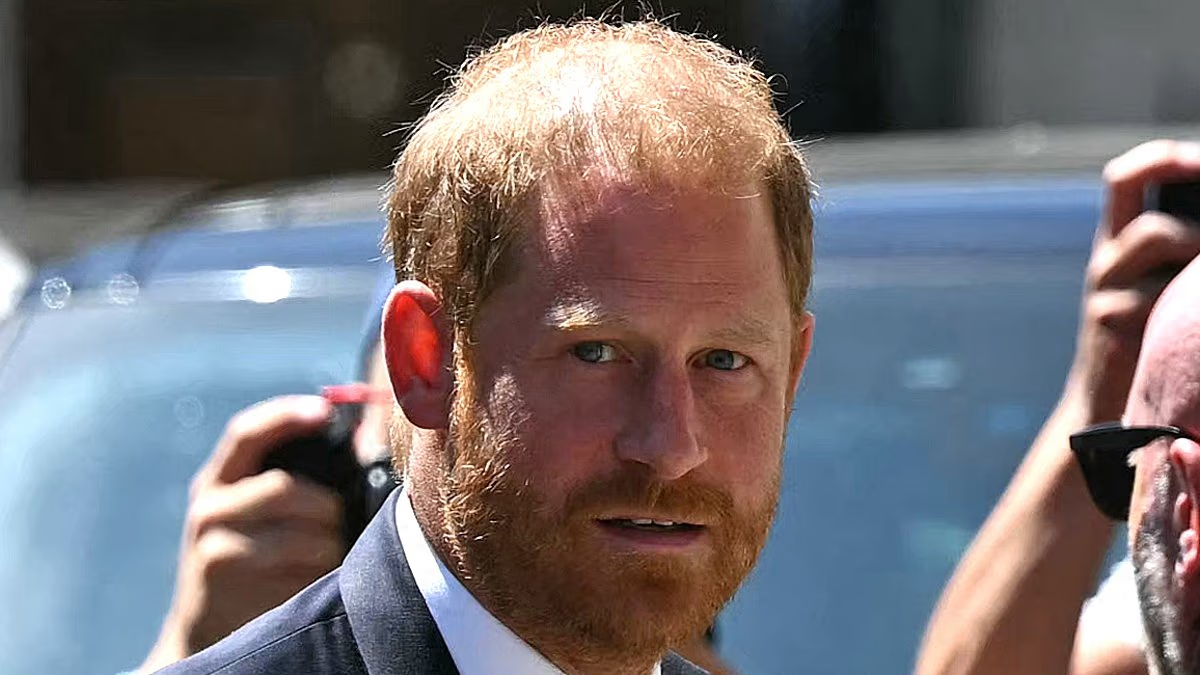

A £50million legal claim alleging phone hacking and other unlawful activity, brought by Prince Harry, Doreen Lawrence and several high-profile figures against the publisher of the Daily Mail, was thrown out in its entirety today.
The action, filed by the Duke of Sussex and six other claimants — among them Sir Elton John and Elizabeth Hurley — was considered during a three-month trial at London’s High Court earlier this year.
Mr Justice Nicklin, who presided over the proceedings, concluded that all of the articles at the centre of the complaints had been obtained through lawful means.
The claim was directed at Associated Newspapers, the media group behind the Daily Mail and The Mail on Sunday.
In an executive summary of the ruling, Mr Justice Nicklin said: “Associated called journalist witnesses who gave lawful explanations for the sourcing of the disputed articles and incidents.
“The Court accepted their evidence, including their denials of UIG [unlawful information gathering].

Prince Harry, pictured today, was among the claimants in the £50million case against the Daily Mail’s publisher, which has now been dismissed in full
“The allegations were serious: they included allegations of dishonesty, unlawful conduct and deliberately false evidence. The more serious and less likely an allegation is, the more convincing the evidence must be before a court can find it proved.”
An Associated Newspapers spokesman said: ‘Associated Newspapers welcomes today’s judgment, which is an overwhelming victory for the Daily Mail and its journalists, and for a free press generally.
‘Mr Justice Nicklin today cleared the Daily Mail and The Mail on Sunday, and dismissed every single one of the 97 allegations made by the claimants. In every case, the Judge accepted the honesty of our journalists’ evidence on how they sourced their stories.
‘This is a magnificent vindication of the Daily Mail’s journalism.
‘For some of the most outrageous allegations made when the case was launched in a blaze of publicity four years ago – placing bugs in people’s cars and homes, listening to calls as they were made and illicitly accessing bank accounts – no credible evidence was ever presented.
‘As we said at the time, these allegations were “lurid” and “preposterous”, and were a fishing expedition by the claimants and their legal teams in a politically motivated campaign to muzzle the free press.
‘The reputations of our decent and hard-working journalists were terribly impugned, and today they have been exonerated.
‘As the judgment clearly shows, every single article was legitimately sourced.
‘Associated Newspapers thanks Mr Justice Nicklin for the patience and wisdom he has displayed throughout this misguided legal action, which has wasted so much valuable court time and more than £50million in legal costs.
‘We will look to resolve outstanding issues, including the recovery of the costs we have incurred while defending ourselves against this egregious litigation.’
Prince Harry flew in from California to give evidence in his case, which lasted only 75 minutes.
READ MORE: Viral Coca-Cola Recipe Trend Takes Over Social Media With Wild Fan Creations
Bristling with anger, he told the judge his wife’s life had been made ‘an absolute misery’, even though the Duchess of Sussex had nothing to do with the case.
Yet far from being a victim of phone hacking, evidence emerged Prince Harry had spoken to journalists himself and even partied at a country house one weekend with a Mail on Sunday reporter who called him ‘Mr Mischief’. Harry called her ‘sugar’ and wrote to her: ‘Miss our movie snuggles!!’
The judge said that in assessing Prince Harry’s evidence overall, ‘it was apparent that he wished the court to understand the personal impact of the matters in issue. At times, this led him beyond giving factual evidence into advancing arguments on the issues.’
Mr Justice Nicklin added: ‘As I indicated to Prince Harry at the time, that is not uncommon: many litigants feel a strong instinct to argue their case themselves.
‘Overall, this did not affect the quality of Prince Harry’s evidence, which I accept. As with each of the claimants, Prince Harry has limited evidence to give on the contentious matters in dispute.’
From the moment the case began in 2022, the Daily Mail has consistently denied the accusations, for which there was never any credible evidence.
Even the claimants’ own supposed star witness, a private investigator named Gavin Burrows, told them he had never worked for the Mail, yet they ploughed ahead with the case anyway.
Prince Harry, Ms Hurley, Sir Elton, his husband David Furnish and Baroness Lawrence all launched their claims on the basis of alleged ‘admissions’ from Mr Burrows about hacking their voicemails, tapping their landlines, bugging Hugh Grant’s car and, in Ms Hurley’s case, placing a sticky microphone on her dining room window – none of which was true.
Mr Burrows said in his evidence that his ‘confession’ statement had been penned by Prince Harry’s legal researchers and was ‘a pack of lies’ complete with a forgery for his signature.
The statement was authenticated with a ‘certificate of compliance’ by Baroness Lawrence’s glamorous solicitor Anjlee Sangani.
She quit the case just before the trial started.
When Mr Burrows came to give evidence on oath, the claimants tied themselves in knots and were reduced to calling their star witness a liar and a drunk.
The judge dismissed all the Burrows allegations.
Mr Justice Nicklin found that Mail journalist Stephen Wright gave truthful evidence, his explanations were ‘coherent and plausible’, and the allegation he had corruptly paid police officers was dismissed.
His ruling said: ‘I accept Mr Wright’s evidence that he has not made corrupt payments to serving police officers, whether in relation to the specific incidents alleged or generally.’
The Mail’s Royal Editor Rebecca English was ‘an impressive and honest witness’ and the judge said her explanations for where she had sourced stories were ‘entirely plausible’.
He threw out an allegation that she had tried to get the flight details of Prince Harry’s former girlfriend Chelsy Davy.
The judge was critical of the claimants’ lawyers for advancing allegations against Ms English her at trial in relation to phone hacking which were ‘entirely unsupported by evidence’.
Mr Justice Nicklin said: ‘It was, in substance, a serious allegation advanced without particulars and without evidential foundation.’


