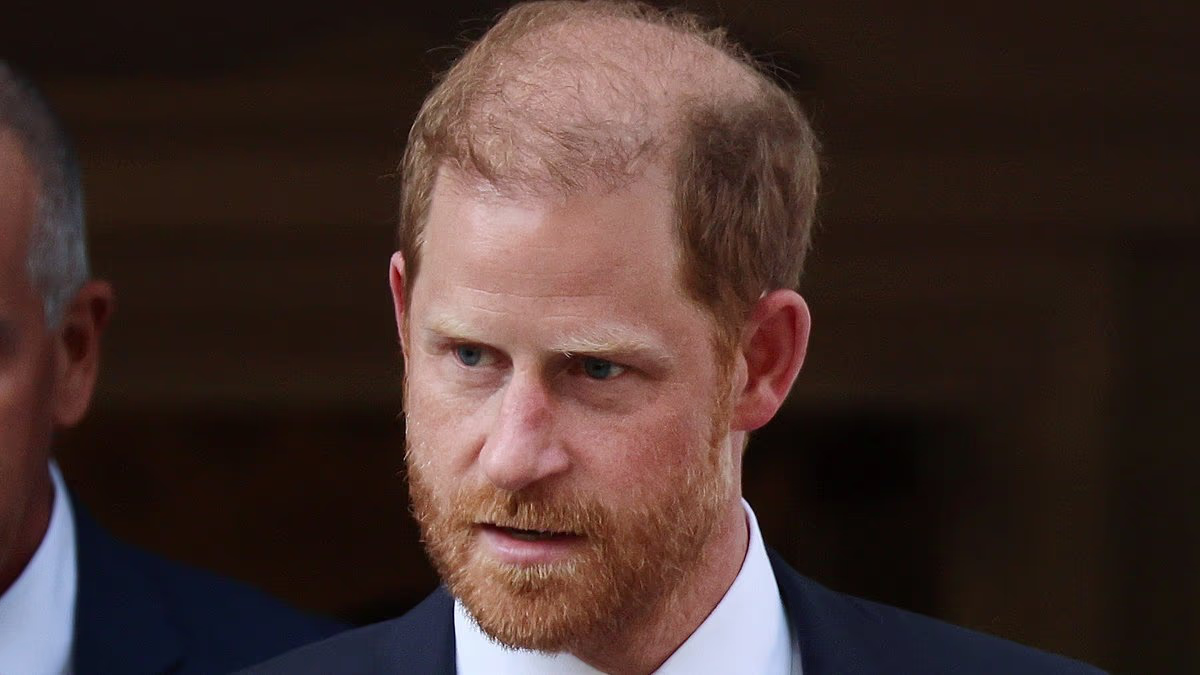

Winston Churchill once observed: “In war, resolution; in defeat, defiance; in victory, magnanimity.” The line feels apt after a bruising, four-year legal campaign by Prince Harry and others aimed at this newspaper.
In the end, the judge found no evidence of wrongdoing and delivered a ruling wholly in the Daily Mail’s favour. Magnanimity may be the order of the day, but it is hard to deny a faint note of schadenfreude when those who brought the case have, in the process, inflicted such distress on others.
That is why it is important to recall the role this newspaper played in one of the most significant justice campaigns in modern Britain: the fight to hold Stephen Lawrence’s killers to account.
In 1997, the Daily Mail’s then editor, Paul Dacre, took the extraordinary step of putting the suspects’ faces on the front page — a decision that carried serious personal and legal risk. Without that act of defiance, it is difficult to imagine the Macpherson Inquiry, or the eventual retrial and conviction of two of the original suspects, unfolding in the way they did.
For that reason, Stephen’s mother being drawn into this attack is especially painful. Her involvement in the case feels deeply misplaced, and lends a bitter new resonance to the old phrase: no good deed goes unpunished.
It was more troubling still, after the ruling, to hear Stephen’s mother echo Prince Harry’s response by describing the outcome as “a complete and obvious whitewash” and claiming they had been denied “justice” and “accountability.”
Public figures have always had an uneasy relationship with the press. Fame often depends on publicity, yet those who live in the spotlight understandably seek boundaries around their private lives.
But there is a clear difference between objecting to the conduct of an overzealous journalist and declaring open war on an entire industry simply because it will not bend to your wishes.

It’s certainly the case that Prince Harry, that most perpetually peeved member of that most privileged of elites, has never seemed particularly mindful of the repercussions of his actions on others, writes Sarah Vine
It’s certainly the case that Harry, that most perpetually-peeved member of that most privileged of elites, has never seemed particularly mindful of the repercussions of his actions on others. We have seen this time and again in his interactions with his own family.
His father, his brother, his sister-in-law, even his late grandmother, Queen Elizabeth II: none of their feelings appeared ever to be taken into consideration when Harry was on the warpath.
We saw this most acutely in his autobiography, Spare, where he not only trampled on the feelings of everyone close to him, but also seemed to delight in demolishing the so-called ‘little people’ in his life.
People such as the matron at his school, Pat, whom he described with such careless cruelty: ‘Pat wasn’t hot. Pat was cold. Pat was small, mousy, frazzled, and her hair fell greasily into her always tired eyes,’ he wrote.
Poor Pat: she was probably being driven half-mad by spiteful little lordlings like Harry. He goes on to recall how he and his mates would mock her for her ‘crooked spine’ and laugh at her as she painfully descended the stairs.
And let’s not forget the woman he lost his virginity to, an episode dismissed as a ‘quick ride’. He never even thought to warn her that she might be identified after being described in the book.
The fact that the feelings of neither seemed to matter a jot to Harry spoke volumes – to my mind, at least – about his true character. These people are entirely disposable to him, and certainly not women whose feelings really counted.
Whether this high-handed attitude to other people is something Prince Harry recognises in himself is debatable. Unlikely, since he never stops going on about how he considers himself such a champion for ‘kindness’.
But to the rest of the world it’s a glaringly obvious character trait which has informed many of his poor decisions in life, especially in recent years.
In essence, if he doesn’t get his own way, he blames others and lashes out. At his father, at the Royal Family itself, at the British government, at the media – even at former friends and colleagues who dare to question his victim narrative.
MORE STORY: Nearly 900 NYC Schools Face Concerns Over Grade Inflation and Weak Accountability
This latest, unsuccessful, attempt to shift the blame on others for his difficulties is the ultimate expression of that delusion. As is his response to this judgment, about which he is dismissive (‘a whitewash’). He also demonstrates a fundamental ignorance of the way newspapers – and the law – work.

Perhaps like his mother, Princess Diana, Harry has been convinced that the Royal Family is against him, writes Sarah Vine

It’s been clear all along that Prince Harry doesn’t really understand the process of the law very well at all, writes Sarah
‘This judgment represents a complete reversal of the position which previous judges have taken in relation to the hacking claims successfully brought against both News Group Newspapers and Mirror Group Newspapers,’ he states.
I hate to break it to you, sir, but the Daily Mail is neither of those organisations, and the law – quite correctly – does not make decisions based on previous verdicts, rather on the merits of every individual case.
But then, it’s been clear all along that Prince Harry doesn’t really understand the process of the law very well at all.
There is a very telling passage in the judge’s verdict where he writes: ‘In assessing Prince Harry’s evidence overall, it was apparent that he wished the court to understand the personal impact of matters in issue. At times, this led him beyond giving factual evidence into advancing arguments on the issues…
‘As I indicated to Prince Harry at the time, that is not uncommon. Many litigants feel a strong instinct to argue their case themselves. However, when giving evidence, that is not a burden they are required to carry. The responsibility for advancing the party’s case rests with the advocate.
‘Overall, this did not affect the quality of Prince Harry’s evidence, which I accept. As with each of the claimants, Prince Harry had limited evidence to give on the contentious matters in dispute.’
In other words, Harry has no real idea what he’s doing here. But perhaps he’s not entirely to blame. After all, he is not the sharpest tack in the box. And I can’t help wondering if, in this instance at least, his mind may have been captured – or perhaps influenced – by more cunning actors in this saga.
Tragically, this is what happened with Harry’s mother, Princess Diana. She became convinced, through the duplicitousness of the BBC and its disgraced reporter Martin Bashir, that the Royal Family were out to get her.
Bashir ruthlessly exploited her anxiety and paranoia by falsifying bank statements to secure the trust of her brother, Earl Spencer, and thence hers, and fabricated frightening conspiracy theories, telling her that her phone was being tapped and her life in danger. As a result, she acquiesced to the 1995 Panorama interview under the delusion that it was the only way to protect herself.
Truly, if ever there was a media organisation that Prince Harry ought to have gone after, it is the BBC, which still has not made reparations or formally reprimanded Bashir. But the BBC being bad does not fit the narrative, does it?
Bottom line, there is relief for newspapers in this verdict, but no real sense of victory. Some colleagues will never fully recover, but now at least they will the satisfaction of knowing that they have been vindicated.
As for Harry, perhaps this would be an opportune moment to pause and reflect on some of his choices over the past few years, and to consider which battles are worth fighting. It has the potential to be what my ex-husband, one-time Education Secretary, used to call a ‘teachable moment’.
For what is life if not a series of mistakes from which we must learn? Then again, knowing Harry, maybe not.


