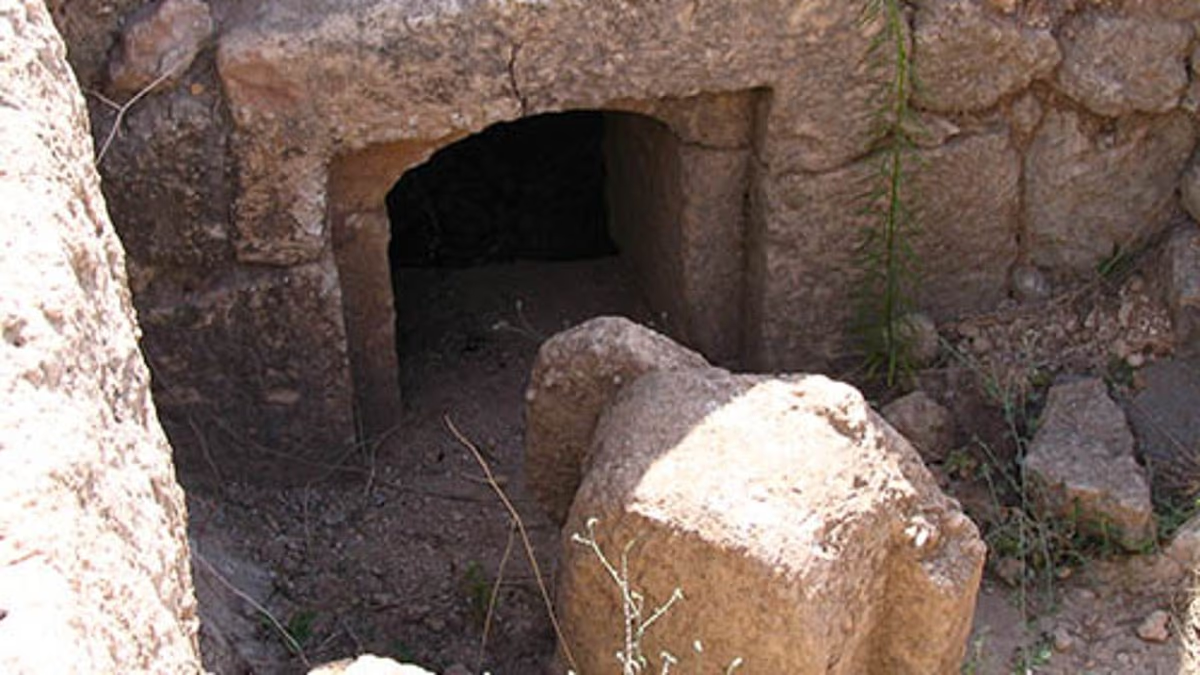

At the center of an ancient Jerusalem church, a rock-cut burial chamber is believed by millions of Christians to be the tomb where Jesus Christ was laid to rest.
The tomb lies beneath a small shrine inside the Church of the Holy Sepulchre, a site revered for nearly 1,700 years as the place of Jesus’ crucifixion, burial and resurrection.
Archaeologists have now identified the remains of a circular marble monument, measuring about 20 feet across, that once surrounded the burial chamber. The find provides new physical evidence that this tomb was deliberately distinguished and honored in antiquity.
Researchers discovered that the rock around the chamber had been intentionally cut away. Archaeologist Francesca Romana Stasolla described it as “the chamber in which tradition recalled the deposition of Christ.”
The monument may have been built around this specific tomb because early Christians believed it was Jesus’ burial place. That tradition could have been preserved and passed from one generation to the next.
Fragments of the ancient structure were found beneath the existing shrine. Researchers believe its circular design may have echoed the form of the original monument commissioned by Roman emperor Constantine nearly 1,700 years ago.
Stasolla said the monument was kept deliberately modest, explaining that “the monumentalization was kept to a minimum, in an effort to preserve as far as possible the original appearance of the venerated Tomb.”
The surviving marble could date to a later construction phase, but researchers called the remains “the earliest archaeologically documented monument built around the venerated tomb.”

Archaeologists uncovered the remains of a 20-foot-wide circular marble monument around the burial chamber, providing new evidence of how the tomb was singled out and honored in antiquity.
Stasolla said the tomb’s association with Jesus may have endured through an ancient chain of communal memory.
“It is nonetheless possible that the memory of this tomb had crystallized within the early community and had been transmitted across generations,” she wrote in the excavation report.
The Church of the Holy Sepulchre draws an estimated four million visitors every year.
The first church at the site was dedicated in AD 335, after Roman structures traditionally described as a temple to the goddess Venus were demolished.
During the construction, workers uncovered a rock-cut chamber that was identified as Jesus’ burial place, almost 300 years after his death.
Constantine’s builders concentrated on a single tomb that was already being venerated as Christ’s burial site, excavating around it to separate it from the surrounding graves.
The church standing today was built and restored beginning around 614 to 626 AD, after the Persian Sassanid invasion caused extensive destruction and fire.
Many scholars support the Church of the Holy Sepulchre’s identification as the site, pointing to the first-century rock-cut tombs found there.

Evidence uncovered beneath the Church of the Holy Sepulchre is consistent with biblical descriptions of the place where Jesus was buried.
Other researchers argue that the Garden Tomb, another ancient burial site in Jerusalem, more closely fits the biblical descriptions.
MUST READ: Bronx Man Shot by ICE Was Undocumented, Had Criminal Record
The latest discoveries are presented in a 605-page report based on excavations carried out between May 2022 and October 2025.
The surviving structure was constructed from recycled marble slabs, carefully shaped and joined with mortar to form a circular platform centered on the burial chamber.
Archaeologists also identified a narrow channel carved into the marble, apparently designed to carry water around the monument and into a nearby collection system.
But the marble itself holds another clue to the shrine’s turbulent past.

Archeologists were excavating the floor of the church (pictured) when they uncovered signs of an ancient garden that is mentioned in the Bible as where Jesus was laid to rest

In first-century Jerusalem (during the Second Temple period), more than 98% of Jewish burial caves were sealed using heavy, square, or plug-type blocking stones rather than round disks
Two of the surviving slabs bear faint traces of ancient decorative patterns that appear to date from after Constantine’s reign, suggesting the structure may have been rebuilt or repaired centuries after its original construction.
Stasolla raised the possibility that the surviving marble belonged to restoration work carried out following the Persian attack on Jerusalem in 614 AD.
Researchers are now examining the mortar used to join the slabs in an effort to establish when different parts of the structure were assembled.
Despite those uncertainties, the monument’s circular shape closely matches early depictions of the shrine, leading archaeologists to believe that the original fourth-century structure may have followed the same design.
That early monument may also have featured a ring of small columns, an arrangement depicted in ancient representations of the tomb and echoed in descriptions left by later pilgrims.
However, only a portion of the marble base has survived, preventing researchers from determining exactly how the original structure appeared.

Archaeologists uncovered an ancient road under the church, which could have been taken by Jesus to the cross nearly 2,000 years ago
The report also included the discovery of an ancient road leading out of where the church stands, which archaeologists speculated could have been a path of execution.
The surviving section measures roughly 10 by 12 feet and lies beneath a Crusader-era walkway inside the church. Its original edges no longer survive, but its curve and pronounced slope suggest it climbed toward the southwest.
Professor Francesca Romana Stasolla, who leads the excavation, wrote: ‘One possibility – at present no more than a hypothesis – is that this was a suburban road ascending toward the area of the Calvary, assuming that the site functioned as a place of public executions.’ The Bible says Jesus was crucified on Calvary.
Stasolla considered whether it served Roman construction crews, but the step would have hindered carts hauling heavy building materials. Its construction and dimensions also made it unlikely to have been merely a small path leading to nearby tombs.
Roman executions were public spectacles, and an approach road needed to accommodate spectators whose presence added to the humiliation of the condemned.


