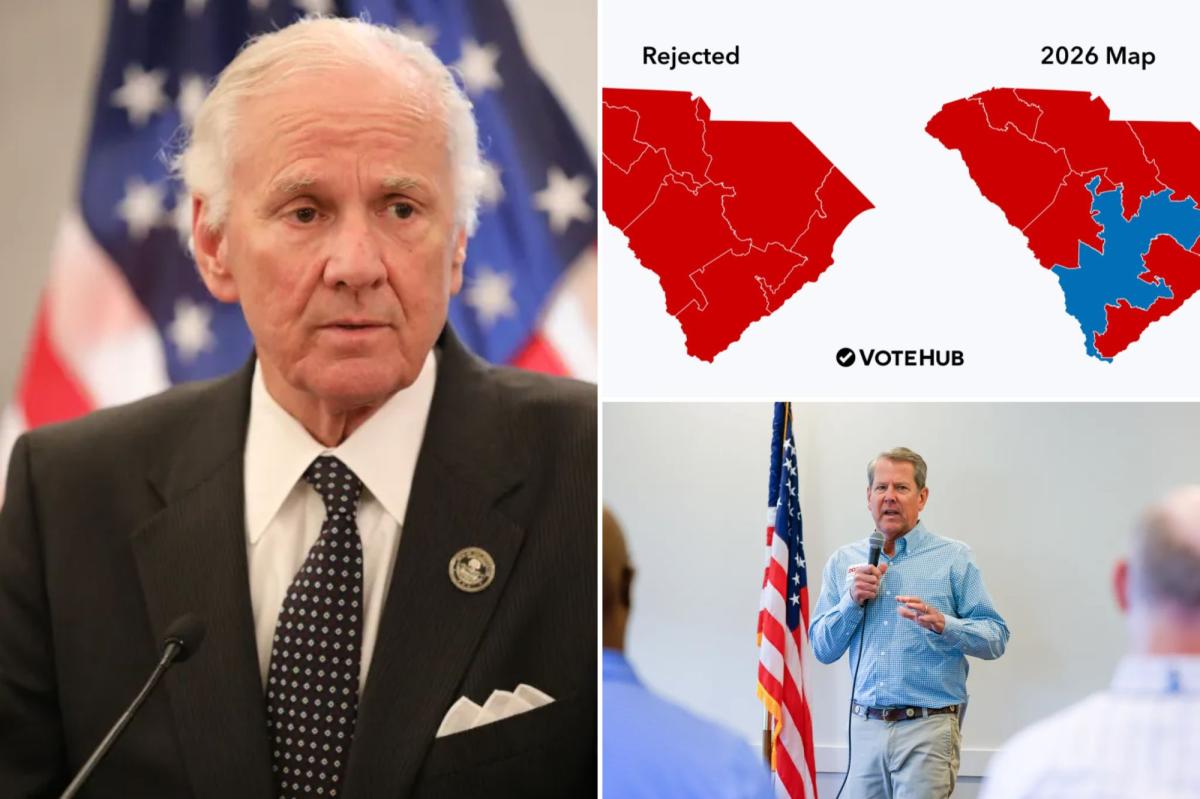


In Washington, speculations are swirling around South Carolina Governor Henry McMaster, who may be planning to convene a special legislative session aimed at reshaping the state’s congressional map. Such a move could pose a threat to the seat of Rep. Jim Clyburn, the state’s only Democratic member in Congress.
The state’s legislature, which has been unable to finalize the redistricting process, is set to conclude its current session by the end of the week. Should McMaster decide to pursue this route, it would necessitate action after the assembly adjourns.
“I urge the General Assembly to finish its work according to the U.S. and South Carolina constitutions and the best interests of the people,” McMaster remarked in a public statement. However, when asked about the possibility of a special session, the governor’s spokesperson chose not to comment.
Prominent political figures in South Carolina, including Rep. Ralph Norman, suggest that McMaster is indeed considering this decisive step. This comes after a significant setback on Tuesday when five Republican lawmakers broke rank, opposing the proposed congressional map that could potentially dismantle the state’s lone Democratic stronghold.
South Carolina Senate Majority Leader Shane Massey, a Republican who resisted the push for the new map, voiced his concerns, stating, “We are the most gerrymandered Republican state in the country already.” His remarks highlight the ongoing debate and resistance within the state’s political landscape.
“We are the most gerrymandered Republican state in the country already,” South Carolina Senate Majority Leader Shane Massey (R), who opposed the measure, argued.
Unlike the vote on Tuesday, a special session would enable Republicans to pass the new map with a simple majority.
South Carolina has seven congressional seats, all but one of which are held by Republicans.
Earlier this month, McMaster expressed opposition to calling a special session. Since then, he has faced pressure from President Trump’s allies.
“Our influence is contagious,” firebrand Rep. Nancy Mace (R-SC), who is vying for governor, later crowed on X. “We called on South Carolina to follow the Constitution. We applied pressure on the Governor.”
“That is what happens when you apply real pressure and mean it.”
Meanwhile, in Georgia, outgoing Gov. Brian Kemp (R) has formally called for a special session in the Peach State starting June 17 with the goal of reworking congressional and state legislative maps for 2028.
Republicans in Georgia are mulling plans that could net them two more House seats and expand their grip on the state legislature.
The maneuvers in both states come in the wake of the Supreme Court’s ruling that courts effectively can’t force states to draw majority minority districts under Section 2 of the Voting Rights Act unless there’s proof that the maps were drawn with racist intent.
That ruling has opened the floodgates to Southern states scrambling to ax their VRA districts.
Some observers estimate that Republicans could gain 10 or more House seats from their mid-decade redistricting efforts, once the dust settles, depending on how states and the courts proceed.
“Republicans have clearly concluded that the only way they can win in November is to cheat,” House Minority Leader Hakeem Jeffries (D-NY) told reporters Wednesday. “We’re only three seats short right now.”
“Perhaps they’ll add a handful of seats when this is all said and done,” he added, arguing that Democrats will flip the House nonetheless.