The identity of South Korea’s next leader will be determined this week by the economy, housing prices and incomes, but the road to the presidential Blue House will also be dotted with the wreckage of the country’s poisonous gender politics.
The successor to Moon Jae-in, who is restricted by law to a single five-year term, will not be able to ignore the fallout from a campaign defined by the culture war being waged in the world’s 10th-biggest economy.
On one side, a feminist movement that led the Me Too movement in Asia; on the other, young men whose resistance to the modest gains made by South Korean women has been exploited by the two main candidates.
In 2018, women took to the streets in record numbers to call for government action against an epidemic of molka – the use of spy cams to secretly film women, often in public toilets – and helped bring down several public figures, including a candidate for the presidency, for sexual misconduct.
A year later, they helped overturn a decades-old ban on abortion, and shone a light into the darkest corners of an entrenched culture of male chauvinism, unequal pay and the expectation that their careers will end when they have children.
Despite the global success of its pop music and TV dramas, South Korea continues to perform poorly in international comparisons of women’s rights.
The 2021 World Economic Forum global gender gap report ranks it 102 out of 156 countries in an index that examines jobs, education, health and political representation.
South Korea has by far the largest gender pay gap among OECD countries, at about 32%, while women account for just over 19% of MPs in the national assembly. Only 5.2% of Korean conglomerates’ board members are female, and experts say the country’s record-low birthrate proves how difficult it is for its women to combine careers with family life.
Women have responded by challenging social norms, from refusing to wear bras and publicly destroying their makeup collections to vowing never to marry or have children or, in some cases, have sex with men.
Five years after its first female president, Park Geun-hye, went on trial on corruption charges, South Korea’s election campaign has brought the anti-feminist backlash into sharp focus.
Online “men’s rights” groups have condemned hiring quotas, while calls to abolish the ministry of gender equality and family – created in 2001 – have been seized on by the frontrunner.
The anti-feminist movement’s list of grievances includes the weighty subject of military service exemptions but often finds expression in vicious personal attacks on prominent women. They include An San, the triple Olympic archery gold medalist, who was abused during last summer’s Tokyo 2020 Games simply for having short hair.
Last year, South Korea’s biggest convenience store pulled ads for sausages after a a so-called men’s rights group complained that a promotional image – a hand gesture commonly used to indicate something small – had once been used by a feminist group to exploit male anxiety over penis size.
The misogyny contagion spread to the country’s politics late last year, when Cho Dong-youn, a military specialist, was forced to resign just three days after she had been appointed co-chair of the ruling Democratic party’s election committee.
Cho, a Harvard graduate with successful military and academic careers behind her, stepped down after a YouTube channel and broadcaster questioned her suitability for office. Her crime: having a child out of wedlock during her first marriage.
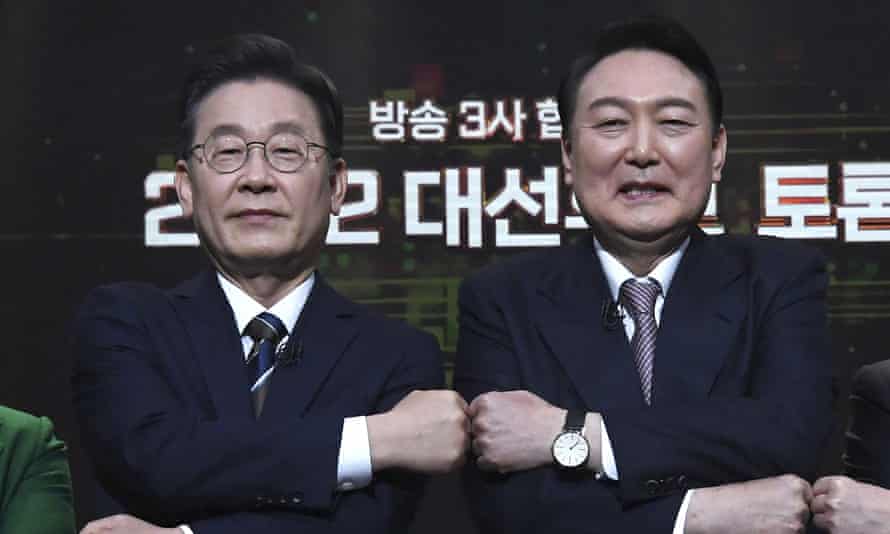
As the campaign enters its final stages, the conservative People Power party candidate, Yoon Suk-yeol, and his ruling Democratic party rival, Lee Jae-myung, have been accused of pandering to sexism to win the votes of young men who regard women’s advancement as a threat to their financial security, amid a bleak job market and rising living costs.
Many resent having to do 18 months of military service, a requirement for all able-bodied Korean men aged 18-28, while women are exempt. Hong Eun-pyo, who runs an anti-feminist YouTube channel, has tried to justify the gender pay gap, insisting that men work longer hours and do more difficult jobs. “If [women] want to reach as high as their male peers and be paid the same wages, they should keep working and not get pregnant,” he said.
Yoon, a former prosecutor general, has accused the gender equality ministry of treating men like “potential sex criminals” and has promised to introduce tougher penalties for false claims of sexual assault – a step campaigners say will deter even more women from coming forward.
In addition, scrapping the gender ministry could weaken women’s rights and “take a toll on democracy”, said Chung Hyun-back, an academic who served as gender equality minister under Moon.
Yoon, 61, is said to be heavily influenced by his party chairman, Lee Jun-seok, a 36-year-old Harvard graduate and “men’s rights” advocate who has criticised hiring targets for women and other female-friendly policies as “reverse discrimination”, and described feminist politics as “blowfish poison”.
Even Lee, the potential liberal successor to self-proclaimed feminist Moon, has said he opposes “discrimination” against men, and cancelled an interview with a media outlet because of its supposed feminist leanings. Although he opposes Yoon’s plans to abolish the gender equality ministry, he wants to drop the word “women” from its official Korean-language title.
By the weekend, Yoon had established a small lead over Lee, after Ahn Cheol-soo, a minor party candidate, withdrew from the race and threw his support behind the People Power candidate. According to a Realmeter poll published on Wednesday, 46.3% of respondents said they would vote for Yoon, with 43.1% backing Lee.
While the two frontrunners go out of their way to avoid offending young male voters, women say the election has plunged South Korea back into the dark ages. “We are being treated like we don’t even have voting rights,” said Hong Hee-jin, a 27-year-old office worker in Seoul.
“Politicians are taking the easy path. Instead of coming up with real policies to solve problems facing young people, they are fanning gender conflicts, telling men in their 20s that their difficulties are all down to women receiving too many benefits.”
Agencies contributed reporting
Source: This post first appeared on The Guardian