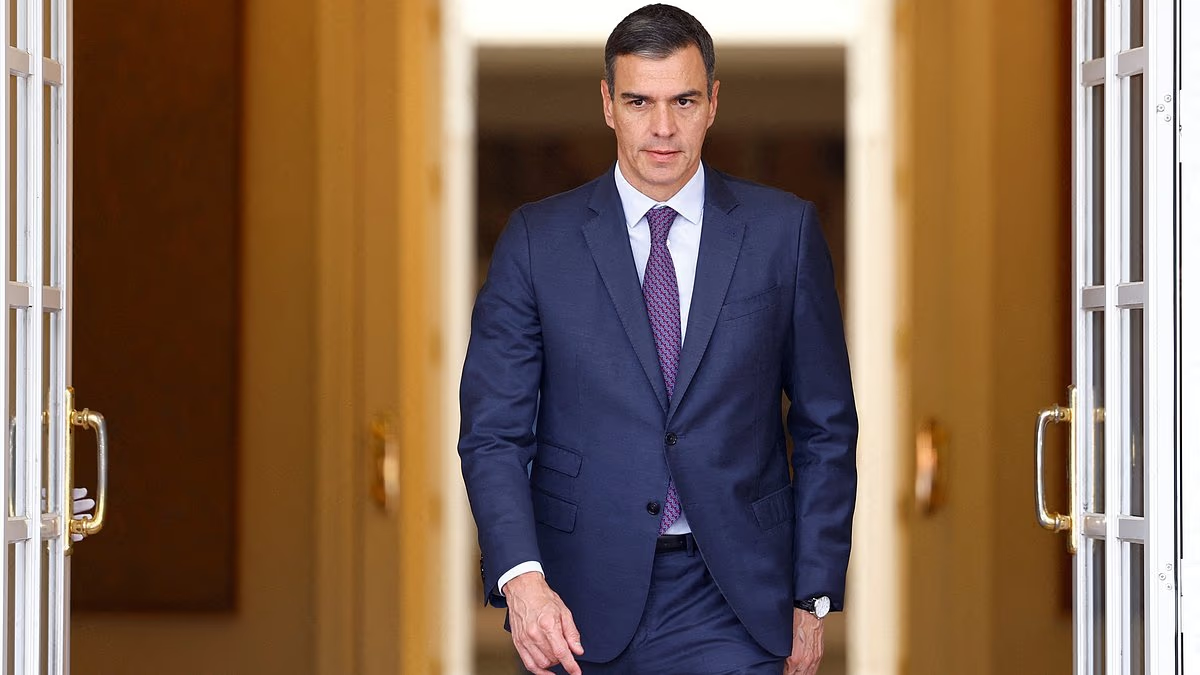

Spanish Prime Minister Pedro Sánchez has called an early general election after his Socialist-led government suffered a major parliamentary defeat over emergency measures intended to address the country’s worsening housing crisis.
The election is scheduled for November 29. Pressure on Sánchez has intensified in recent weeks as Spaniards demand action on soaring housing costs. Protests have spread across the country, fueled in part by public anger over the televised eviction of an 87-year-old woman in Madrid last month.
Right-wing opposition parties united in Parliament to block two emergency decrees that included measures aimed at limiting evictions and curbing property speculation. The defeat immediately raised questions about whether Sánchez would bring forward a national vote planned for next year.
Announcing the election, Sánchez urged voters to decide whether Spain should “regress or keep moving forward.”
He accused his opponents of forming a “far-right coalition that offers no proposals” after they rejected housing reforms that would have restricted the eviction of vulnerable tenants and introduced automatic lease renewals.
Spain’s main opposition force, the conservative People’s Party, welcomed the snap election. It posted a video online carrying the brief caption: “At last.”
Sánchez, 54, has served as Spain’s prime minister since 2018, making him one of Europe’s longest-serving national leaders.
On the international stage, Sánchez has become known for his outspoken support of progressive causes, including Palestinian statehood, multilateral institutions and efforts to rein in powerful technology executives. At home, however, a string of political setbacks and scandals has weakened his position.
Calling voters to the polls is a gamble, with Sánchez’s Socialist Party trailing in opinion surveys. Yet the prime minister has gained some political momentum from housing proposals that were broadly welcomed before right-wing lawmakers defeated them on Friday, prompting plans for further public demonstrations over housing affordability.

Spanish Prime Minister Pedro Sánchez has called an early election after his government suffered a damaging parliamentary defeat over housing reforms.
A loss would bring an end to one of Europe’s few remaining left-leaning governments at a time when far-right parties are making significant gains across the continent and increasing numbers of voters are turning away from the political centre.
Polling indicates that the most likely outcome is a conservative People’s Party government supported by Vox. Such an arrangement would place the far-right party at the heart of Spain’s national government for the first time since the restoration of democracy following the death of dictator Francisco Franco.
Even so, Sánchez has built a reputation as a determined and unpredictable political survivor, repeatedly defying forecasts that his career was nearing its end.
Although he has never secured enough votes to govern with a majority, he has assembled a succession of fragile and unlikely alliances. Those coalitions have ranged from far-left parties to right-wing separatists, enabling him to remain in office for three consecutive terms over eight years.
But divisions among his parliamentary partners have deepened. During his third term, the government has passed relatively little legislation and has failed to approve a national budget since 2023, despite Spain’s economy continuing to rank among the strongest in the developed world.
EXPLORE MORE: Coast Guard Personnel Exchange Gunfire With Shooters Across US-Mexico Border
Sánchez first became prime minister after leading the parliamentary effort to remove centre-right leader Mariano Rajoy, whose People’s Party was engulfed in major corruption scandals.
In the past year, however, senior figures within Sánchez’s own Socialist Party have faced graft allegations. The controversy has further damaged the party’s already modest public support, which has generally remained between 26 and 31 per cent during his time in office.
Against expectations, Sánchez won another four-year term in 2023, despite heavy Socialist losses in earlier regional and local elections. He secured power by negotiating backing from a loose alliance of parties in Parliament.

Protesters clash with police during a demonstration over Spain’s housing crisis in Valencia.

Demonstrations against short-term rentals erupted into violence across Spain on Saturday, with protesters seen throwing sections of fencing at riot police.

An 87-year-old Spanish pensioner is set to return to the home she was evicted from after a proposed 275 per cent rent increase sparked protests

The woman was removed from the property despite pleas from her supporters
That was achieved after promising a highly controversial amnesty for pro-independence Catalan leaders in exchange for their support, a move still bitterly remembered by many voters as a betrayal of Spanish unity.
Sanchez won early plaudits for moves including the exhumation of Franco from a mausoleum the dictator built for himself outside Madrid, and the reform of a labour law that has seen unemployment fall to its lowest level in almost two decades.
He cemented his humanitarian and pro-immigration credentials early by saying in June 2018 that Spain would accept the Aquarius migrant rescue ship and its 629 passengers, after Italy and Malta both refused to let the ship dock in their harbours.
As other European countries have toughened their policies towards foreign arrivals, Sanchez has consistently argued that immigration is essential for sustaining Spanish growth by plugging gaps in key sectors such as construction, agriculture and hospitality and for providing revenue to prop up Spain’s strained welfare system.
More recently, his refusal to agree to US-led demands to increase defence spending to 5% of GDP while pivoting toward China has rattled US President Trump and some European leaders concerned about the threat of the bloc being flooded with Chinese goods.
Sanchez’s housing measures provided a rare chance for the Socialist leader to pitch himself as the leader of a mobilised left and distract from the more politically damaging issues of the migrant crisis in Ceuta and corruption scandals, said Lorenzo Bernaldo de Quiros, economist and president of consultancy Freemarket Corporate Intelligence.
‘This is a window of opportunity,’ de Quiros said. ‘If he does not call elections fast, (those topics) will return to centre stage.’
More to follow.


